

Most running shops will watch you jog for ten seconds, tell you that you overpronate, and sell you a stability shoe. It’s a confident, professional-looking process.
The evidence behind it is a lot shakier than you’d think.
This isn’t a list of shoes to buy. It’s what the research actually says about choosing running shoes, which turns out to be simpler and cheaper than the industry would like.
The pronation thing is mostly a story
Here’s the finding that should change how you shop.
Motion control shoes — the heaviest, most corrective, most expensive category — reduce pronation by roughly 1.5% compared to a plain cushioned shoe. That’s it.
And more importantly, that small change doesn’t translate into fewer injuries.
It gets more awkward. Assigning shoes based on arch height doesn’t reduce injury rates either.
And there’s evidence that motion control shoes actually cause more leg pain and more lost training days — across every arch type, including the people they’re supposedly designed for.
So if you’ve been told you need a stability shoe because your ankles roll in a bit, that advice isn’t backed by the outcomes that matter.
What about heel drop?
Heel drop — the height difference between heel and forefoot — does genuinely change things. Just not in a “one is better” way.
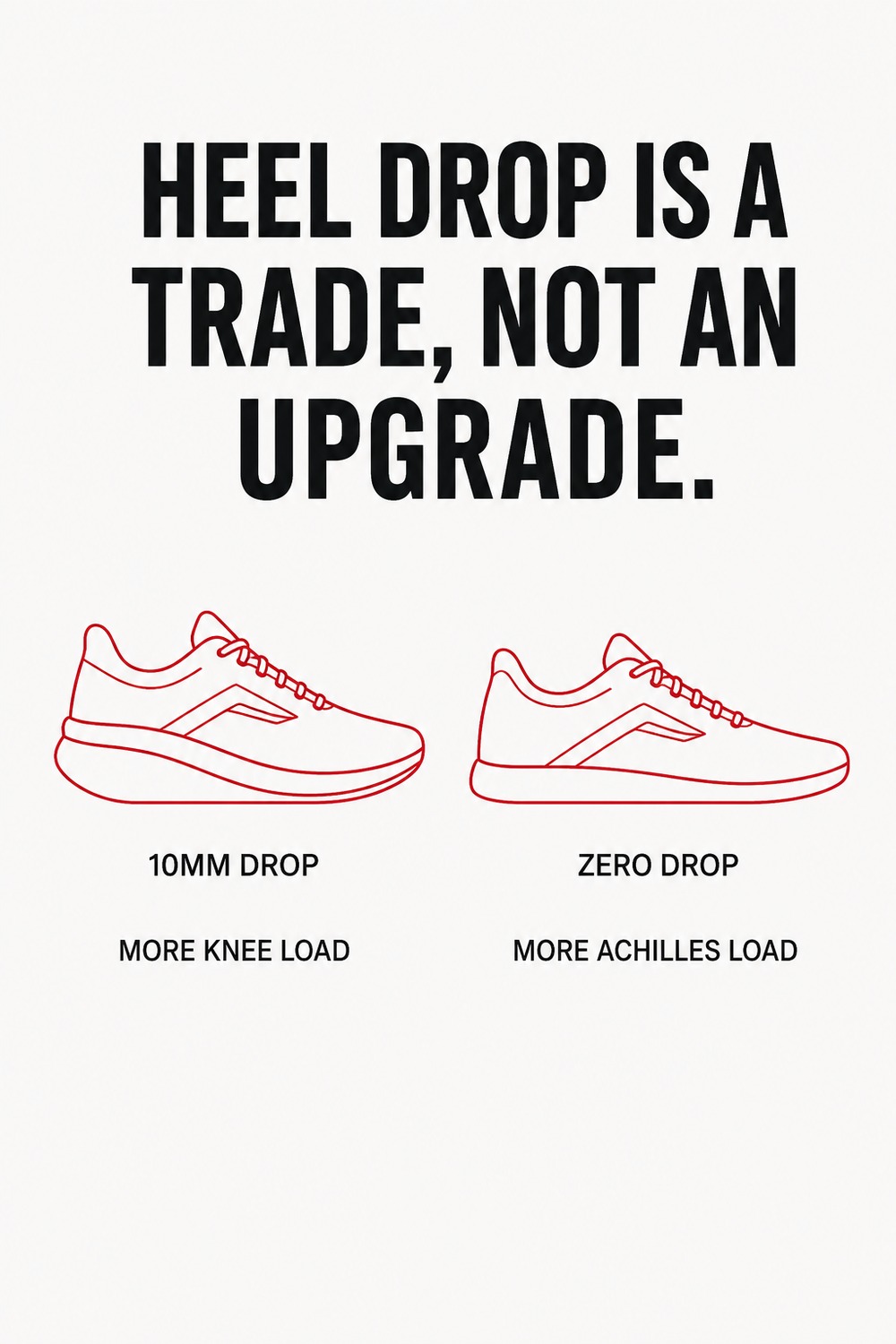
Higher drop shoes, around 10mm, shift stress upward. Research on drop and running biomechanics associates them with more knee injuries but fewer ankle and foot problems.
Lower and zero-drop shoes do the opposite. They load the Achilles and calf considerably more. In one comparison, ankle and foot injuries turned up in 41% of zero-drop runners versus 31% of those in 10mm shoes.
So it’s a trade, not an upgrade. Sore knees? A higher drop might help. Grumpy Achilles? Probably don’t go to zero.
So what should you actually buy?
The evidence-based advice is almost disappointingly plain: pick the lightest, most comfortable shoe with the least correction technology in it.
Comfort isn’t a soft criterion here. It’s the one thing that consistently tracks with better outcomes. If a shoe feels right on your foot when you run in it, that matters more than what any gait analysis says.
Which means the process is:
- Try them on late in the day, when your feet have swollen slightly. They will on a run too.
- Actually run in them. Walking tells you almost nothing. Most decent shops have a treadmill.
- Leave a thumbnail of room at the front. Feet spread under load.
- Pick the one that feels best. Not the one with the most features.
- Ignore the price tier. More expensive does not mean fewer injuries.

When you genuinely do need something specific
The evidence is against prescriptive fitting for most people. There are real exceptions.
Trail running. Grip is not a marketing feature, it’s the difference between staying upright and not. Get proper trail shoes if you’re off-road regularly.
Racing. Carbon-plated shoes do measurably improve running economy. They’re also less stable and wear out fast. Race day, not Tuesday.
Existing injury or a diagnosed condition. Then you’re not choosing a shoe from an article, you’re following a clinician who’s looked at you.
How many pairs, and when to replace them
Rotating two pairs is worth doing once you’re running more than a couple of times a week. Different shoes load your legs slightly differently, and it spreads the stress around.
On replacement: the 500-mile rule you’ve heard is a rough guide, not a law. Midsole foam compresses at different rates depending on your weight, your surfaces and the shoe.
The more useful signal is how they feel. When a run leaves your legs more beaten up than it used to, and nothing else has changed, that’s your answer.
Related reading
If running is part of a wider plan, our 4-day hybrid athlete split explains how to train strength and endurance together without one blunting the other. Training at home? the five-item small home gym setup covers the rest.
If you lift as well as run, your gym bag needs a flat-soled pair too. See our gym bag essentials for men for the full kit.
Running through the winter? Our guide to cold weather running outfits shows exactly what to wear at every temperature, with a layering chart.
Got your shoes sorted and ready to start? Our couch to 5K schedule takes you from zero to 30 minutes of running in nine weeks.
Building a training space at home? Start with our garage gym ideas.
Buying for a runner rather than for yourself? Our guide to gifts for runners explains why a gift card toward their next pair usually beats guessing the shoe, and what to buy instead.
Shopping for an athlete who isn’t (only) a runner? Our gifts for athletes guide is sorted by budget and sport.
More from SportsFable: if this helped, you might also like our guides to gifts for football players, from game day bags to senior night and gifts for baseball players by budget.
Also worth a look: gifts for swimmers, gifts for coaches, and gifts for wrestlers.
Questions people ask
How do I know if I overpronate?
You probably do, to some degree — it’s a normal part of how the foot absorbs load. What the research suggests is that knowing this doesn’t help you pick a shoe, because correcting it doesn’t reduce injuries.
Are expensive running shoes worth it?
Not for injury prevention. Price mostly buys weight savings and newer foam. Comfort is what matters, and comfort isn’t reliably correlated with price.
What heel drop should I choose?
Whatever you’re used to, unless you’ve got a specific reason to change. Higher drops load knees more, lower drops load calves and Achilles more. If you switch, do it gradually.
How often should I replace running shoes?
When they start feeling dead and your legs feel more worked after normal runs. Mileage guides are rough at best.
Do I need different shoes for the treadmill?
No. Your road shoes are fine. Treadmills are more forgiving than pavement, not less.
Worth saying
This summarises published biomechanics and injury research rather than personal testing, and we’d rather tell you that than pretend otherwise. If you’re carrying an injury, a physio who can watch you run beats every article on the internet, this one included.
Related Post