

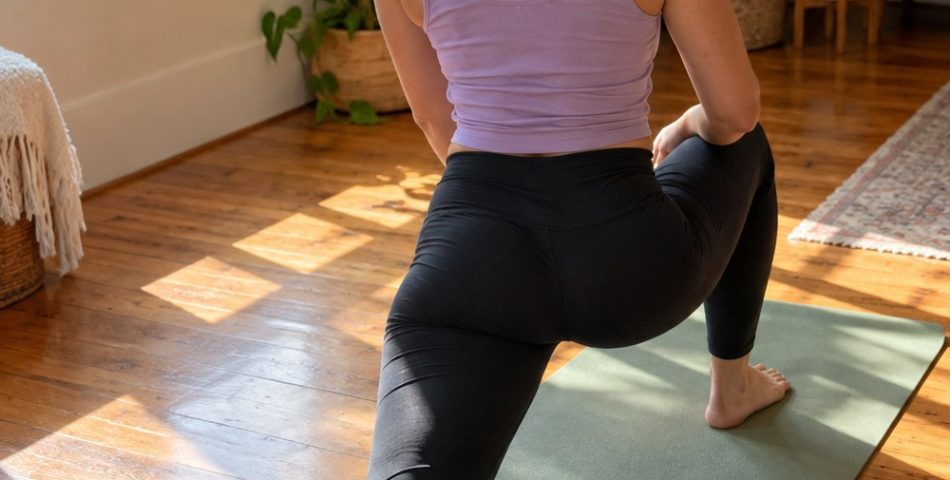
You pull into the rest stop after three hours behind the wheel, open the door, and stand up. For the first ten steps you walk like someone twice your age: hips stiff, lower back complaining, hamstrings acting like guitar strings tuned one notch too tight. By the vending machines you’ve loosened up. By the car, you’ve forgotten about it.
That stiffness is the reason a short stretching routine is worth ten minutes of your day. Most of us spend hours sitting, then ask our bodies to sprint, squat or carry groceries up stairs with no transition. A daily habit won’t turn you into a gymnast in a month, and anyone promising that is selling something. What it can do is make the first ten steps of every day feel like step eleven.
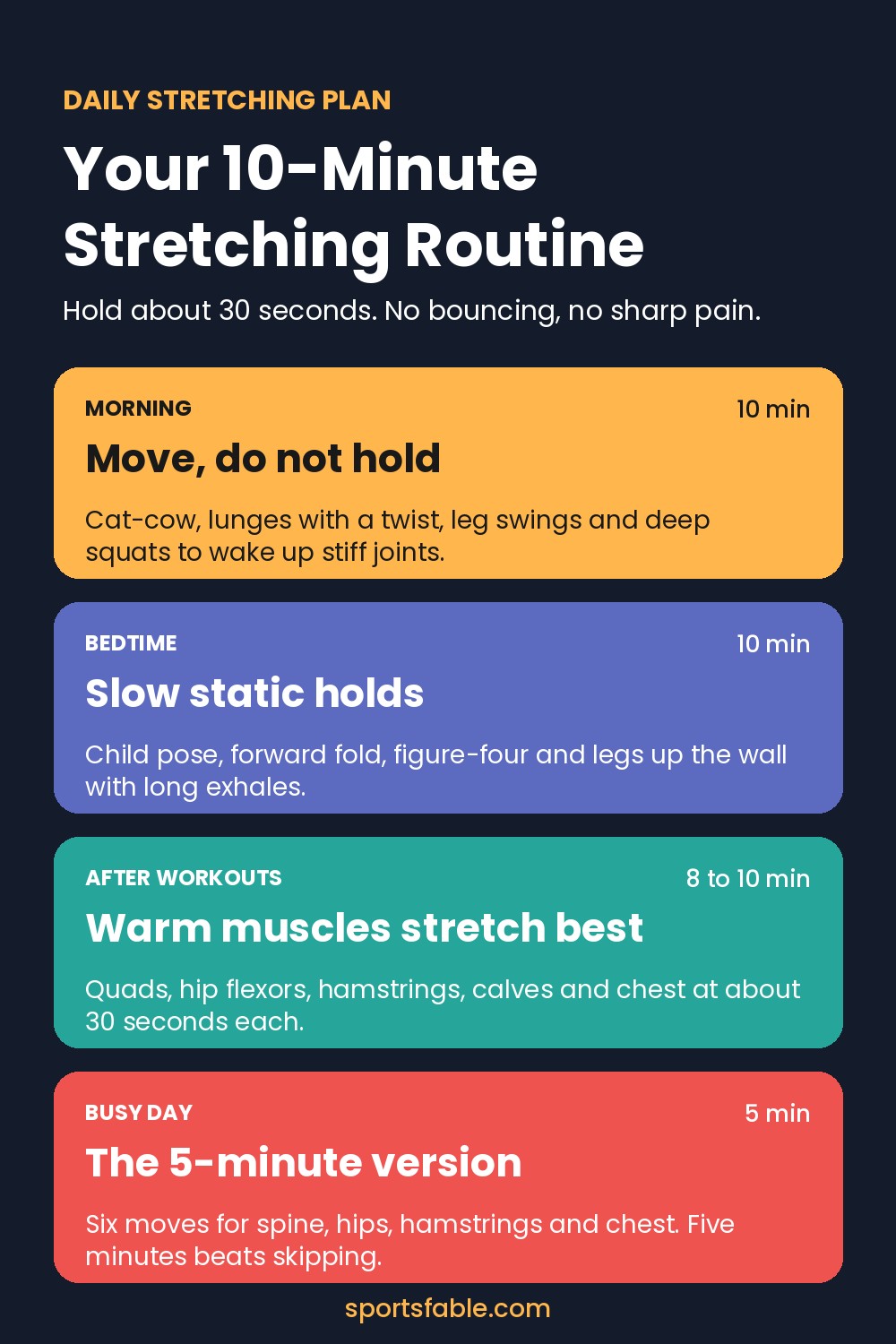
Below you’ll find three full plans: a 10-minute morning routine that moves, a 10-minute bedtime routine that slows you down, and a post-workout routine for when your muscles are already warm. There’s also a 5-minute quick version for busy days and a 30-day progression for dancers and cheer athletes working toward the splits.
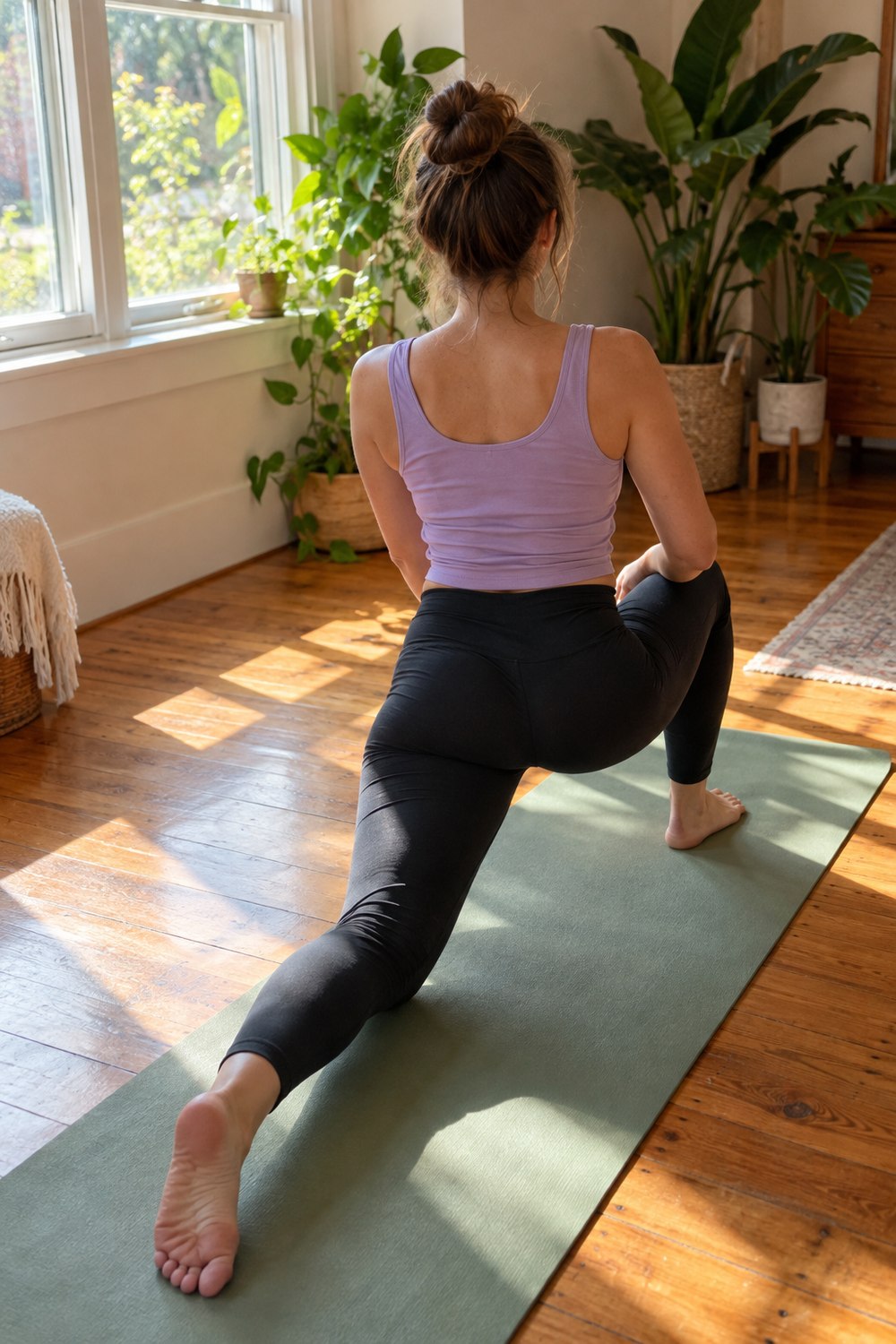
Static vs dynamic: the one rule that decides when you stretch
There are two kinds of stretching, and mixing them up is the most common mistake. Dynamic stretching means moving a joint through its range again and again: leg swings, arm circles, walking lunges. Static stretching means getting into a position and holding it still.
Dynamic work belongs before activity because it raises your temperature and rehearses the movements you’re about to do. Static holds belong after activity or at night, once your muscles are warm. Here’s the part many flexibility posts skip: long static holds right before heavy lifting, sprinting or jumping can slightly reduce how much force you produce for a short window. The drop is small, but if you’re about to test a max squat or work on jumping higher, save the long holds for afterward.
How long should you hold? The American College of Sports Medicine says 10 to 30 seconds per static stretch is enough for most adults, while older adults may get more out of 30 to 60 seconds. Harvard Health suggests repeating a stretch until you’ve spent about 60 seconds in the position. So the routines below use 30-second holds, done twice where it matters. No bouncing, and stop short of pain.
The 10-minute morning stretching routine
Mornings are when you’re stiffest, so this one leans dynamic. You’re not chasing new range; you’re telling your joints the day has started. Do it before coffee, beside the bed, in whatever you slept in.
- Cat-cow (60 seconds): on hands and knees, round then arch your spine slowly, about 10 reps.
- Thread the needle (30 seconds each side): slide one arm under your body and let your upper back twist.
- World’s greatest stretch (60 seconds each side): lunge forward, drop the same-side elbow toward your instep, then rotate that arm to the ceiling. Five slow reps per side.
- Standing leg swings (45 seconds each leg): hold a wall, swing front to back, then side to side.
- Arm circles and band pull-aparts (60 seconds): small circles growing bigger, then reverse.
- Bodyweight squat to stand (60 seconds): sink into a deep squat, pause two seconds, stand. About 10 reps.
- Standing side reach (30 seconds each side): reach one arm overhead and lean, breathing into your ribs.
- Calf pumps on a step (60 seconds): slow raises and lowers, heels dropping below the step.
That’s right around 10 minutes. If you train in the morning, this doubles as your warm-up for something like the 7-day home workout plan.

The 10-minute bedtime stretching routine
The nightly version is the opposite: all static, all slow. Breathe in through your nose for four counts and out for six. The longer exhale is the point. Dim the lights and leave your phone in another room, because scrolling between holds undoes most of the calm.
- Child’s pose (60 seconds): knees wide, arms long, forehead down.
- Seated forward fold (2 x 30 seconds): soft knees are fine; hinge from the hips, not the upper back.
- Figure-four on your back (30 seconds each side): ankle over the opposite knee, pull the bottom thigh in.
- Supine twist (30 seconds each side): knees drop to one side, shoulders stay heavy.
- Butterfly (60 seconds): soles together, let gravity work on the inner thighs.
- Half kneeling hip flexor stretch (30 seconds each side): squeeze the back glute so you feel it in the front of the hip, not your lower back.
- Legs up the wall (2 minutes): lie with your hips near the wall and legs resting up it. Just breathe.
The evening and bedtime routine works best as a fixed habit: same spot, same order, same time. After a week you won’t need to think about it.
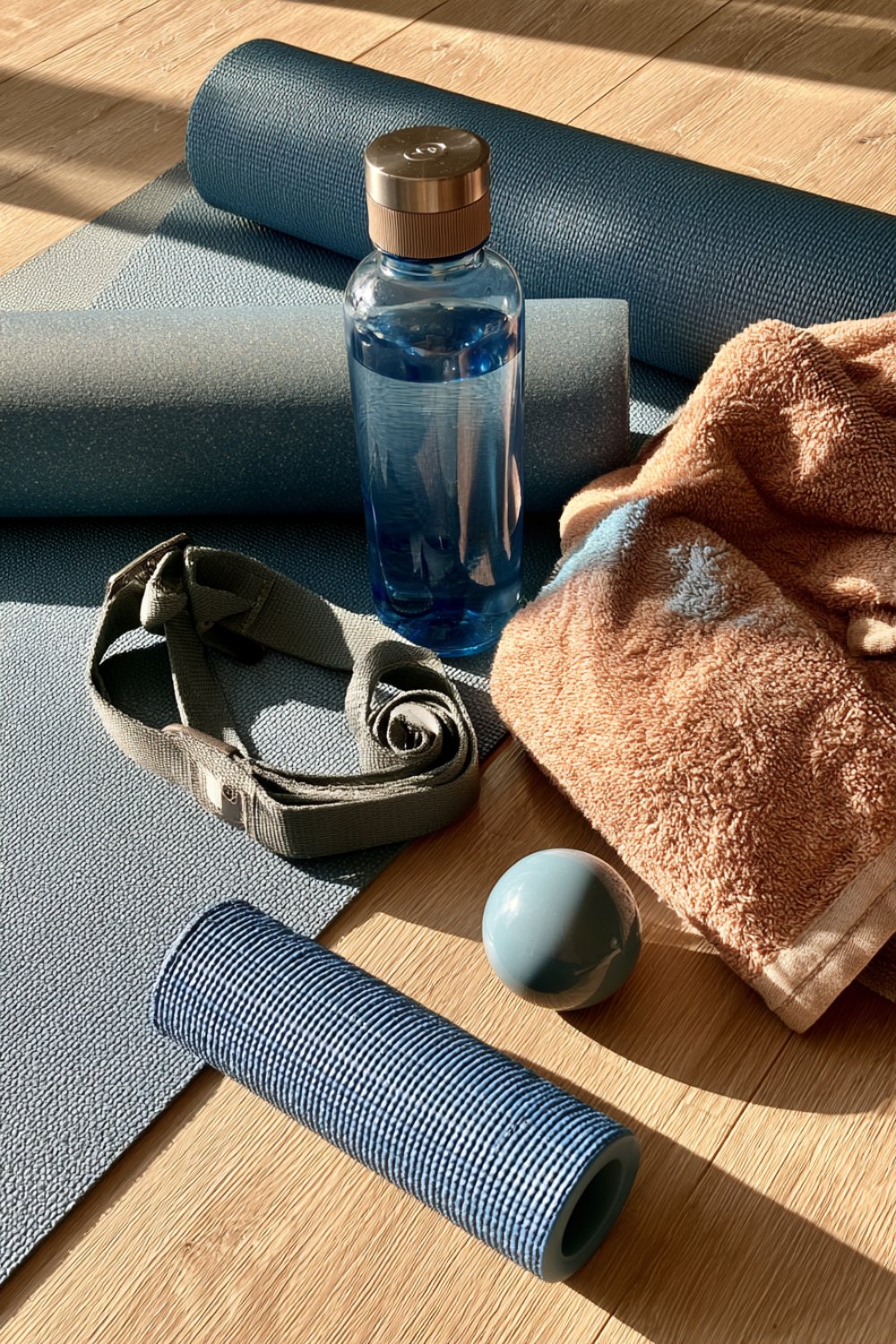
The post-workout routine (8 to 10 minutes)
After training, your muscles are warm, which is when Mayo Clinic notes stretching is easiest. This full body sequence covers the areas that tighten most after lifting or running. If you just finished a beginner leg day workout, give the hip and hamstring holds a second round.
- Standing quad stretch (30 seconds each side): knees together, hips pushed slightly forward.
- Half kneeling hip flexor (30 seconds each side, twice).
- Lying hamstring stretch with a strap or towel (30 seconds each side, twice).
- Pigeon or figure-four (30 seconds each side): for the glutes.
- Wall calf stretch (30 seconds each side): straight knee, then bent knee.
- Doorway chest stretch (2 x 30 seconds): forearms on the frame, step through gently.
- Cross-body shoulder and overhead triceps (30 seconds each).

The 5-minute quick stretching routine
Some days ten minutes isn’t happening. This beginner friendly version hits the big five areas and takes about five minutes. It’s a placeholder, not a replacement, but five minutes done beats ten minutes skipped.
- Cat-cow, 45 seconds.
- Half kneeling hip flexor, 30 seconds each side.
- Standing hamstring fold, 45 seconds.
- Figure-four, 30 seconds each side.
- Doorway chest stretch, 30 seconds.
- Child’s pose with slow breathing, 30 seconds.
A 30-day split progression for dancers and cheer
Ballet dancers and cheer athletes often want a front split or a middle split, and Pinterest is full of “splits in 7 days” promises. Be honest with yourself: if you’re starting from fingertips-to-shins, 30 days gets you meaningfully closer, not necessarily flat. Hip structure varies, adults usually progress slower than teens, and forcing range is how hamstrings and groin muscles get strained. Always do this after a warm-up, never cold.
| Week | Focus | Daily work (after a 5-minute warm-up) |
|---|---|---|
| Week 1 | Build the base | Hip flexor, hamstring and butterfly stretches, 2 x 30 seconds each side. No split attempts yet. |
| Week 2 | Add length | Same stretches at 2 x 45 seconds, plus a half split (front leg straight, back knee down) 2 x 30 seconds. |
| Week 3 | Supported splits | Slide into a front split with yoga blocks under your hands and a cushion under the hip, 3 x 30 seconds. Straddle fold 2 x 45 seconds. |
| Week 4 | Lower the support | Reduce block height only if week 3 felt easy. Add 5 slow active leg lifts each side to build strength at end range. |
Take one or two easy days per week, measure progress with a weekly photo rather than daily attempts, and back off immediately if you feel a sharp or pulling pain behind the knee or in the groin. Dancers and cheer athletes on a team should run this past their coach, since practice already loads the same tissues.
What the research and health sources say
Nothing here needs special equipment or credentials, but it helps to know where the hold times come from. The ACSM stretching and flexibility guidelines recommend stretching at least 2 to 3 days a week, with daily stretching the most effective, and holding static stretches 10 to 30 seconds to the point of tightness or mild discomfort. Mayo Clinic’s stretching guide suggests holding about 30 seconds, breathing freely, and not bouncing. Harvard Health recommends dynamic stretching as a warm-up, static stretching after muscles are warm, and points out that occasional stretching won’t give lasting benefits.
If you have a joint replacement, a recent injury, hypermobility or ongoing pain, check with your doctor or a physical therapist before starting a new stretching routine. A stretch should feel like tension, never like pain.
Your daily stretching checklist
- Dynamic moves in the morning or before training, static holds after.
- Hold static stretches about 30 seconds, repeating to reach roughly 60 seconds per area.
- Never bounce, never push into sharp pain.
- Exhale longer than you inhale during bedtime holds.
- Use the 5-minute version instead of skipping.
- Splits work only after a warm-up, with one or two easy days a week.
Keep building the plan
A stretching routine sticks best when it’s attached to training you already do. Slot it into a weekly workout plan template, log your holds and split progress on a printable workout tracker, and if you’re mixing running with lifting, the beginner hybrid athlete training plan shows where mobility work fits across the week.
Also worth a look: an 8-week pull up progression and a 6-week 5K training plan.
Questions people ask
Is a 10 minute daily stretching routine enough to improve flexibility?
For most people, yes, if it’s actually daily. ACSM notes daily stretching is the most effective frequency. Expect to notice easier movement within a couple of weeks and measurable range changes over a couple of months.
Should I stretch in the morning or at night?
Both work, they just do different jobs. A morning routine with dynamic moves loosens you up for the day, while a nightly or evening routine with static holds and slow breathing helps you wind down. Pick the one you’ll do consistently.
What’s the best beginner full body stretching routine?
Start with the 5-minute quick version above: it covers the spine, hips, hamstrings, glutes and chest. Once that feels easy, move to the full 10-minute morning or bedtime plan.
Can a ballet dancer or cheer athlete get the splits in 30 days?
Some will, many won’t, and that’s normal. Starting point, age and hip structure all matter. Follow the progression, keep the supports in place until they feel unnecessary, and treat sharp pain as a hard stop.
Is it bad to stretch before lifting?
Dynamic stretching before lifting is a good idea. Long static holds right before heavy or explosive work can slightly reduce force output for a short time, so keep those for after your session.
Does a bedtime stretching routine help with sleep?
A quiet, slow routine with long exhales can make it easier to wind down, and it replaces screen time with something calmer. It isn’t a treatment for sleep problems, so talk to a doctor if poor sleep is ongoing.
Images in this article are AI-generated illustrations and original graphics created by SportsFable. They show training scenes, not real people, teams or events.
Related Post