
There’s a reason so many home workout plans die on day three. Day one is exciting. Day two you’re sore. Day three, the living room floor looks a lot less inviting than the sofa, and the plan you found online wants you to do 100 burpees.
The fix isn’t more motivation. It’s a week that’s planned around real life: short sessions, no equipment to buy, hard days followed by easy ones, and exercises you can do in the space between the coffee table and the TV.
This 7 day home workout plan is built exactly that way. It takes about 30 minutes a day, needs nothing but floor space (a mat helps), and works for beginners, women and men alike. You’ll get the full week, how to make each move easier or harder, how to progress after week one, and what to swap in if you own a pair of dumbbells.
How the week is built
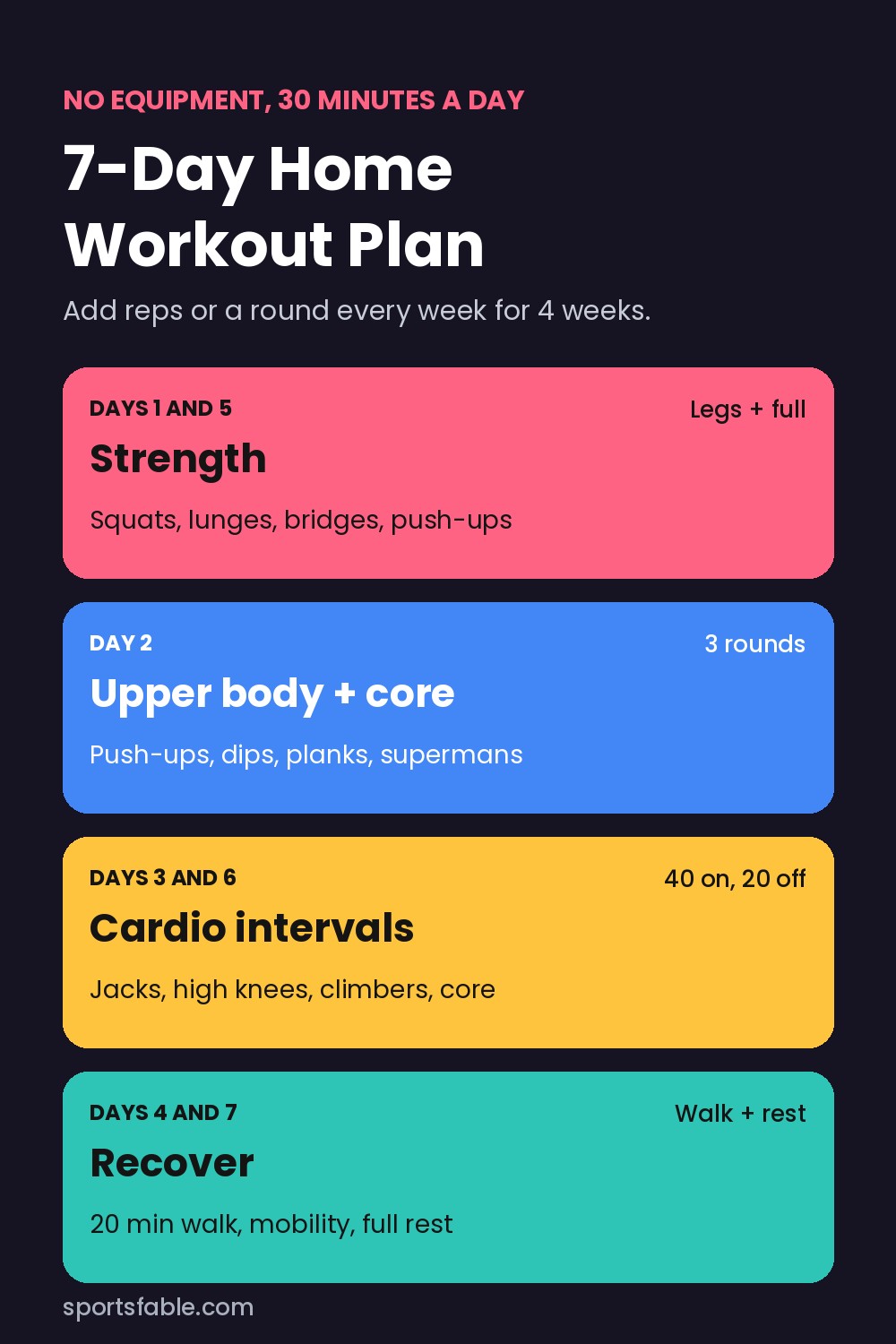
The plan follows the CDC’s guidance for adults: at least 150 minutes of moderate activity a week plus two or more days of muscle-strengthening that work all the major muscle groups. Here, you get three strength days, two cardio days, one active recovery day and one full rest day.
- Day 1: Lower body strength
- Day 2: Upper body and core
- Day 3: Cardio intervals
- Day 4: Active recovery
- Day 5: Full body strength
- Day 6: Cardio and core
- Day 7: Rest
Every session starts with a 5-minute warm-up: march on the spot, arm circles, 10 bodyweight squats, 10 hip hinges and a slow inchworm or two. Finish with 3 to 5 minutes of stretching.
The 7 day home workout plan
Day 1: lower body strength (30 minutes)
Do 3 rounds, resting 60 to 90 seconds between rounds.
- Bodyweight squats: 15 reps
- Reverse lunges: 10 per leg
- Glute bridges: 15 reps, pause 2 seconds at the top
- Wall sit: 30 to 45 seconds
- Calf raises: 20 reps
Keep your heels down in the squat and sit back as if you’re aiming for a chair. Our leg day workout for beginners has more form cues if you want them.
Day 2: upper body and core (30 minutes)
Do 3 rounds, resting 60 seconds between rounds.
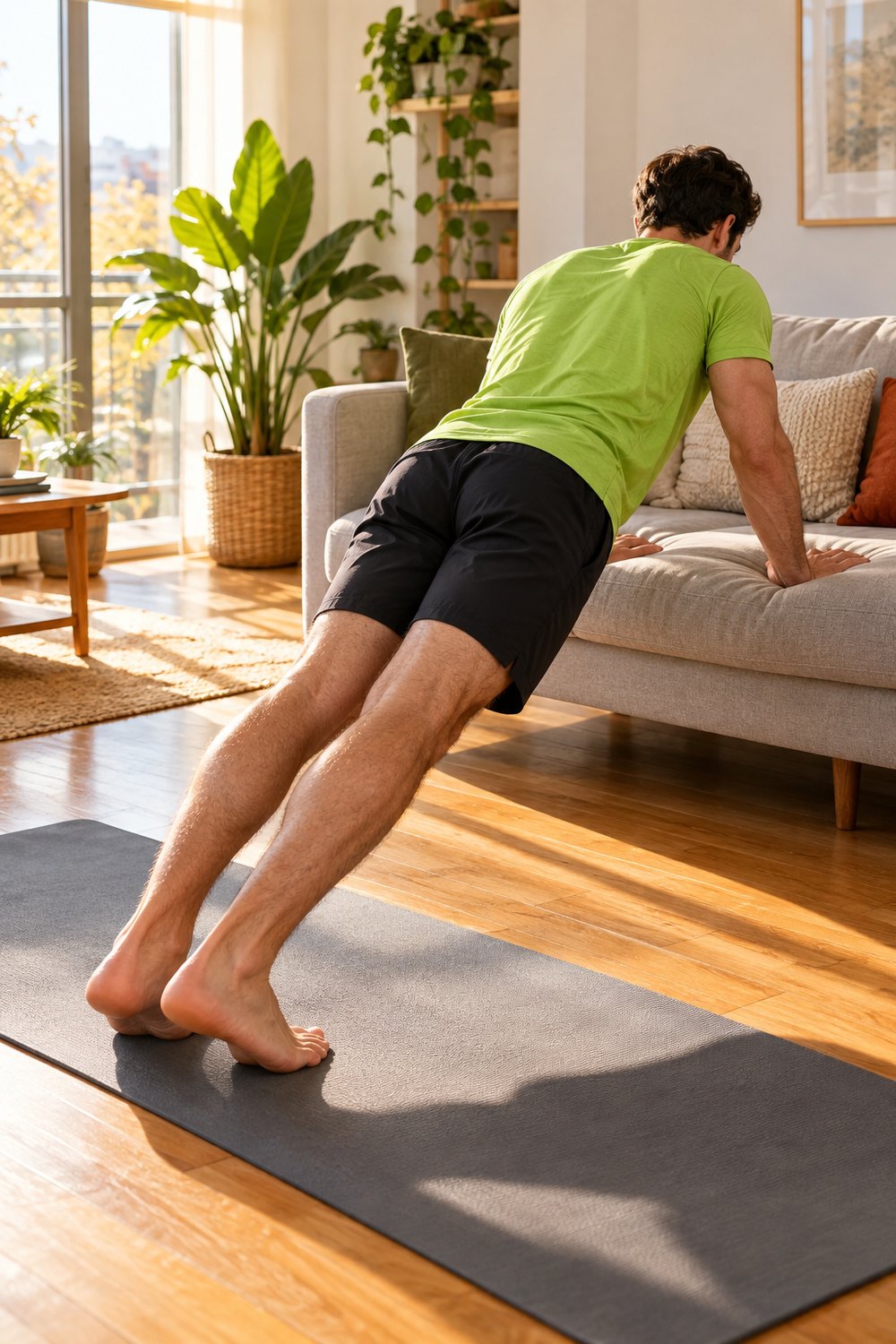
- Push-ups: 8 to 12 reps (hands on a sofa or counter to make them easier)
- Chair dips: 10 reps
- Pike push-ups or shoulder taps: 8 to 10 reps
- Superman holds: 3 holds of 10 seconds
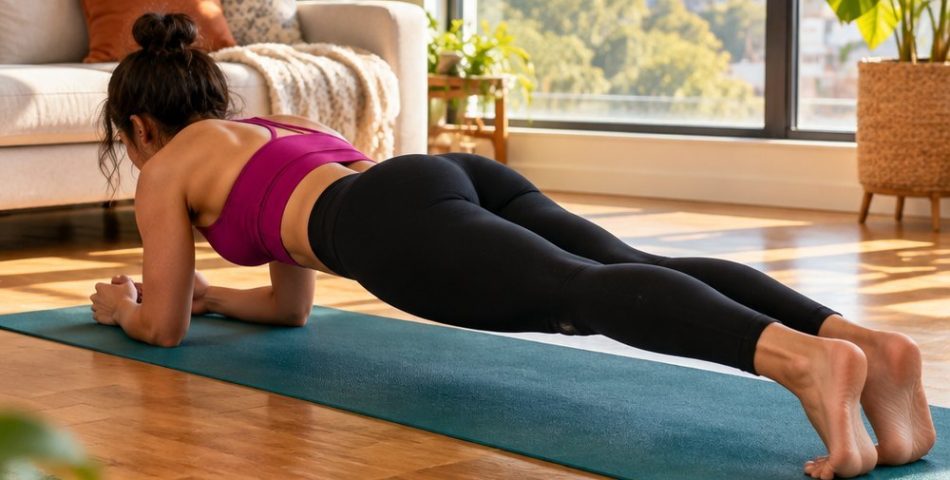
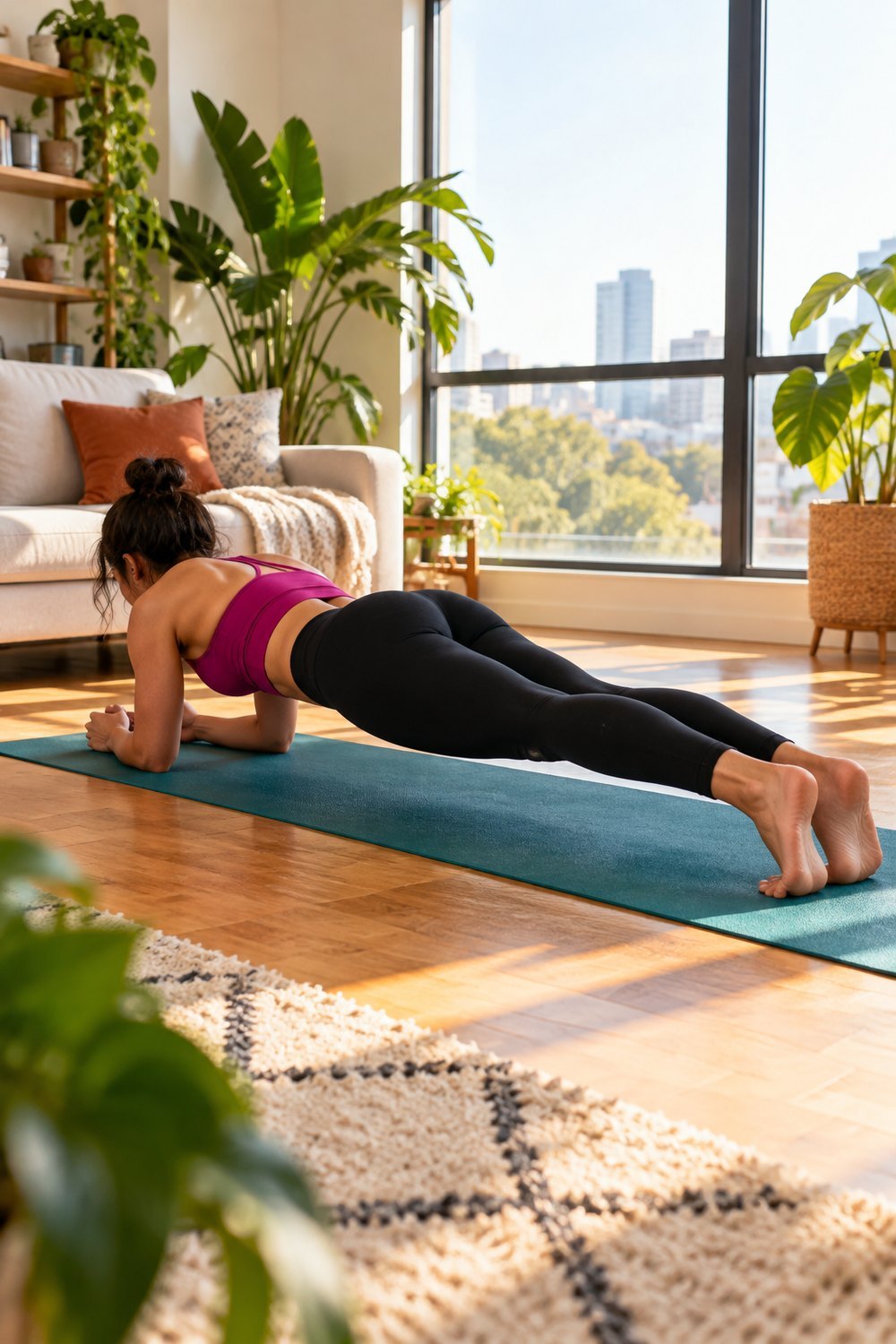
- Forearm plank: 30 seconds
Push-ups are worth taking seriously. In a 10-year Harvard study of 1,104 male firefighters, men who could do more than 40 push-ups had a 96% lower risk of cardiovascular events than men who managed fewer than 10. The authors are clear it may not apply to women or less active men, and it shows a link, not cause and effect. Still, it’s a good reason to track your push-up number.
Day 3: cardio intervals (25 minutes)
Work 40 seconds, rest 20 seconds. Go through the list 4 times.
- Jumping jacks (or step jacks for low impact)
- High knees (or fast marching)
- Mountain climbers
- Squat to calf raise
- Skaters (or side steps)
Aim for an effort where you can say a few words but not hold a conversation. The CDC’s talk test describes vigorous activity as being unable to say more than a few words without pausing for breath.

Day 4: active recovery (30 minutes)
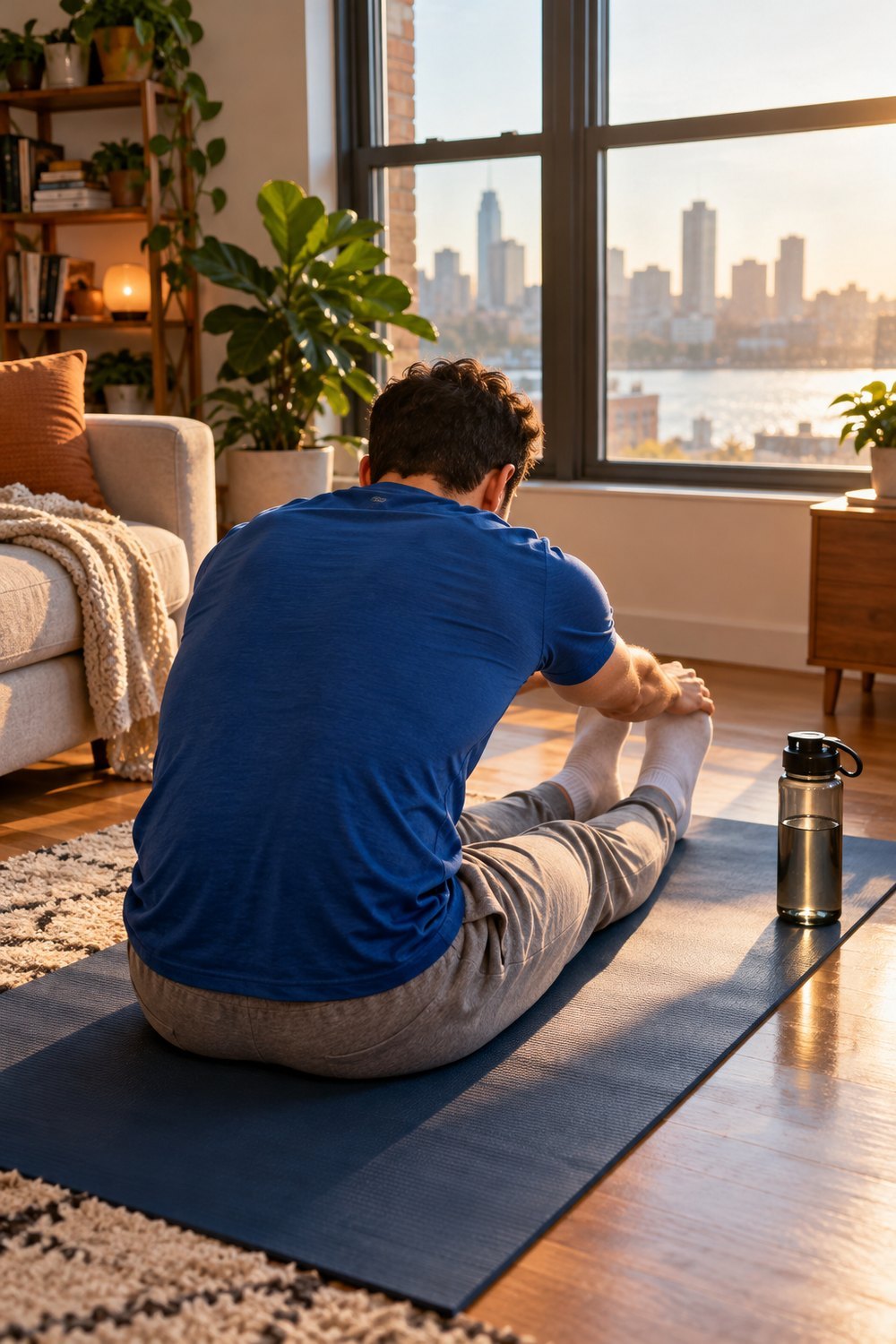
A brisk 20-minute walk plus 10 minutes of mobility: cat-cow, hip flexor stretch, child’s pose, thoracic rotations and a hamstring stretch. This isn’t a skip day. Moving gently helps you feel fresher for day 5.
Day 5: full body strength (30 minutes)
Do 3 rounds, resting 60 to 90 seconds between rounds.
- Squat pulses or split squats: 10 per leg
- Push-ups: as many good reps as you can, stop 2 short of failure
- Single-leg glute bridges: 10 per leg
- Bird dogs: 10 per side
- Bear crawl hold: 20 to 30 seconds
Day 6: cardio and core (25 minutes)
15 minutes of intervals (30 seconds on, 30 seconds off, rotating jumping jacks, mountain climbers and fast feet), then 2 rounds of:
- Dead bugs: 10 per side
- Side plank: 20 seconds per side
- Reverse crunches: 12 reps
- Forearm plank: 30 to 45 seconds
Day 7: rest
Fully off. A walk is fine if you want one. Rest is when the adaptations from the week actually happen, so don’t treat it as wasted time.
Make it easier or harder
- Beginners: do 2 rounds instead of 3, use incline push-ups, and pick the low-impact cardio options.
- Intermediate: add a fourth round on strength days, or slow every rep to 3 seconds down.
- Advanced: swap squats for jump squats, push-ups for decline push-ups, and lunges for Bulgarian split squats on the sofa.
How to progress after week one
Repeat the same week for four weeks, but change one thing each week:
- Week 2: add 2 reps to every strength exercise.
- Week 3: add a round, or cut rest to 45 seconds.
- Week 4: add 10 seconds to every hold and interval.
Test your max push-ups on day 1 and again at the end of week 4. That single number tells you more about your progress than the scale does.
Three mistakes that stall home workouts
- Going all-out every day. If every session leaves you wrecked, you won’t make it to week two. The easy days in this plan are there on purpose.
- Racing through reps. Bodyweight exercises get easier fast when you bounce through them. Control the lowering phase, pause at the bottom, and the same squat suddenly does a lot more work.
- Never tracking anything. Without a number to beat, home workouts drift into the same effort every week. Write down your reps, rounds and hold times in your phone after each session.
Got dumbbells? Easy swaps
- Goblet squat instead of bodyweight squat.
- Dumbbell Romanian deadlift instead of glute bridge on day 5.
- Bent-over row added to day 2 (the plan’s one missing pull).
- Overhead press instead of pike push-ups.
If you’re thinking about kitting out a corner, our small home gym ideas show what’s worth buying first.
Your 7 day home workout checklist
- Pick your training time and put it in your calendar.
- Clear a space about two meters long and wide.
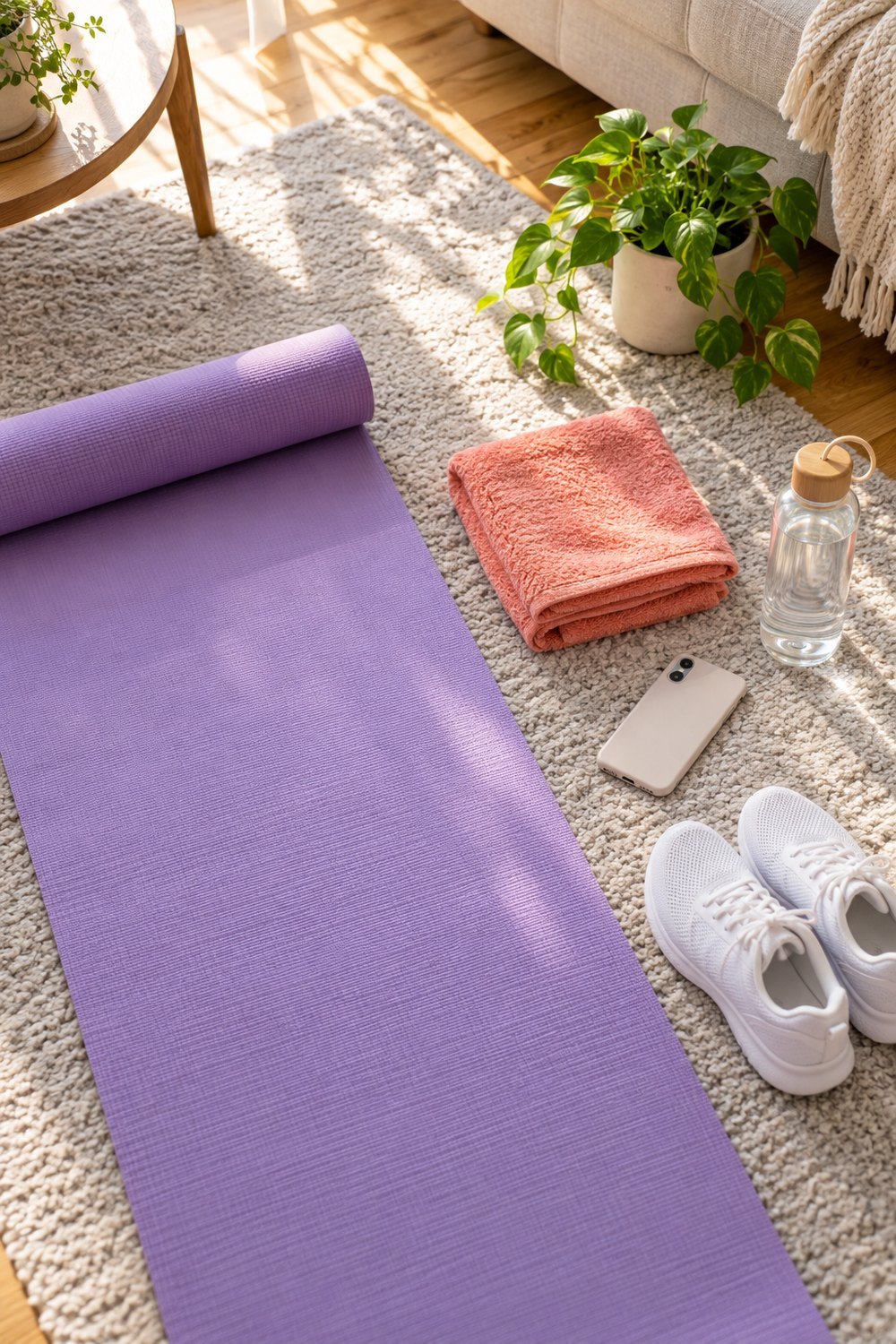
- Mat, towel, water bottle, phone timer.
- Warm up for 5 minutes every session.
- Write down your reps so you can beat them next week.
- Keep day 7 as a real rest day.
Keep building your routine
Ready to move from home to the gym? The 3-day workout split for beginners is the natural next step, and the beginner gym workout plan walks you through your first month on the gym floor. Want to add running? Our couch to 5K schedule fits around this week neatly.
Added dumbbells and ready for a longer block? Run the 12-week workout plan at home with the swaps it lists.
Training on a hard floor? Our home gym flooring guide compares mats, tiles and more.
Questions people ask
Is a 7 day home workout plan good for beginners?
Yes, as long as it includes easy days. This plan has an active recovery day and a full rest day, and every exercise has an easier option.
Is this a good 7 day workout plan for women?
Yes. It’s the same plan for everyone. If glutes are a priority, add an extra set of glute bridges and reverse lunges on days 1 and 5.
Can I do this plan in a gym instead?
You can, but in a gym it makes more sense to use the equipment. Try a structured split like the 5-day workout split for women instead.
Is 30 minutes a day enough?
For general fitness, yes. Six active days of 25 to 30 minutes adds up to more than the 150 weekly minutes the CDC recommends, plus three strength sessions.
What should I do in my first week?
Follow the plan as written at the easiest level. Your only goal in week one is to show up for six sessions. Intensity can come later.
Can I do it with dumbbells at home?
Yes. Use the swaps above. A single pair of adjustable dumbbells covers almost every upgrade.
Images in this article are AI-generated illustrations and original graphics created by SportsFable. They show workout ideas, not real people or events.
Related Post