

Open almost any gym bag in January and you’ll find the same thing: a nice notebook with four pages of neat handwriting, then nothing. The first week has every set written down. By week three it’s a grocery list. Nobody quit training, exactly. They just stopped writing, and a few weeks later they couldn’t remember whether 25 pounds on the goblet squat was easy or a fight.
That’s the real problem a log solves. Your memory is a terrible coach. It rounds up on good days, rounds down on bad ones, and forgets the boring middle where most progress actually happens. A printable workout tracker is the cheapest fix there is, but only if you know what to write and, more importantly, what to do with it once it’s written.
So this isn’t another pretty template. It’s a method: how to log sets, reps and load in under a minute, how to rate effort without a lab, which questions to answer every Sunday, and what to do when a week goes sideways. The free 4-page PDF at the end includes a weekly planner, a 2026 monthly habit grid you can color in, a strength log and a cardio log.

Who this is for and what you need
This works for anyone training two to six days a week: beginners on a 3-day beginner split, runners adding gym work, or people following a beginner hybrid athlete plan that mixes lifting and cardio. You need a pen, a printed sheet, and about 60 seconds after each workout. That’s the cost. The benefit is you’ll never again stand in front of a dumbbell rack guessing.
Logging won’t fix a bad program, so if you don’t have one yet, start with a weekly workout plan template.
Why writing it down actually matters
This part isn’t just motivational poster talk. A 2009 meta-regression in Health Psychology looked at healthy eating and physical activity interventions and found that self-monitoring explained more of the difference between studies than any other technique. Programs that paired self-monitoring with at least one related technique, such as setting goals and reviewing them, did better than those that didn’t (effect sizes of 0.42 versus 0.26).
Here’s the part most tracker sites skip: writing things down helped most when combined with a goal and a review. A log you never look at is a diary. A log you read every week is a coach. That’s why this method has three parts: log, rate, review.
How to log a workout in 60 seconds
Use sets x reps x load
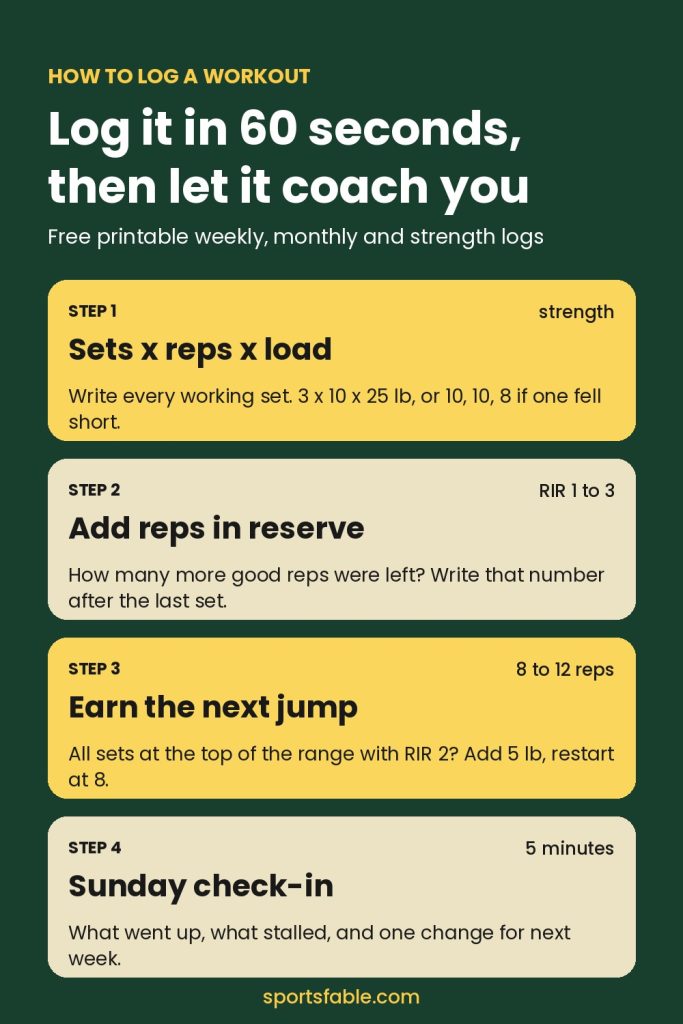
For every strength exercise, write three numbers in the same order every time: sets, reps, weight. “3 x 10 x 25” means three sets of ten reps with 25 pounds. If one set came up short, write the actual reps: “25 lb: 10, 10, 8”. The missed reps are the most useful data on the page.
Add one effort number: reps in reserve
Weight alone doesn’t tell you how hard a set was. Reps in reserve (RIR) does. After your last set, ask: how many more good reps could I have done? If the answer is two, write RIR 2. A 2016 study in the Journal of Strength and Conditioning Research introduced a resistance training effort scale built exactly this way, where an RPE of 10 means zero reps left and an RPE of 9 means one rep left. You don’t need the full scale. Just write the reps you had left.
For most people, finishing sets with about 1 to 3 reps in reserve is a sensible working zone. Your guesses will be rough at first. They get better the more you write them down.
For cardio, log time, distance and feel
Cardio logs need fewer numbers: minutes, distance if you know it, and an effort word (easy, steady, hard). If you’re following our couch to 5K schedule or a 10K training plan, copy the planned session into the left column and what actually happened into the right. The gap between the two is your feedback.

Progressive overload: turning the log into progress
Progressive overload just means doing slightly more over time: more reps, more weight, or more sets. The log is how you know when you’ve earned the next step. A simple rule that’s easy to stick to is double progression:
- Pick a rep range, such as 8 to 12.
- Start with a weight you can lift for 8 reps on every set with about 2 reps in reserve.
- Each session, try to add a rep or two to any set.
- When every set hits 12 reps at RIR 2 or more, add the smallest jump available (often 5 lb for lower body, 2.5 to 5 lb for upper body) and drop back to 8 reps.
Here’s what that looks like on a real page. This is a made-up example for a goblet squat, three sets, rep range 8 to 12:
| Week | Load | Reps per set | RIR (last set) | Next time |
|---|---|---|---|---|
| 1 | 25 lb | 8, 8, 8 | 3 | Add reps |
| 2 | 25 lb | 10, 10, 9 | 2 | Add reps |
| 3 | 25 lb | 12, 11, 10 | 2 | Add reps |
| 4 | 25 lb | 12, 12, 12 | 2 | Add 5 lb |
| 5 | 30 lb | 9, 8, 8 | 2 | Add reps |
| 6 | 30 lb | 10, 9, 8 | 1 | Hold, repeat |
Notice week 6. Reps went up a little, but RIR dropped to 1, so the note says hold. The log stops you adding weight on a tired day, and it shows that weeks 1 to 4 at “same weight” were actually 12 extra reps of progress.

The weekly check-in: five questions every Sunday
This is the review part, and it takes about five minutes. Answer these at the bottom of the weekly page:
- How many sessions did I plan, and how many did I do?
- Which lift or run went up this week (reps, load, distance or pace)?
- Was anything a struggle two weeks in a row?
- How did I sleep and feel overall, from 1 to 5?
- What’s the one change for next week?
Keep the last answer to one change. Missed sessions usually mean a scheduling fix, not more effort. For a reference point on volume, the CDC’s adult physical activity guidelines recommend at least 150 minutes of moderate-intensity activity a week (or 75 minutes vigorous) plus muscle-strengthening activities on at least 2 days that work all major muscle groups. Add up your cardio log minutes and strength days, and you’ll see at a glance whether your week covered that baseline.
The 30 day habit grid
The monthly page is a grid of circles, one per day, for up to four habits. Color a circle when you do the thing. That’s all. It sounds childish, but a visible run of colored circles on the fridge is something you won’t want to break.
Pick habits you control, not outcomes. “Trained” or “walked 20 minutes” or “stretched 5 minutes” are good rows. “Felt great” isn’t. And keep one row deliberately easy (like “filled in the log”) so there’s always something to color on a rough day.

What to do after a missed week
You will miss a week. Illness, travel, a kid’s birthday. Here’s the plain answer:
- Don’t try to make up the sessions. Doubling up next week is how sore, frustrated people quit.
- Repeat your last completed week instead of moving forward. Same loads, same reps.
- If you were off for two weeks or more, drop your loads by roughly 10 percent for the first week back, then return to the double progression rule.
- Write “missed, reason” in the log rather than leaving it blank. A gap with a reason is information; a blank page feels like failure.

The printable gives you four pages: a weekly planner and log, a 2026 monthly habit grid with circles to color in, a strength log with sets x reps x weight rows, and a cardio log.
Free printable
Weekly planner and log, 2026 monthly 30 day habit grid to color in, strength log and cardio log.
Download the free 4-page workout tracker (PDF)Save or pin this card so the four logging steps are on your phone the next time you forget your notebook:
How to adjust it and common mistakes
Adjusting for your training style
If you run more than you lift, use two cardio pages a week and one strength page. If you’re doing a 4-day workout split or push pull legs, give each training day its own strength page so you can compare like with like. For beginner HYROX prep, the weekly page shows whether hard runs and hard leg days are stacking up.
Mistakes that make a tracker useless
- Logging only the top set. Write every working set, or you can’t see fatigue.
- Changing the exercise every week. You can’t progress what you don’t repeat; keep your main lifts for at least 4 to 6 weeks.
- Skipping the effort number. Without RIR, “same weight” could mean easy or maxed out.
- Adding load because the calendar says so. Add it because the log says so.
- Never reading old pages. The review question “what went up?” is the whole point, per the self-monitoring research above.
If you have a medical condition, are pregnant, or are coming back from injury, check with a doctor before starting a new training plan.
Quick checklist
- Print the weekly page and the strength log before Monday.
- Write sets x reps x load for every working set.
- Add reps in reserve after the last set.
- Color one circle per habit each day.
- Answer the five check-in questions every Sunday.
- After a missed week, repeat the last week instead of skipping ahead.
Keep going
Need a program to log? Try the 12-week workout plan or the 7-day home workout plan. Runners can pair the cardio log with our running pace chart, treadmill workouts or the half marathon training plan.
Questions people ask
Is this printable workout tracker really free?
Yes. The PDF is free to download and print as many times as you like for personal use. Print a fresh weekly page and strength log each week and keep them in a folder.
Is there a free coloring version?
The monthly page is the coloring version. Each day is an empty circle you color in when you complete a habit, so a month of training turns into a pattern you can see at a glance.
Can I use these as free templates for my own plan?
That’s the idea. The pages don’t assume a specific program, so you can write in any split, from a 3-day beginner routine to a 6-day schedule. Write the exercise names once, then photocopy it as your own template.
Should I use a monthly or a weekly tracker?
Use both, for different jobs. The weekly page holds the details (sets, reps, load, effort) and the check-in questions. The monthly page shows consistency, which is the thing that matters most over a full year.
Does the free 2026 monthly tracker work for a 30 day challenge?
Yes. The habit grid has 31 circles per row, so it covers any month of 2026 or a 30 day challenge starting on any date.
Do I need a daily or yearly tracker too?
Not really. The weekly page already has a box for each day, so a separate daily sheet is extra paperwork. For a yearly view, keep your 12 monthly grids together; flipping through them shows your year better than any single summary page.
What should I write if I only did a short workout?
Write exactly what you did, even if it’s 10 minutes. A short session still counts toward consistency and still gets a colored circle.
Images in this article are AI-generated illustrations and original graphics created by SportsFable. They show training ideas, not real people or events. The printable is free for personal use.
Related Post