

Your first week in a gym is mostly about not being overwhelmed. There are forty machines, none of them are labelled usefully, and everyone else looks like they know exactly what they’re doing.
This is a seven-day plan that takes that decision-making away. Three training days, four rest days, the same six movements each session, and enough structure that you can walk in knowing precisely what you’re doing.
Why three days, not five
Almost every beginner plan you’ll find online runs five or six days. That’s not because five days works better. It’s because more days looks more serious.
For your first month, three sessions is genuinely better. You recover fully between them, you repeat the same movements often enough to actually learn them, and — the part nobody mentions — you’re far more likely to still be doing it in six weeks.
You can add days later. Almost nobody regrets starting smaller.
The week
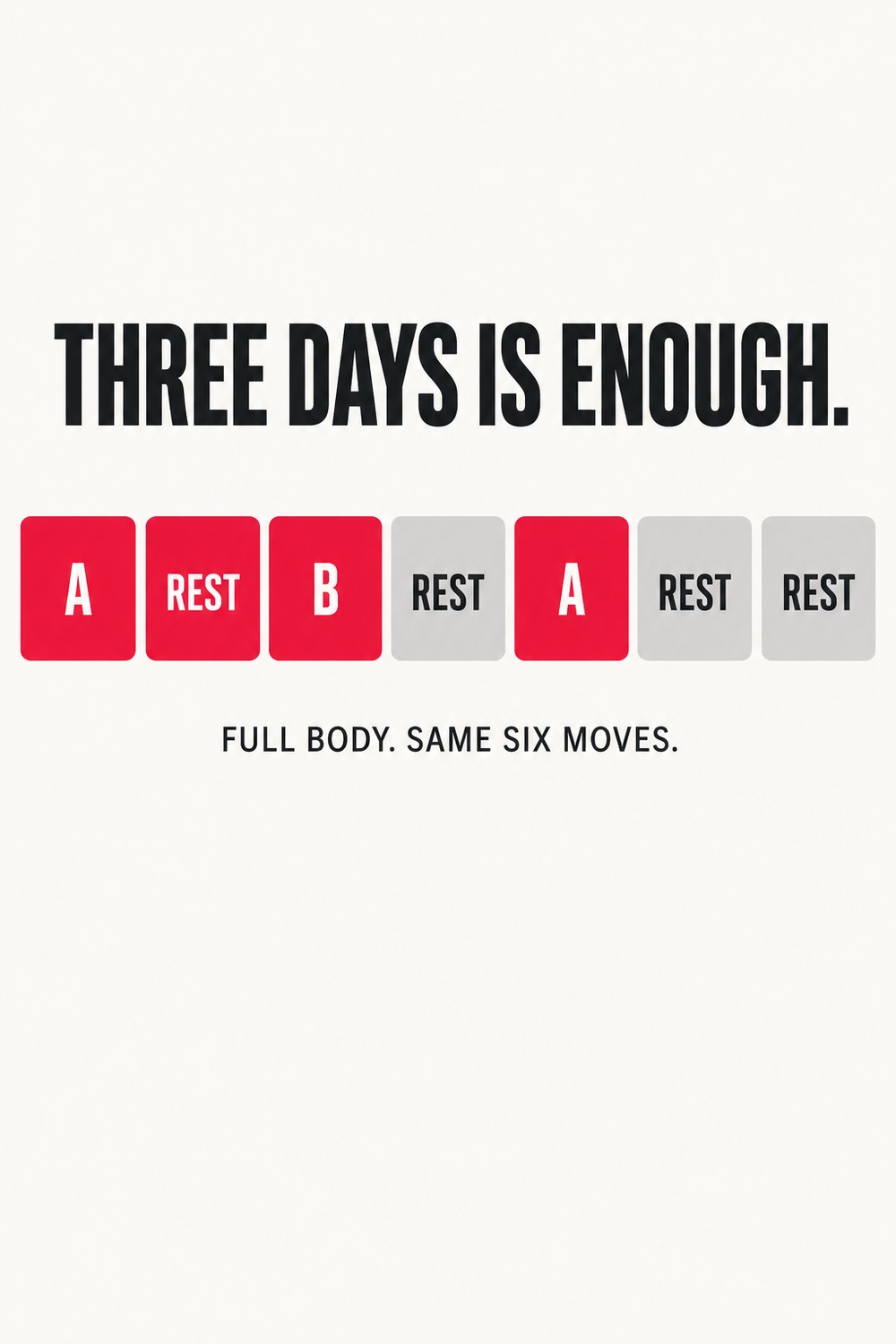
Monday — Full body A
Tuesday — Rest or a walk
Wednesday — Full body B
Thursday — Rest
Friday — Full body A again
Saturday and Sunday — Rest, or something you enjoy that isn’t lifting
Next week, you start with B instead of A and alternate again. That’s the whole system.
Workout A
- Goblet squat — 3 × 8
- Chest press machine — 3 × 10
- Seated row — 3 × 10
- Romanian deadlift with dumbbells — 3 × 10
- Lat pulldown — 3 × 10
- Plank — 3 × 30 seconds
Workout B
- Leg press — 3 × 10
- Dumbbell shoulder press — 3 × 10
- Chest-supported row — 3 × 10
- Leg curl — 3 × 12
- Dumbbell bicep curl — 3 × 12
- Dead bug — 3 × 10 each side
Both sessions should take about 45 minutes. If they’re taking 90, you’re resting too long between sets. Aim for 90 seconds.
Machines feature heavily here on purpose. They’re easier to learn, harder to do badly, and they let you focus on effort rather than balance while you’re finding your feet. Free weights come later, and they’re worth waiting for.
What weight should you start with?
Lighter than you think, for the first two weeks.
Pick a weight where the last rep of each set feels like you could have done three or four more. That will feel almost pointless.
Do it anyway. You’re teaching your body the movement and finding your baseline, and starting too heavy is the single most common way beginners injure themselves in month one.
From week three, add a small amount whenever you finish all three sets comfortably. That’s it. That’s progressive overload, and it’s the only thing that actually matters long-term.
Four things nobody tells beginners
Nobody is watching you. Genuinely. Everyone in there is thinking about their own set, their own phone, or their own reflection.
Write it down. Notes app is fine. You cannot progressively overload if you can’t remember what you lifted on Friday.
Soreness isn’t the goal. It’s a side effect, and it fades as you adapt. A session that didn’t leave you sore was not a wasted session.
Warm up properly. Five minutes on a bike, then one light set of the first exercise. That’s enough.
Where to go after four weeks
Once this feels routine and the weights are climbing, you’ve got a choice.
Add a fourth day and split upper and lower body (our weekly workout plan templates show how to lay that week out). Or, if you want to keep some cardio in the mix, move onto our 4-day hybrid athlete split, which is built for training strength and endurance together without one wrecking the other.
If it’s specifically legs you want to focus on, our machines-only leg day plan works as a straight swap for Workout A.
And if you’re training at home rather than a gym, the five-item home setup covers everything in this plan with dumbbells instead of machines.
Before your first session, pack your bag once and properly. Our gym bag essentials for men checklist covers the core kit, the shower kit and what to leave at home.
Ready for a structured program? Our 3 day workout split for beginners gives you two full-body workouts with exact sets and reps.
Packing for your first sessions? See our gym bag essentials for women checklist too.
Not ready for the gym floor yet? Start with the no-equipment 7-day home workout plan and move to this plan when you are.
Finished your first month? Move on to the 12-week workout plan, a four-day upper/lower program with built-in progression.
Not sure what to wear for your first sessions? See our gym outfits for women and gym outfits for men, each with seven looks matched to the kind of workout you are doing.
Questions people ask
Is a 3-day beginner gym workout plan enough?
For your first two or three months, yes, and it’s more sustainable than five. Full recovery between sessions matters more than frequency when you’re starting out.
Should beginners use machines or free weights?
Machines first. They’re easier to learn and harder to get wrong, which means you can focus on effort instead of balance. Free weights are worth adding once the movements feel automatic.
How long until I see results from a beginner gym plan?
Strength usually climbs within three to four weeks. Visible change takes longer and depends far more on nutrition than on the plan.
Can women follow this beginner gym workout plan?
Yes, unchanged. The exercises, sets and progression are identical. Only your starting weights differ, and those vary between individuals more than between sexes.
What if I miss a session?
Do it the next day and shift the week along. Missing one session matters far less than deciding the week is ruined and skipping the rest of it.
Before you start
This is a general beginner plan built from standard programme design, not personalised coaching. If you’ve got an injury or a health condition, or it’s been a very long time since you trained, check with a professional first.
Related Post