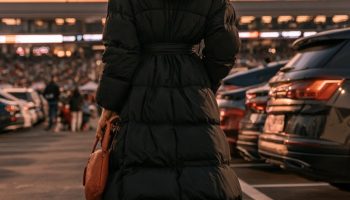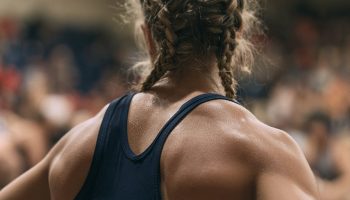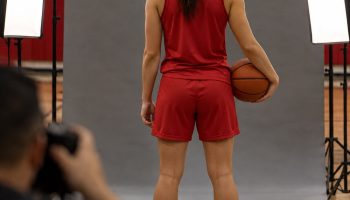
The line forms along the wall next to a black backdrop. Twelve gymnasts in matching long sleeve leotards wait their turn, chalk still on their palms from warm ups, and somebody keeps wiping her hands on her warm up pants and then remembering she shouldn’t.
At the front, the photographer says “whenever you’re ready,” and the next athlete steps onto the tape mark. She is fearless on beam, but on the mark she has no idea what to do with her arms. They hang, then cross, then land on her hips, and the shutter keeps clicking through all of it.
That moment is why gymnastics media day poses are worth planning before you walk in. You get about 90 seconds on the mark, so walk in knowing your first three.
Quick answer
Plan three standing poses (arms crossed, hands on hips, grips over the shoulder), one sitting pose and one personality frame such as medals or a crown. Do action shots only with skills you already compete, on a mat, with your coach watching. For groups, close the gaps to under 4 inches and stagger head heights.
How gymnastics media day works
Media day is the preseason session where every athlete gets a headshot and a few full length frames for the roster, meet programs and senior night. Clubs run a smaller version before the first meet.
Most sessions follow this order:
- Check in (10 minutes early): hair done, chalk wiped off, photo consent form handed in.
- Headshot (20 to 30 seconds): neutral face, then a smile.
- Individual set (60 to 90 seconds): three or four standing or sitting poses on the backdrop.
- Action station (2 to 5 minutes, optional): a handstand, a leap or a beam pose on a low beam or floor mat.
- Groups (15 to 30 minutes): duos, trios, class year, seniors, then the full team.
Photo rules are stricter than most families expect. The USA Gymnastics Safety and Response Policy allows photos of athletes only in public view, bans photography in locker rooms and changing areas, and says parents’ requests not to be photographed must be honored at sanctioned events. For school teams, the Department of Education FERPA photo and video FAQ notes that schools often ask for consent before sharing event photos.
Nobody tells you this: the warm up jacket frame is often the one families actually print. Shoot it every time.
Decision rule: if you have under an hour for a full roster, skip the action station and save it for a practice day.
Individual poses, standing and sitting
Default setup: lead shoulder turned about 30 degrees from the lens, weight on the back foot, chin forward half an inch. Hold each pose 2 to 3 seconds.
Standing poses
- Arms crossed: fold arms just below the chest, fingertips tucked under the opposite arm instead of fists.
- Hands on hips: thumbs forward, elbows slightly back so light shows between arm and body.
- Salute: one arm straight up, palm open, the other relaxed like presenting to a judge. Every gymnast already owns it.
- Grips over the shoulder: hold your grips by the wrist straps and rest them on the shoulder nearest the camera.
- Chalk clap: clap chalky hands once in front of your chest while the photographer shoots a burst.
- Relevé: rise onto the balls of your feet, arms in a low V, chin lifted. A cute, lighter frame.
- Looking away: three quarter turn, eyes on a point 4 feet to the side of the lens. Easiest for camera shy athletes.
- Senior pose: hold a class year sign or your first leotard at chest height. Shoot it vertical.
Sitting and ground poses
- Beam sit: sit sideways on a low beam, ankles crossed, hands resting on the beam beside you.
- Straddle sit, leaning forward: on the floor mat, forearms on the mat in front, chin up. Shoot from chest height, not from the floor.
- Knee hug: sit with knees bent, arms wrapped around them, head slightly tilted.
- One knee down: back knee on the mat, forearm on the raised knee, grips or medals in the free hand.
- Lying on the mat, shot from above: on your back, arms in a loose V overhead, photographer on a step stool.
- Medals: hold two or three medals by the ribbons at chest height, or wear one and hold the rest. Stop at three; ten looks like a medal rack.
- Crown: a $5 to $15 party store crown, held at chest height or worn for one frame. Great for seniors.
- Laughing frame: ask a teammate behind the photographer to say something ridiculous. Shoot the burst.
Match the pose to where the photo will be used:
| Pose | Best use | Camera height | Orientation |
|---|---|---|---|
| Arms crossed | Roster page, senior banner | Chest | Vertical |
| Salute | Meet programs, intro graphics | Waist, aimed up | Vertical |
| Grips over the shoulder | Bars specialists, social posts | Chest | Vertical or square |
| Beam sit | Feature stories, parent prints | Eye level with the athlete | Horizontal |
| Straddle sit | Team grid, season preview | Chest | Square |
| Medals or crown | Senior night, award posts | Chest | Vertical |
| Looking away | Shy athletes, story covers | Eye | Vertical |
Common mistake: shoulders creeping up toward the ears. Exhale right before the frame and let them drop an inch.
Decision rule: if the line is long, shoot arms crossed and the salute first. Those two individual gymnastics media day poses cover the roster and the program.
Duo, trio and team gymnastics media day poses (2 to 5 people)
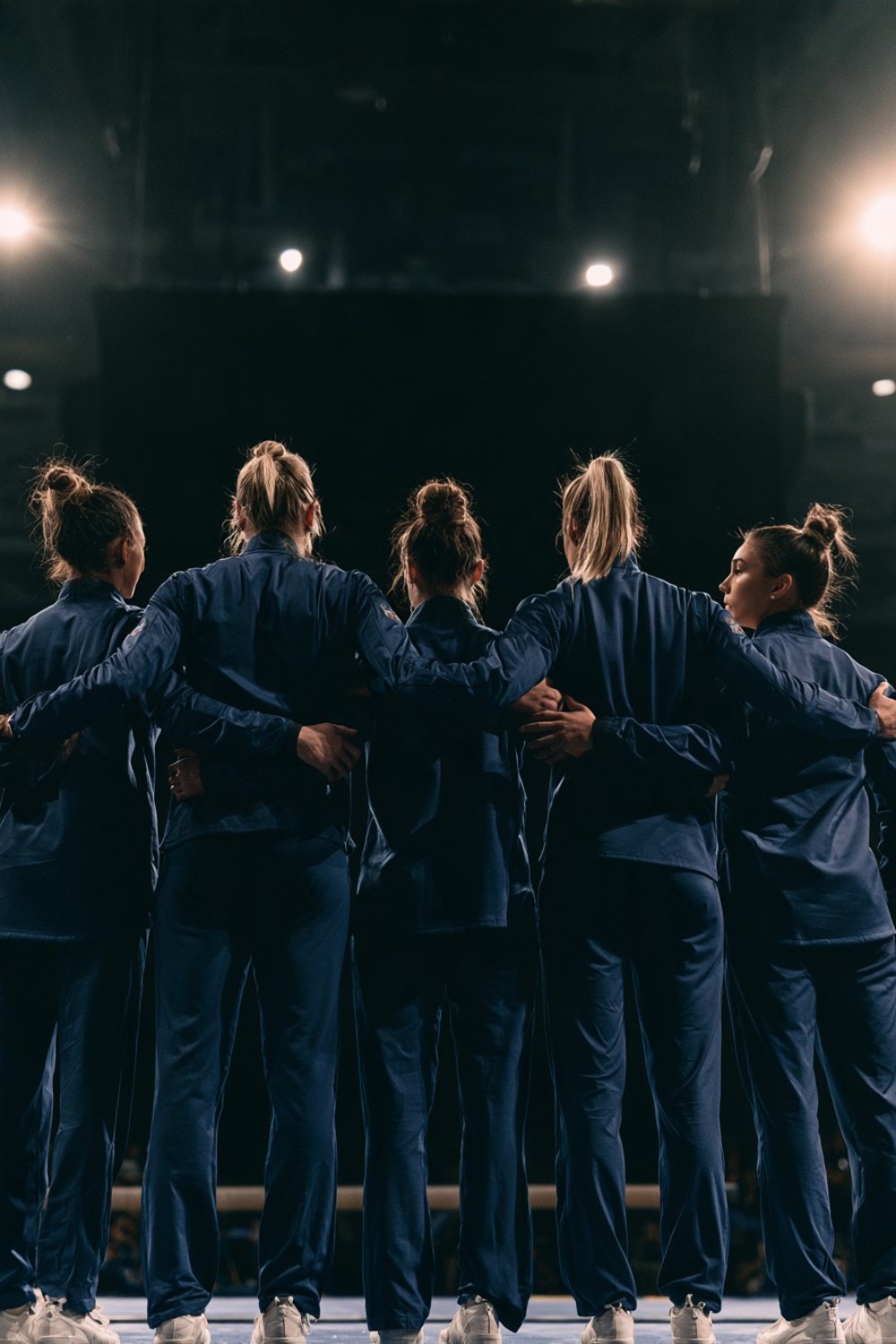
Group frames fail on gaps between bodies and heads all at one height. Close gaps to 4 inches or less and stagger heads by half a head.
| Group size | Go to formation | Fun option | Time needed |
|---|---|---|---|
| 2 people (duo) | Back to back, arms crossed | Mirror salutes, outside arms up | 1 to 2 minutes |
| 3 people (trio) | Center one step forward, outside two angled in | Arm in arm, all looking back over the shoulder | 2 minutes |
| 4 people | Two standing, two sitting on a low beam | Heads together on the floor, shot from above | 2 to 3 minutes |
| 5 people | V shape, tallest at the point | Seated row along a low beam | 3 minutes |
| Full team | Kneeling row, standing row, back row on a mat stack | Laughing round | 6 to 10 minutes |
Duo poses
Back to back, each turned 30 degrees out, works for any height difference. Mirror salutes (outside arms up, inside arms linked) read instantly as gymnastics. For a cute best friend frame, sit side by side on the beam.
Trio poses
Arm in arm from behind, all looking back at the camera, is the trio shot people save most. The wedge (center one step forward) is the safer roster version.
Group and team poses
For the full team, this order takes about 8 minutes:
- Line up by height, tallest in the center.
- Split into rows: front row kneeling, middle row standing, back row on a stacked mat if you have more than 15.
- Shift each row half a body so every face shows between two heads in front.
- Shoot 5 frames serious, then 5 frames laughing.
Nobody tells you this: the overhead “flower” frame, with everyone lying on their backs and heads together in a circle, needs the photographer at least 8 feet up. For more than 4 people, use a balcony or a ladder held by a spotter.
Action poses on beam, floor and handstands, safely
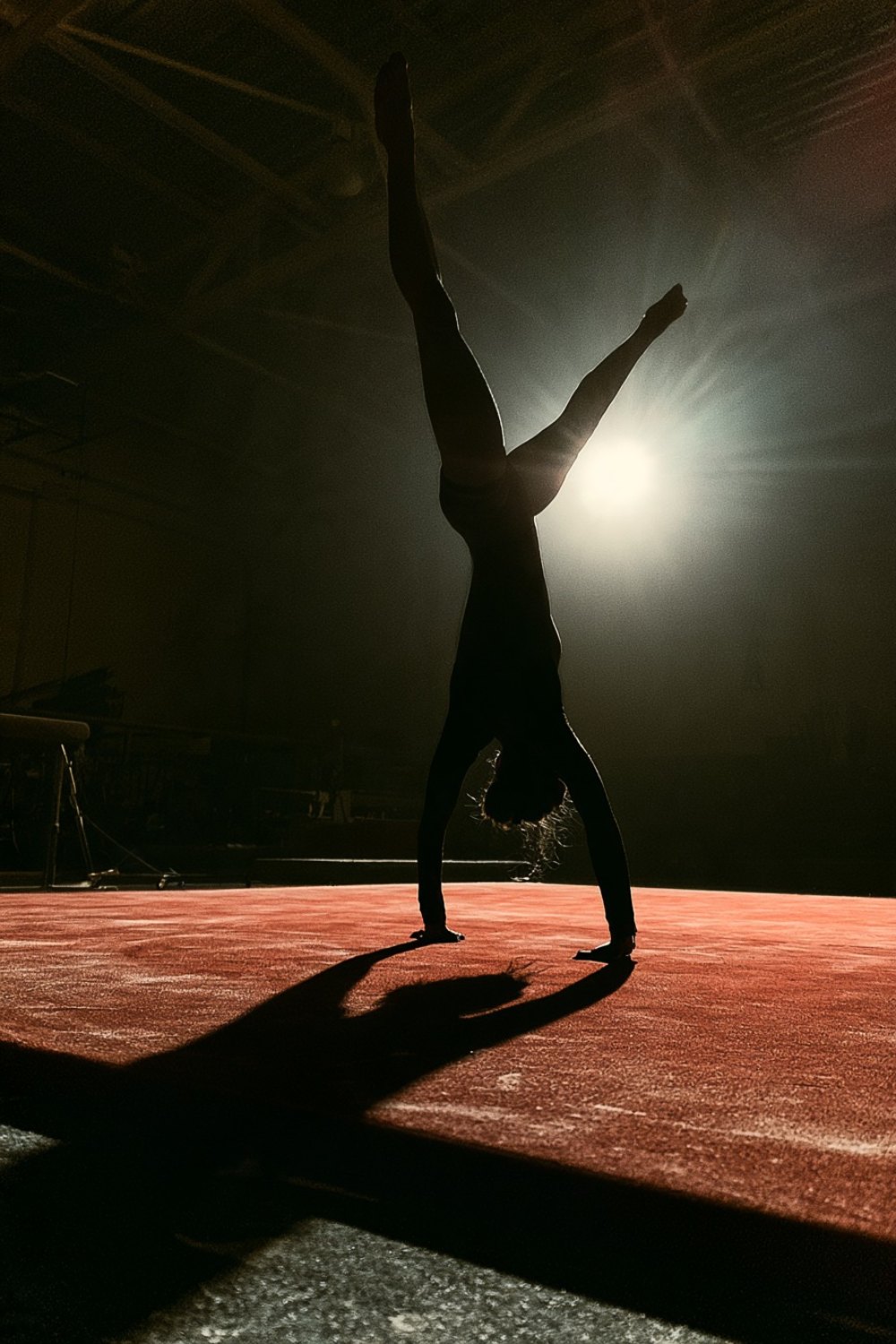
Action frames carry the most risk, because athletes are cold, distracted and showing off for a camera. Treat every action shot like a practice turn.
- Warm up first: 10 minutes of the normal team warm up.
- Only competed skills: nothing new or “almost there.”
- Coach present: the coach decides which skills are allowed and stays within reach.
- Low equipment: use the floor beam or a low beam for beam poses and put landing mats under everything.
- Three attempts max: if the shot isn’t there by attempt three, take a standing pose instead.
Shots that work well within those rules:
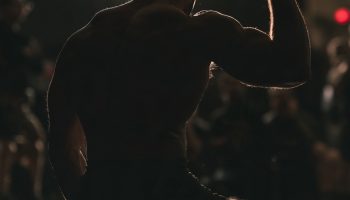
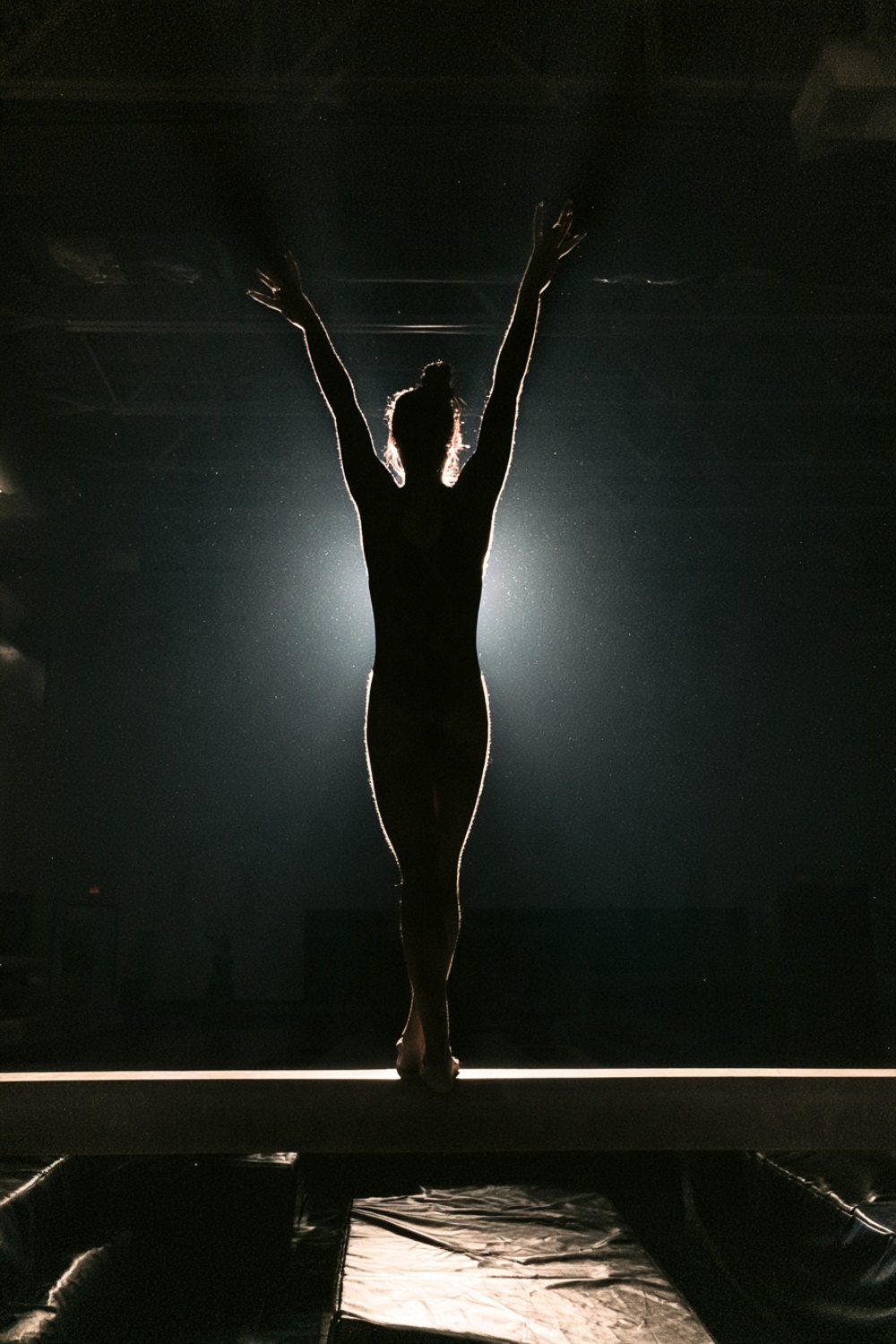
- Handstand silhouette: a straight handstand on the floor mat, lit from behind so only the outline shows. Hold 2 seconds for a burst.
- Split leap: on the floor, shot from the side at waist height. If the split isn’t full yet, our splits stretching routine is the off season fix.
- Beam arabesque or scale: on a low beam.
- Chalk toss: a small handful of chalk tossed upward in front of a dark backdrop, lit from the side.
Common mistake: asking a gymnast to “do it again, higher” for the camera. Height comes from shutter timing, not from extra effort.
Decision rule: if the skill would need a spot in practice, it needs a spot for the photo, and the spotter will be in the frame. Pick a different skill.
Lighting and framing that look college level
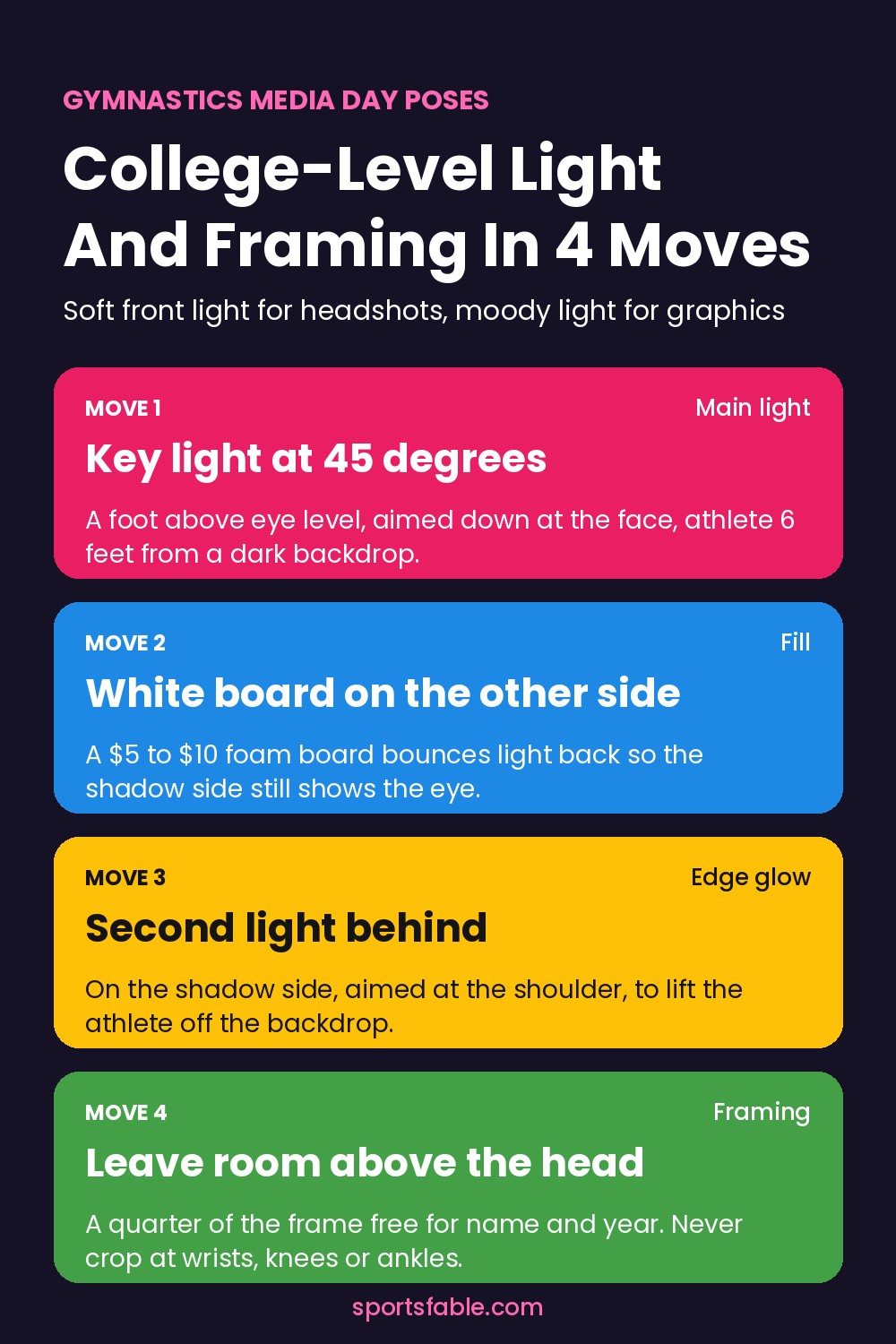
College media days look dramatic because of light and framing, not fancy poses. The recipe is classic three point lighting, explained in this portrait lighting guide from B&H: a key light at about 45 degrees to the subject, a fill on the opposite side and back lights behind the subject. Our wrestling media day poses guide uses the same setup on a mat.
To build a budget version:
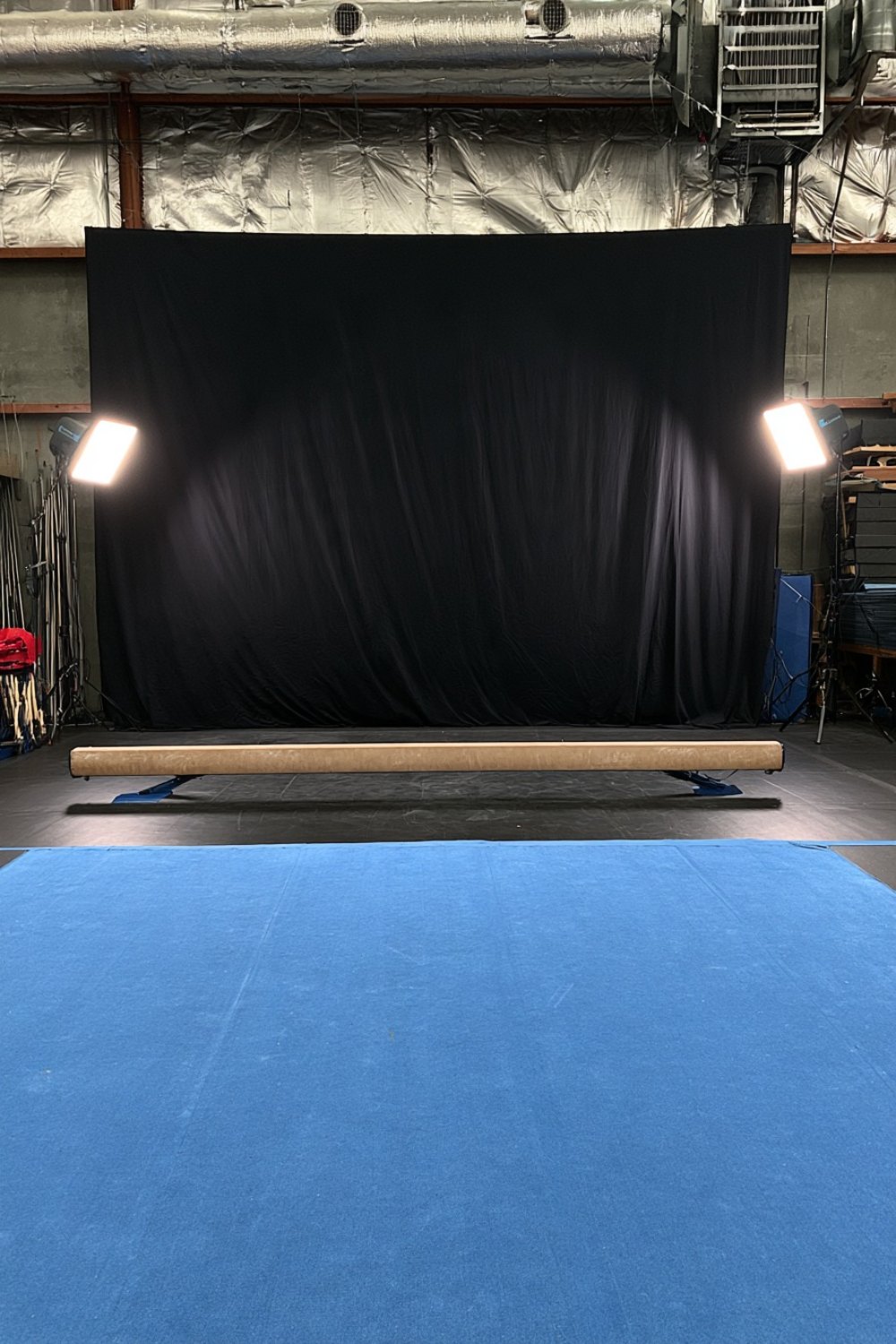
- Hang a black or dark grey backdrop and stand the athlete 6 feet in front of it.
- Set one softbox or LED panel 45 degrees to one side, about a foot above eye level, aimed down at the face.
- Add a white foam board ($5 to $10) on the opposite side as fill.
- A second light goes behind the athlete on the shadow side, aimed at the shoulder.
- Camera at chest height, aimed slightly up for standing poses and level for sitting ones.
| Setup | Rough cost | Look | Best for |
|---|---|---|---|
| Big window or open bay door | $0 | Soft and even | Headshots, club teams |
| One LED panel plus foam board | $50 to $130 | Gentle shadow on one side | Roster photos |
| Two lights, one behind | $120 to $300 | Bright edge on the shoulder | Senior banners, social posts |
| Full three or four light setup | $1,000 and up | Glowing edges, dark background | College style intro graphics |
Decision rule: leave a quarter of the frame empty above the head on vertical shots so a designer can add a name and year. Don’t crop at joints (wrists, knees, ankles); crop mid thigh or show the full body.
Nobody tells you this: moody light hides gym clutter but shows every flyaway hair. Keep softer front light for the official headshot.
Props: grips, chalk, medals and crowns, plus what to bring
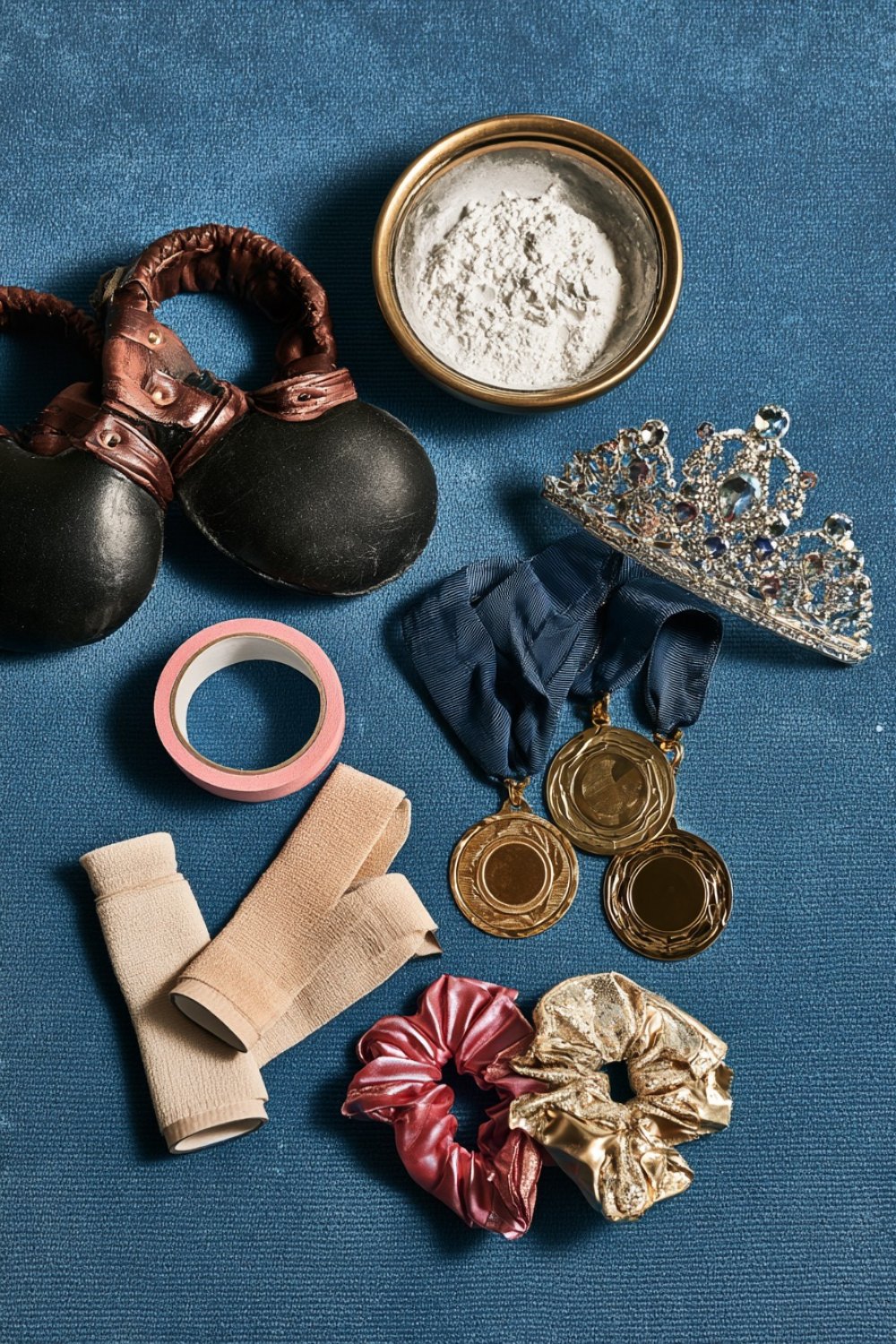
Props give hands a job, which solves the arms problem instantly. One prop per frame.
- Grips: the ones you actually use, not a new pair.
- Chalk: a small bowl for the chalk clap and chalk toss. Wipe hands with a damp towel before headshots.
- Medals: two or three of the most meaningful.
- Crown or tiara: one per team is enough.
- Tape: neat, fresh wrist tape if you normally wear it.
Grab our free printable pose card and shot list, tick the poses you want and hand it to whoever is shooting.
Free printable
Gymnastics Media Day Pose Card and Shot List
A free 2 page printable: 16 standing and sitting poses with cues, duo, trio and team setups, action shot safety rules and a lighting setup, then a what to bring checklist, shot order, phone settings and a team planner.
Download the free PDFWhat to bring in the bag:
- Competition leotard plus the team warm up jacket
- Two scrunchies or hair ties, bobby pins, hairspray, a comb
- Damp towel or wipes for chalk
- A lint roller for dark warm ups
- Signed photo consent form if your club or school asks for one
Nobody tells you this: hair ruins more frames than poses do. A slicked high bun or tight braids survive handstands and still look neat in the headshot.
Common mistake: changing into the warm up halfway through the individual set. Shoot the whole leotard set first, then change once.
Phone tips for parents and teammates
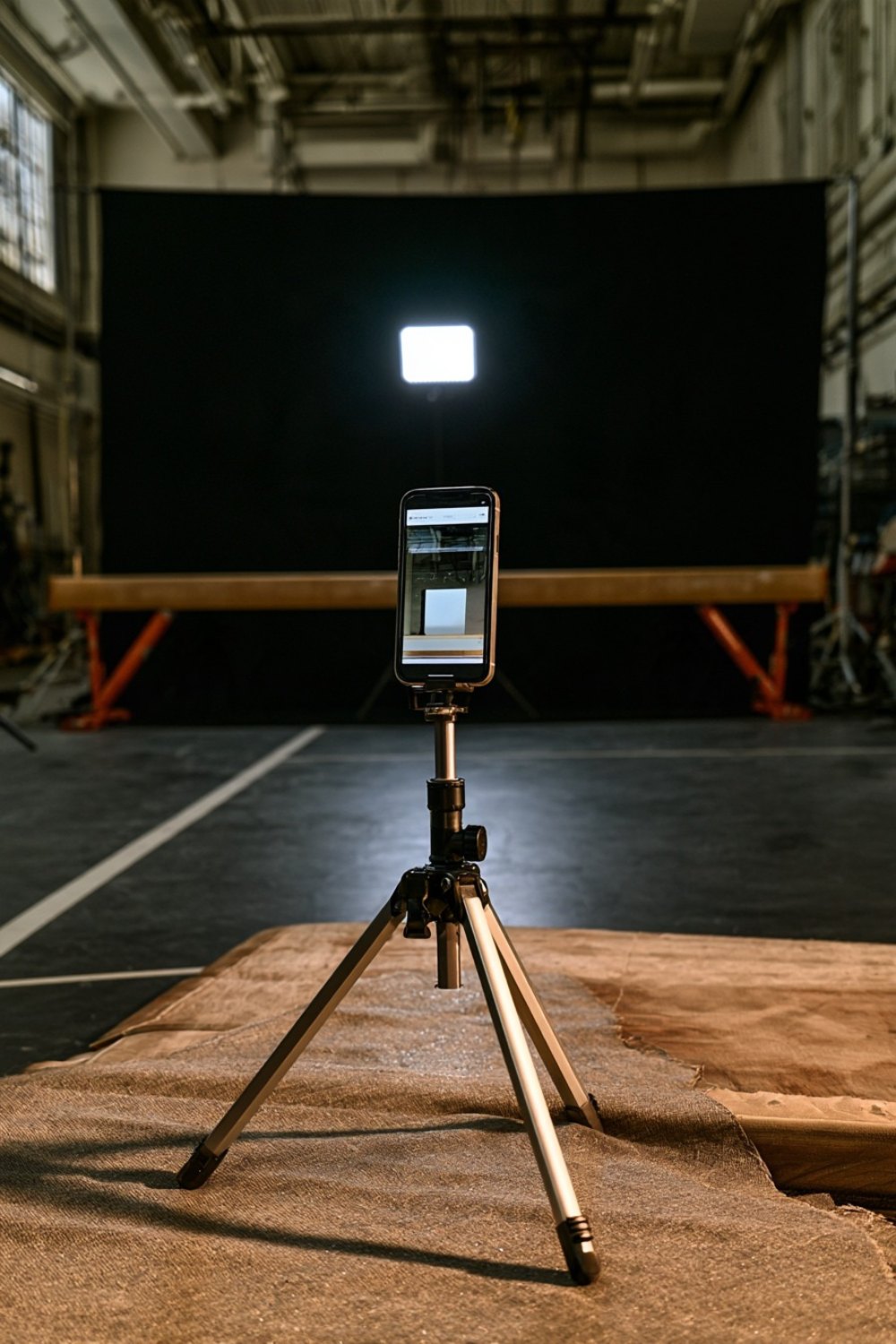
Club media days are often shot by a parent volunteer. Set the phone up like this:
- Lens: 2x from 8 to 10 feet for one athlete, 1x for groups. Skip 0.5x; it stretches whoever is near the edge.
- Height: phone on a $15 to $30 tripod at the athlete’s chest height.
- Focus and exposure: tap on the eyes, then slide brightness down one notch so a white leotard doesn’t blow out.
- Light: turn the athlete toward a big window or open door.
- Burst: hold the shutter for chalk claps, leaps and laughing rounds.
Decision rule: if the gym has a big window or bay door, use it before you buy any light.
Flash is a no at competitions: the USA Gymnastics photo and video policy bans flash photography at its events. The logic carries over to practice: a sudden burst of light can startle an athlete mid skill, so never use flash during an action shot.
For senior banners, shoot vertical and full length. A 12 megapixel phone file on a 2 by 4 foot banner prints around 84 pixels per inch, sharp from 6 feet but soft up close, so don’t crop hard.
Order banners 10 to 14 days before senior night; a framed print of the best frame also makes one of the better gifts for gymnasts. Ask families before posting anyone else’s gymnast.
Keep building the season
End of season ideas live in our team gifts and gifts for coaches guides. Keep flexible between meets with this stretching routine, and borrow group ideas from our basketball media day poses.
Questions people ask
What are the best gymnastics media day poses for one person?
Arms crossed, the salute and grips over the shoulder. They are simple and crop well for rosters. Add one sitting pose and one medals or crown frame.
What are cute gymnastics media day poses for 2 people?
Back to back with arms crossed is the easiest. Mirror salutes with inside arms linked or a side by side beam sit are the cuter options.
How do you pose a group of 4 or 5 gymnasts?
Put the tallest in the center and build a V, or seat two on a low beam with the rest standing behind. For a fun frame, lie on the floor with heads together and shoot from at least 8 feet above.
Should gymnasts do handstands at media day?
Only if the coach approves it and the athlete already competes the skill. Do it on a floor mat after a full warm up, with three attempts at most. A backlit handstand silhouette is the safest way to get the look.
What should I wear for gymnastics media day?
Your competition leotard for the main set and the team warm up jacket for one more frame. Add neat hair and your usual grips.
Can parents take photos at gymnastics media day?
Usually yes, in public areas, if the club or school allows it. Never photograph in locker rooms or changing areas, skip flash and ask other families before posting their gymnast.
How long does gymnastics media day take?
Plan 1 to 2 minutes per athlete for portraits, 15 to 30 minutes for groups. A team of 15 usually needs 60 to 90 minutes.
Images in this article are AI-generated illustrations and original graphics created by SportsFable. They show outfit ideas, not real people, teams or events. The printable is an original SportsFable resource.
Related Post