
It’s a quiet Sunday night in the first week of January, and someone is lining things up by the front door like they’re packing for a trip. A full water bottle, sneakers with the laces already loosened, and a paperback with a receipt tucked in as a bookmark, still on page one.
On the fridge, held up by a magnet shaped like a lemon, there’s a tracker with 75 empty boxes. It looks a little ambitious. It also looks like hope, the slightly nervous kind that says maybe this is the time you actually finish something.
If that’s you, the 75 soft challenge is a kind place to start. It keeps the structure that makes these challenges stick (daily habits, a fixed finish line, boxes to check) and drops the all-or-nothing pressure. Below you’ll find the rules most people follow, a 75-day workout plan, meal ideas, tracker and journal setups, and a free printable tracker you can tape to your own fridge.
Quick answer
The 75 soft challenge has no official rulebook, but the version most people follow is four daily habits for 75 days: eat well and drink alcohol only on social occasions, work out for 45 minutes with one active recovery day a week, drink about 3 liters of water, and read 10 pages of any book. Miss a day and you don’t have to restart; you adjust and keep going.
What the 75 soft challenge rules are
The 75 soft challenge started online as a gentler cousin of a much stricter program. Nobody owns it, and there’s no official rulebook, which is good news: you’re allowed to shape it around your life.
The 75 soft challenge rules list most people follow
- Eat well, and only drink alcohol on social occasions.
- Do a 45-minute workout every day, with one day a week as active recovery.
- Drink about 3 liters of water a day.
- Read 10 pages of any book.
That’s it. Four boxes a day, 75 days in a row, which works out to a little under 11 weeks.
How to adapt the rules to your life
Write your own version before day one, because deciding at the end of a long Tuesday is how rules quietly dissolve. If 45 minutes is a big jump from where you are now, start at 20 or 30 and build up over the first few weeks. “Eat well” means whatever you can sustain, like a vegetable at two meals or cooking at home five nights a week.
Some people swap the reading habit for a faith or reflection practice, and that works fine if it’s what you’ll actually do. Pregnant, recovering from an injury, or managing a heart or other medical condition? Check with your doctor first and adjust the workout and water rules with them.
75 soft vs 75 hard: which one fits your life
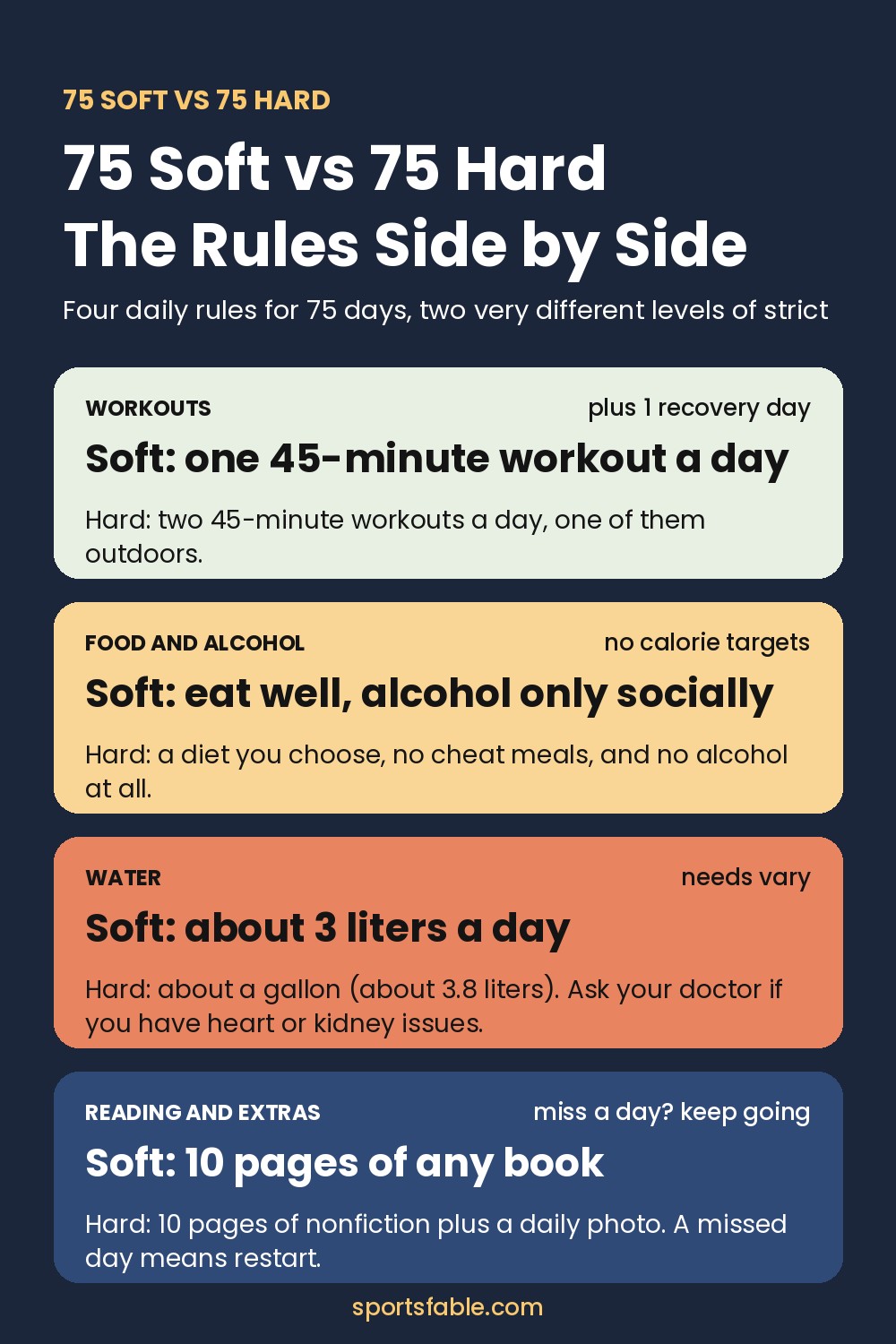
The 75 hard version asks for two 45-minute workouts a day (one outdoors), a strict diet with no alcohol and no cheat meals, about a gallon of water, 10 pages of nonfiction, and a daily progress photo. Miss anything and you start over at day one. The soft version keeps the shape and lowers the stakes.
| Rule | 75 soft | 75 hard |
|---|---|---|
| Workouts | One 45-minute workout a day, one active recovery day a week | Two 45-minute workouts a day, one outdoors |
| Food and alcohol | Eat well; alcohol only on social occasions | A diet you choose, no cheat meals, no alcohol |
| Water | About 3 liters a day | About a gallon (about 3.8 liters) a day |
| Reading and extras | 10 pages of any book | 10 pages of nonfiction plus a daily photo |
| Missed day | Adjust and keep going | Restart at day one |
If you’ve got a demanding job, kids, or a body that needs rest days, the soft version is usually the realistic pick. If you want to read up on the stricter option first, our guide to the 75 hard challenge breaks it down. Honestly, there’s no rule against doing soft first and deciding later if you even want hard.
A 75-day workout plan with recovery built in

Forty-five minutes a day, six days a week, comes to about 270 minutes, plus an easy seventh day. That’s well above the CDC’s adult physical activity guidelines of at least 150 minutes of moderate activity a week and 2 days of muscle strengthening. So you don’t need every session to be hard; you need most of them to happen.
Weekly workout plan template
| Day | Workout (45 minutes) | Effort |
|---|---|---|
| Monday | Full-body strength: squats, push-ups, rows, glute bridges | Moderate |
| Tuesday | Brisk walk, easy jog, or bike | Easy to moderate |
| Wednesday | Lower body and core strength | Moderate |
| Thursday | Yoga, Pilates, or mobility flow | Easy |
| Friday | Upper body strength plus a short walk | Moderate |
| Saturday | Fun cardio: a hike, dance class, swim, or run intervals | Moderate to hard |
| Sunday | Active recovery: easy walk and 10 minutes of stretching | Easy |
That gives you 3 strength days, which covers the CDC’s 2-day minimum with one to spare. Swap days freely, just try not to stack two hard strength days back to back. If you like building your own week, our weekly workout plan template has a fill-in version.
Three phases across 75 days
- Days 1 to 25, foundation: keep most sessions easy enough that you could talk in full sentences. Strength days are 2 sets of 8 to 12 reps per move, and it’s fine to use your body weight or light dumbbells.
- Days 26 to 50, build: move to 3 sets on strength days, and add a few reps or a little weight once the last 2 reps of a set feel easy. Turn Saturday into your one harder cardio day.
- Days 51 to 75, own it: keep 3 strength days, make one walk longer, and start deciding which workouts you want to keep after day 75.
Always warm up for about 5 minutes first, with marching, arm circles, and a few easy squats. Stop if you feel sharp pain, dizziness, chest pain, or numbness, and talk to a doctor before you keep going.
Meals and meal ideas without strict dieting
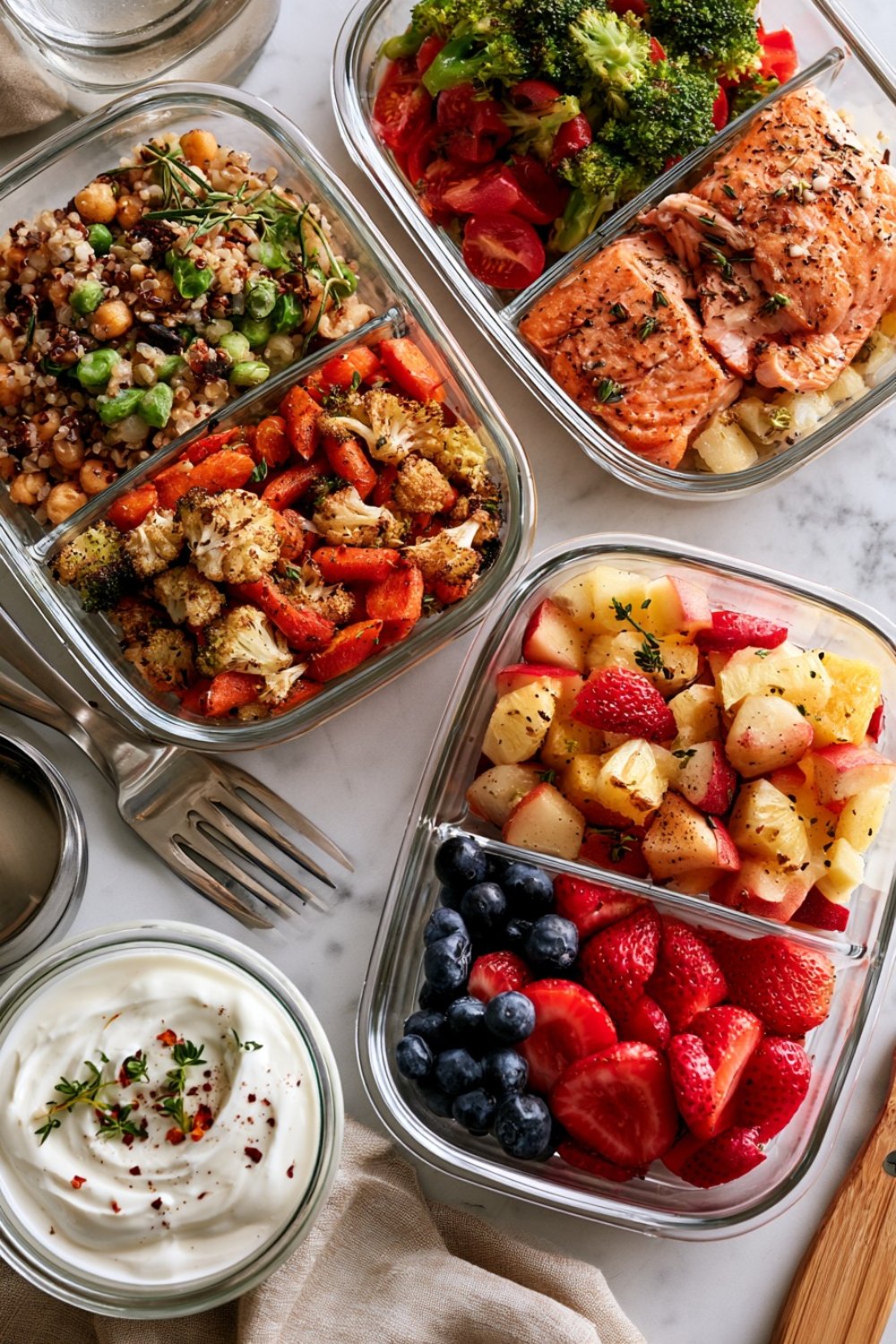
“Eat well” is the vaguest rule, and that’s on purpose. No calorie targets, no banned foods, no cheat meals, because there’s nothing to cheat on. In practice it usually means more meals built around protein, a fruit or vegetable, and something filling, without guilt about the birthday cake.
A simple 75 soft meal plan
| Meal | Idea 1 | Idea 2 | Idea 3 |
|---|---|---|---|
| Breakfast | Greek yogurt, berries, and granola | Oatmeal with peanut butter and banana | Eggs, toast, and sliced tomatoes |
| Lunch | Chicken or chickpea grain bowl | Turkey and veggie wrap with fruit | Leftover soup and a side salad |
| Dinner | Sheet-pan salmon or tofu with potatoes and broccoli | Turkey or bean chili with rice | Stir-fry with frozen veggies and eggs |
| Snack | Apple and cheese | Hummus with carrots and crackers | Trail mix or a smoothie |
Pick two or three breakfasts and lunches you like and repeat them. Batch-cook one grain and one protein on Sunday, and weeknights get much easier.
Allergies, diabetes, or another condition that affects how you eat? A doctor or registered dietitian can help you tailor these ideas.
Alcohol on social occasions
The soft rule doesn’t ban alcohol; it just moves it off the weeknight couch. The CDC’s page on moderate alcohol use notes that drinking less is better for your health than drinking more. Some people use the 75 days to skip it entirely, and that’s a fine version too.
Water, reading, and the small daily habits

These two rules look tiny next to a workout. They’re also the ones people forget at night, standing in the kitchen with half a bottle left and a book still on page one.
How to drink about 3 liters of water a day
Mayo Clinic’s page on how much water to drink every day says many healthy adults get enough from about 11.5 to 15.5 cups (2.7 to 3.7 liters) of total fluid a day, with food supplying about 20%. Needs vary with your body, the weather, and how much you sweat, so 3 liters is a target, not a rule carved in stone. If you have a heart or kidney condition, talk to your doctor before you change how much you drink.
- Use a 1-liter bottle and aim to empty it three times.
- Finish the first one by lunch.
- Mark times on the bottle with tape so you can see if you’re behind.
- Stop sipping hard in the last hour or two before bed so you aren’t up all night.
Making 10 pages stick
Ten pages often takes about 15 to 20 minutes, depending on the book. Keep it on your pillow so you see it at bedtime. Any book counts, including fiction, cookbooks with stories, and that novel your friend keeps texting you about.
Daily tracker, checklist, and journal ideas

A tracker turns a big, fuzzy goal into a box you can check, and checking it feels better than it should. Keep it somewhere you see daily: the fridge, a bathroom mirror, or the inside of your journal.
75 soft challenge daily tracker template
The simplest daily tracker has 75 rows with four checkboxes each: food, workout, water, and reading. Add a tiny note column for things like “walked in the rain” or “pizza night, still fine.” That note is the part you’ll love reading on day 75.
Bullet journal and aesthetic tracker ideas
- Draw a 75-box grid and color each box when all four habits are done.
- Use four colors, one per habit, so you can see which one slips.
- Add a water drop row with 3 drops per day for each liter.
- Write one line a day about how you feel, even if it’s only “tired, did it anyway.”
For an aesthetic tracker, pick two soft colors and one accent and stick with them. Our fitness journal ideas have more page layouts if you’re a journal person.
Prefer an app? That works too; just pick one method so you aren’t tracking in three places.
Our free printable, the 75 Soft Challenge Tracker and Rules Sheet, has the 4 rules, a 75-day checklist, the weekly workout template, meal ideas, and a weekly reflection page.
Free printable
75 Soft Challenge Tracker and Rules Sheet
Page 1 has the 4 daily rules and a 75-day tracker with 4 checkboxes per day. Page 2 has a weekly 45-minute workout template, meal ideas, and a weekly reflection.
Download the free PDFWhat results to expect and how to stay on track

Let’s be honest about results. For most people, over weeks, the 75 soft challenge can bring steadier energy, better sleep routines, more confidence in their own follow-through, and a few habits that stick. It isn’t designed around a number on a scale, and it’s healthier not to judge it by one.
The real win is quieter. It’s a cold morning in week seven, tying your sneakers on the front steps without negotiating with yourself first.
What to do if you miss a day
The soft version doesn’t require a restart. Cleveland Clinic’s overview of the 75 soft challenge describes it the same way: no penalty, no starting over. You’ve got three honest options, and it helps to choose one before you start:
- Keep going: mark the missed box with a dot and pick up the next day. It’s the simplest choice, and it keeps your end date.
- Add a day at the end: your challenge runs to day 76 or 77, so you still get 75 full days.
- Restart: only if you set that rule for yourself, and only if it motivates you instead of crushing you.
If you’re missing the same habit over and over, change the habit, not your opinion of yourself. Shorten the workout, pick a smaller book, or move water earlier in the day.
Ways to stay on track
- Pack your gym bag or lay out clothes the night before.
- Plan your active recovery day for your busiest day of the week.
- Tell one person you’re doing it.
- Every 25 days, review your tracker and adjust one rule if you need to.
Keep building after day 75
- Keep the strength habit with our 12-week workout plan.
- Track your next goal with a printable workout tracker.
- Try a shorter push with the 30-day workout challenge.
- Stay warm on winter gym days with winter gym outfits.
- Turn your walks into a goal race with a 5K training plan.
Questions people ask
What are the 75 soft challenge rules?
There’s no official rulebook, but the version most people follow has four daily rules for 75 days. Eat well and only drink alcohol on social occasions, do a 45-minute workout with one active recovery day a week, drink about 3 liters of water, and read 10 pages of any book.
Do you have to restart 75 soft if you miss a day?
No, the 75 soft challenge doesn’t require a restart. You can mark the missed day and keep going, or add a day at the end to get 75 full days. You can choose a restart rule if it motivates you, but it’s optional.
Is 75 soft or 75 hard better for beginners?
For most beginners, 75 soft is the more realistic choice. It asks for one 45-minute workout a day instead of two, has a weekly active recovery day, and lets you keep going after a missed day instead of starting over.
How much water is 3 liters a day?
Three liters is about 101 ounces, or roughly three 1-liter bottles. Water needs vary with body size, activity, and weather, so treat it as a target. If you have a heart or kidney condition, talk to your doctor about how much fluid is right for you.
What results can you expect from the 75 soft challenge?
For most people, over weeks, results look like more consistent habits, steadier energy, and more confidence about sticking with a plan. The challenge doesn’t promise weight loss or a set result by day 75, and results vary from person to person.
Is there a Christian edition of 75 soft?
There’s no official Christian edition of the 75 soft challenge. Some people swap the reading habit for a faith or reflection practice and keep the other three rules the same.
Can you get a free 75 soft challenge tracker PDF?
Yes, our free 75 soft challenge tracker printable is a 2-page PDF. Page 1 has the 4 rules and a 75-day checklist with four boxes per day, and page 2 has a weekly workout template, meal ideas, and a weekly reflection.
Does a walk count as a 75 soft workout?
Yes, a brisk 45-minute walk counts as a 75 soft workout for most people. Mix in at least 2 strength days a week, which matches the CDC’s guideline for adults, and use an easy walk on your active recovery day.
The featured photo is a licensed stock photo credited in its caption. The other images in this article are AI-generated illustrations and original graphics created by SportsFable. They show fitness and habit ideas, not real people, teams or events. The printable is an original SportsFable resource.
Related Post