
You’re clearing a shelf when a notebook slides out: last January’s. The first page has a goal written in your neatest handwriting. Page two is a tidy grid of workouts, and page three is half filled in and a little messier.
Then nothing, for about 150 blank pages. The notebook didn’t fail because you lack discipline; it failed because it asked for 15 minutes a day and gave nothing back. The best fitness journal ideas fix both problems: logging takes 2 minutes, and by Sunday the pages tell you something useful.
Below: what to track and what to skip, daily, weekly and monthly layouts, goal pages that survive February, a 30 day commitment tracker, aesthetic and DIY setups, the digital or paper decision, and a free 2 page printable starter.
Quick answer
Track five things at most: the workout, effort (1 to 10), sleep, steps or active minutes, and a one line note. Use one goal page, a weekly log you fill in right after each session, and a 30 day tracker with one small daily action. Review for 10 minutes every Sunday, and never miss two days in a row.
What to track in a fitness journal (and what to skip)

A journal earns its place when it answers one question at the end of the week: what actually happened? That needs five columns, not fifteen.
| Track this | How to log it | Why it matters | Time |
|---|---|---|---|
| Workout | Type plus minutes, or exercise, sets x reps x load | Shows progress you can’t feel day to day | 45 sec |
| Effort | 1 to 10 (7 = hard but you could do 2 more reps) | Spots creeping fatigue before it becomes a bad week | 5 sec |
| Sleep | Hours, rounded to the half | The most common reason a workout felt awful | 5 sec |
| Steps or active minutes | Copy from your phone or watch | Captures movement outside the gym | 10 sec |
| Energy and notes | 1 to 5, plus one line | Where the real patterns hide | 30 sec |
Build your weekly totals around the CDC’s physical activity guidelines for adults: 150 minutes of moderate activity a week and at least 2 days of muscle strengthening. A running minutes tally and a strength day count at the bottom of each week is the whole scoreboard.
Skip these, at least for the first month: calories to the gram, every warm up set, mood on a 10 point scale, and daily weigh ins. If you want body measurements, they’re optional; take them once a month, same conditions, and keep them on the monthly page so they don’t dominate the daily one.
Decision rule: if logging takes longer than 2 minutes, cut a column. If you’ve never looked at a column during a weekly review, cut it too.
Nobody tells you this: the notes column beats every number. “Slept 5 hours, legs heavy” or “new shoes, shin felt fine” is what explains the numbers three weeks later.
If you’d rather start from a ready grid, our printable workout tracker is built the same way.
Daily, weekly and monthly fitness journal ideas
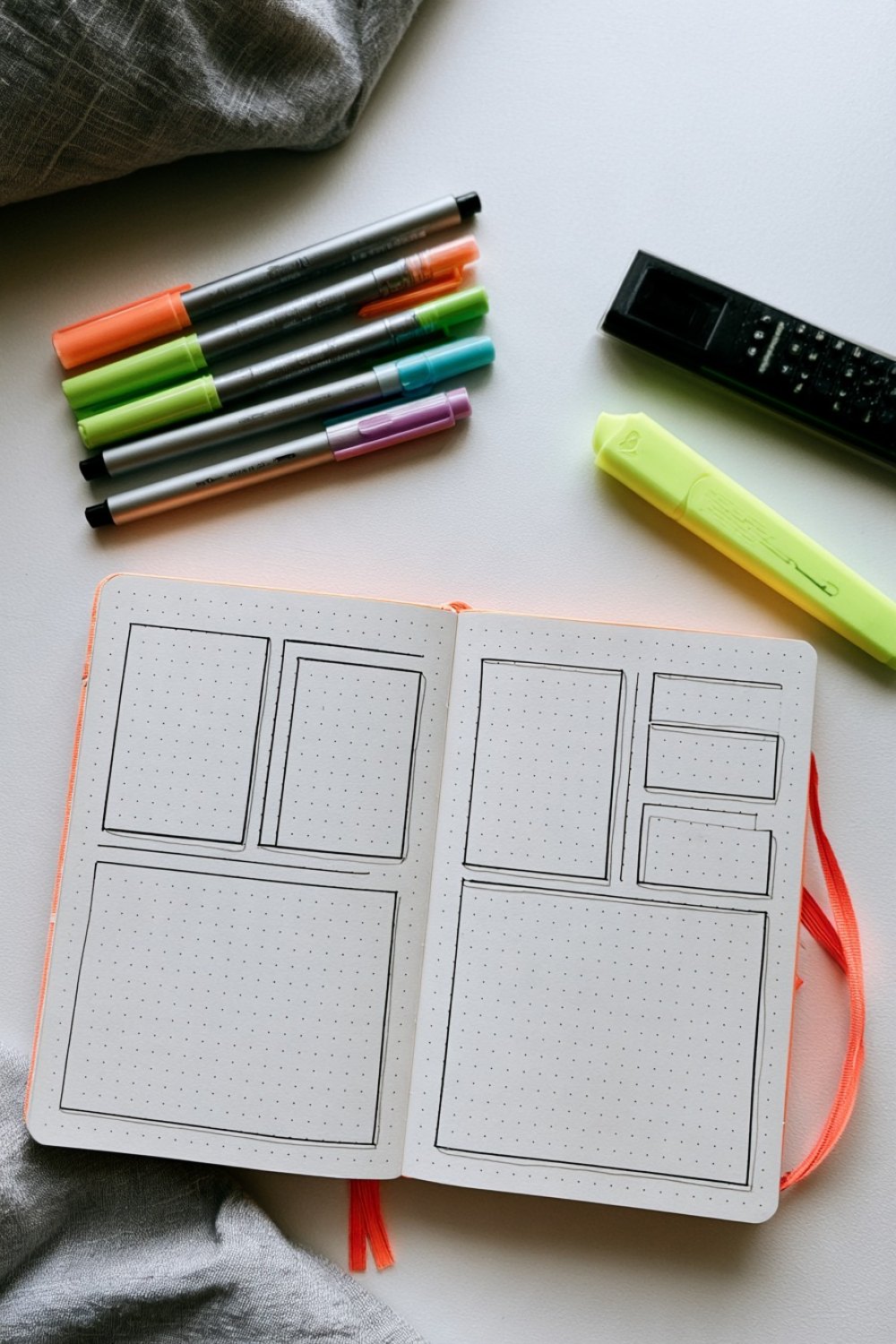
Most people need one layout, not three, so treat these fitness journal ideas as a menu. Pick by how often you train and how much you enjoy the notebook itself.
| Page type | Best for | What goes on it | Setup time |
|---|---|---|---|
| Daily page | Strength training with lots of exercises | Date, workout table, effort, sleep, energy, note | 2 min per day |
| Weekly spread | 3 to 5 sessions a week, mixed training | 7 rows, 5 columns, weekly totals box | 10 min per week |
| Monthly overview | Spotting streaks and patterns | 31 squares, color code, monthly check in | 15 min per month |
Daily page ideas
Rule a small table: exercise, sets, reps, load, and a last column for “next time”. That last column is the trick. If 3 x 10 at 20 pounds felt like a 6 out of 10, write “22” there and you’ve planned the next session in five seconds.
Weekly spread ideas
Draw 7 rows down the page and 5 columns across: workout, minutes, effort, sleep, steps. Leave a box at the bottom for totals and three lines for the Sunday review. This is the layout on page 2 of the free printable.
Monthly and bullet journal ideas
A bullet journal works well here because the symbols do the work: a dot for a planned session, an X when it’s done, an arrow when you moved it, a circle for planned rest. A monthly grid of 31 squares colored by workout type shows a pattern at a glance that no app summary will.
Common mistake: drawing a whole month of daily pages in advance. Life changes the plan by day 9, and the blank pre drawn pages start to feel like an accusation. Draw one week ahead, never more.
Goal setting pages that work

A goal page should fit on one side and be readable in 20 seconds. Write it in this order.
- The why, in one line. “Keep up with my sister on the spring hike” beats “get fit”. You’ll reread this in week three.
- The process goal. Turn the why into something you control: “3 workouts a week, 30 minutes each”. You can tick it in a box.
- The minimum version. The smallest session that still counts on a bad day, such as 10 minutes of walking or one round of a circuit.
- When and where. “Monday, Wednesday, Friday after work, garage” gives the habit a cue.
- One if then plan. “If it rains, I do the 20 minute home workout.” Write two at most.
- A review date. Four weeks out, in the corner, circled.
Why the structure matters: a meta regression of 122 healthy eating and physical activity interventions found self monitoring was the strongest single technique, and programs that paired it with another self regulation technique, like goal setting or reviewing progress, did better than the rest. A log alone helps; a log plus a goal plus a review helps more.
Decision rule: if a goal can’t be ticked in a box this week, rewrite it until it can. Outcome goals like a race time or a number on a scale can live on the page, but the body can’t promise a timeline, so the boxes should track what you do, not what you weigh.
Nobody tells you this: write the process goal in pencil. You’ll adjust it in week two, and crossing out ink on page one is a small, pointless hit to motivation.
Training for a first run? The couch to 5K schedule already gives you the boxes to fill.
The 30 day commitment tracker
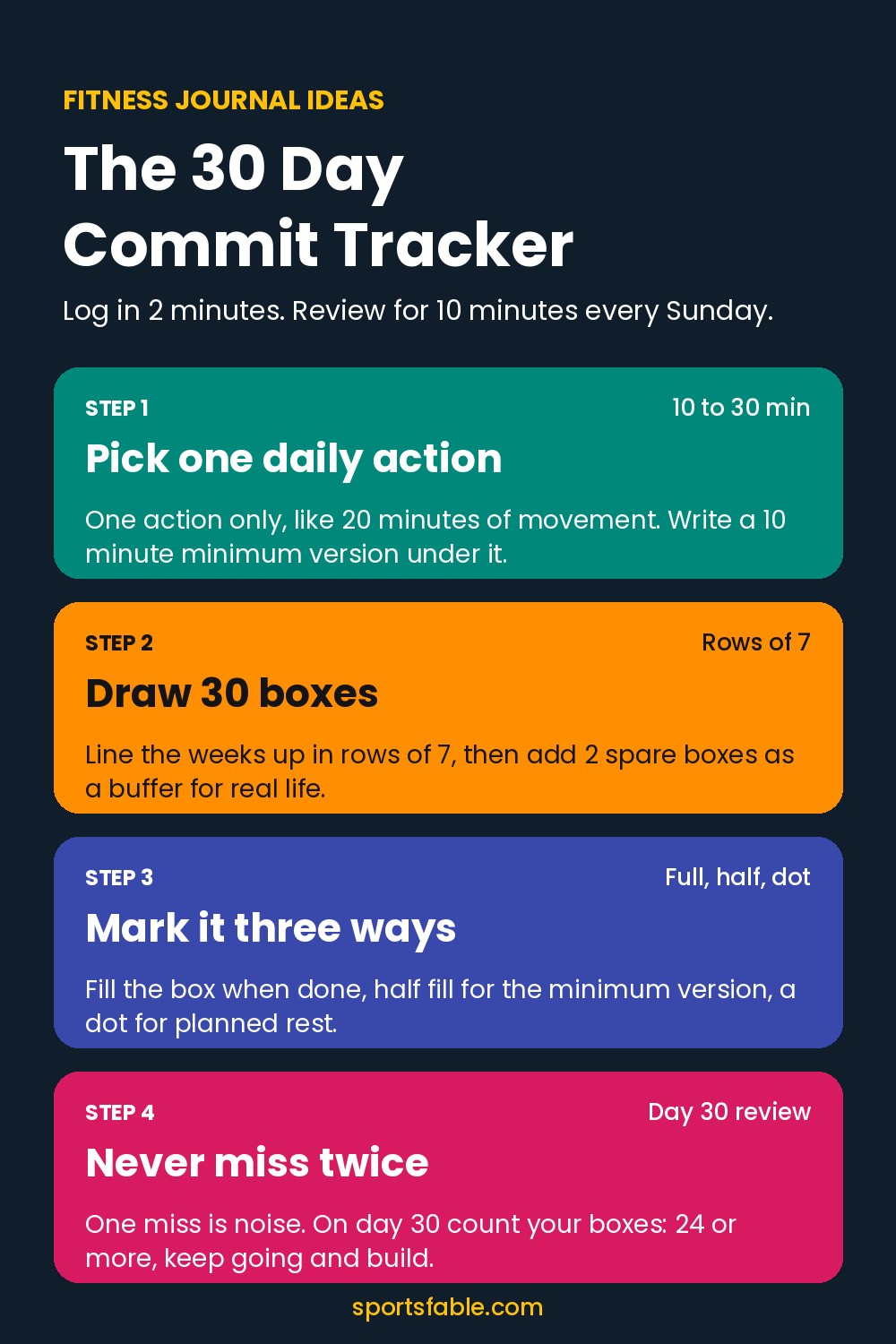
The 30 day commit page is the most useful single idea in this whole guide: one action, 30 boxes, no excuses page. Here’s how to set it up.
- Pick one action you can do in 10 to 30 minutes. Not three. “Move for 20 minutes” is enough.
- Write the minimum version under it, such as 10 minutes of walking.
- Draw 30 boxes in rows of 7 so weeks line up, then add two extra boxes as buffer.
- Use three marks: a filled box for done, a half filled box for the minimum version, a dot for planned rest.
- Follow one rule: never miss twice in a row.
- On day 30, count filled plus half boxes and write one sentence about what changed.
A half box is not a failure, it’s the point. Research summarized by UCL’s habit researchers puts the average time to form a habit at about 66 days, and found that missing a single opportunity did not significantly set the process back. So 30 days is a strong start, not a finish line, and one missed day is just one missed day.
Decision rule: if you hit 24 or more boxes, keep the same action for another 30 and raise the dose slightly. Under 18, shrink the action, not your expectations of yourself.
Common mistake: choosing a challenge that’s too hard for day 1. A plan like the 30 day plank challenge works because it starts small and builds.
Aesthetic and DIY notebook setups and covers

An aesthetic journal isn’t vanity: if you like opening it, you’ll open it. The trick with aesthetic fitness journal ideas is spending your decorating energy where it pays off.
- The notebook: A5, dot grid, 120 to 160 gsm paper so markers don’t ghost through. Expect to pay $8 to $25.
- Pens: one 0.3 to 0.5 mm fine liner for writing, two or three colors for coding workout types. More colors means more decisions.
- DIY kraft cover: a plain kraft notebook ($3 to $8), washi tape, pressed flowers or leaves, and a clear packing tape layer to seal them.
- Inspiration page: one page inside the cover with your why, a quote you actually believe, and maybe a photo of the trail or race you’re working toward.
For a DIY cover, press flowers in a heavy book for 7 to 10 days first; fresh petals brown and wrinkle. Lay them out, run washi tape along the spine and edges, then seal the whole cover with clear tape or self adhesive laminate so it survives a gym bag.
Decision rule: if you love decorating, decorate the cover and the monthly page. Keep daily and weekly pages plain so logging stays a 2 minute job.
Nobody tells you this: a beautiful first page makes the second page harder. Start your first real log on page 3, and leave pages 1 and 2 for the goal and the inspiration page whenever you feel like making them pretty.
Digital or paper: which to pick

Both formats can carry the same fitness journal ideas. The right one is whichever you’ll actually open on a tired Thursday.
| Factor | Paper notebook | Digital (tablet, app or spreadsheet) |
|---|---|---|
| Cost | $8 to $25 per notebook | Free to about $15 for a planner template, if you own the device |
| Speed to log | About 2 minutes | Under 1 minute, some data logs itself |
| Reflection | Strong: writing makes you notice | Weaker: auto logged data is easy to ignore |
| Charts and totals | By hand | Automatic |
| Best for | Habit building, mindful logging | Data lovers, detailed lifting logs |
A digital fitness journal on a tablet with a stylus gives you the handwriting feel plus copy and paste templates. A spreadsheet is the fastest option if you lift and want automatic volume totals.
Decision rule: if you’ve quit three apps already, go paper. If you’ve abandoned two notebooks, try digital. If your watch already tracks steps and sleep, use a hybrid: let the watch count, and use paper for workouts and the one line note.
Common mistake: setting up the perfect digital template for an evening and then never logging a session. Use something basic for 2 weeks before you customize anything.
How to stick with it past week three

Week three is where most journals go quiet. The novelty is gone and results aren’t visible yet. These six moves get you through it.
- Keep the journal where you work out, on the mat, in the gym bag or by your shoes, with a pen clipped to the cover.
- Log within 5 minutes of finishing, before you shower. Later becomes never.
- Do a 10 minute Sunday review with three questions: what went well, what got in the way, what is the one change for next week.
- Never miss twice. A missed day is noise; two in a row is the start of a new habit you didn’t want.
- Shrink on hard weeks. Log the minimum version and give it a half box rather than skipping the page.
- Restart on the next page, not in a new notebook. Gaps are data, and a new notebook resets your evidence to zero.
Decision rule: if you skip the Sunday review twice, your journal is too complicated. Go back to the five columns in the first section.
Nobody tells you this: the empty pages from last January aren’t wasted. Turn to the next blank one, date it, and start there. The free printable below gives you a goal page, a 30 day commit tracker and a weekly log to get going today.
Free printable
Free Fitness Journal Starter (Printable PDF)
A free 2 page printable: a goal setting page with a 30 day commit tracker and day 30 check in, then a weekly log for workouts, effort, sleep, steps, energy and notes with weekly totals and a Sunday review.
Download the free PDFKeep building the habit
Need something to log? Try the 30 day workout challenge or the 7 day home workout plan for the first month, then move to the 12 week workout plan once the habit sticks. Add the hip mobility stretches routine to your rest days, and pack your journal with our gym bag essentials.
Questions people ask
What should I write in a fitness journal?
Write the workout, your effort from 1 to 10, sleep hours, steps or active minutes, and one line about how it felt. That’s enough to spot patterns within 2 to 3 weeks. Add a weekly total of active minutes and strength days.
How do I start a fitness journal as a beginner?
Start with one goal page and one weekly spread, nothing else. Log right after each session for 2 weeks before adding any trackers or decoration. The free printable on this page is a ready made version of exactly that.
What are some aesthetic fitness journal ideas?
A kraft cover with washi tape and pressed flowers, a color code for workout types, and a monthly grid you shade in as you go. Keep the decoration on the cover and monthly page so daily logging stays quick.
Is a bullet journal good for fitness tracking?
Yes, because the symbols make planning and tracking the same act: a dot for planned, an X for done, an arrow for moved. Draw one week at a time so the layout adapts to real life.
What is a 30 day commit tracker?
It’s a page of 30 boxes for one daily action, like 20 minutes of movement. Fill a box when you do it, half fill it for the minimum version, and never miss two days in a row.
Should I use a digital fitness journal or a notebook?
Use paper if you want the habit and the reflection, and digital if you love charts or lift with lots of numbers. Many people do best with a hybrid: a watch counts steps and sleep, a notebook holds the workout and notes.
Where can I get a free fitness journal printable?
Download the 2 page starter on this page. Page 1 is a goal setting page with a 30 day commit tracker, and page 2 is a weekly log for workouts, sleep, steps, energy and notes.
The featured photo is a licensed stock photo credited in its caption. The other images in this article are AI-generated illustrations and original graphics created by SportsFable. They show training scenes, not real people, teams or events. The printable is an original SportsFable resource.
Related Post