


There’s a moment in every late-season game, usually somewhere early in the third quarter, when the sun has gone, the wind has found the upper rows, and half the stadium starts quietly working out whether they can leave early.
The people who stay are rarely the ones in the biggest coat. They’re the ones who layered properly.
That’s what this guide is for. Cold weather game day outfits that hold up for a whole game are built from three thin layers, proper boots with wool socks, and a hat, all chosen for the coldest hour of the day rather than the warmest. Below is how to put one together at every temperature, for women and men, without looking like you’ve dressed for a polar expedition.

Why the stadium is colder than the forecast
Here’s the cost nobody puts on the ticket: you’re going to stand or sit mostly still, outdoors, for four to six hours. Walking around town at 35°F is fine. Sitting motionless in it from kickoff to the fourth quarter is a different sport.
Three things make it worse than the number on your phone.
Wind. Upper rows catch it, and open bowls funnel it. The National Weather Service wind chill chart shows how fast it adds up: 30°F with a 10 mph wind feels like 21°F. At 20°F and 15 mph it feels like 6°F. At 0°F and 15 mph the wind chill is -19°F, and at that level exposed skin can freeze in 30 minutes.
Metal and concrete. Aluminum bleachers and concrete steps pull heat out of anything touching them, which is mostly your backside and your feet.
The clock. Night kickoffs start in the afternoon’s leftover warmth and finish close to the coldest part of the evening. Dress for the fourth quarter, not the tailgate.
The three-layer system, explained properly
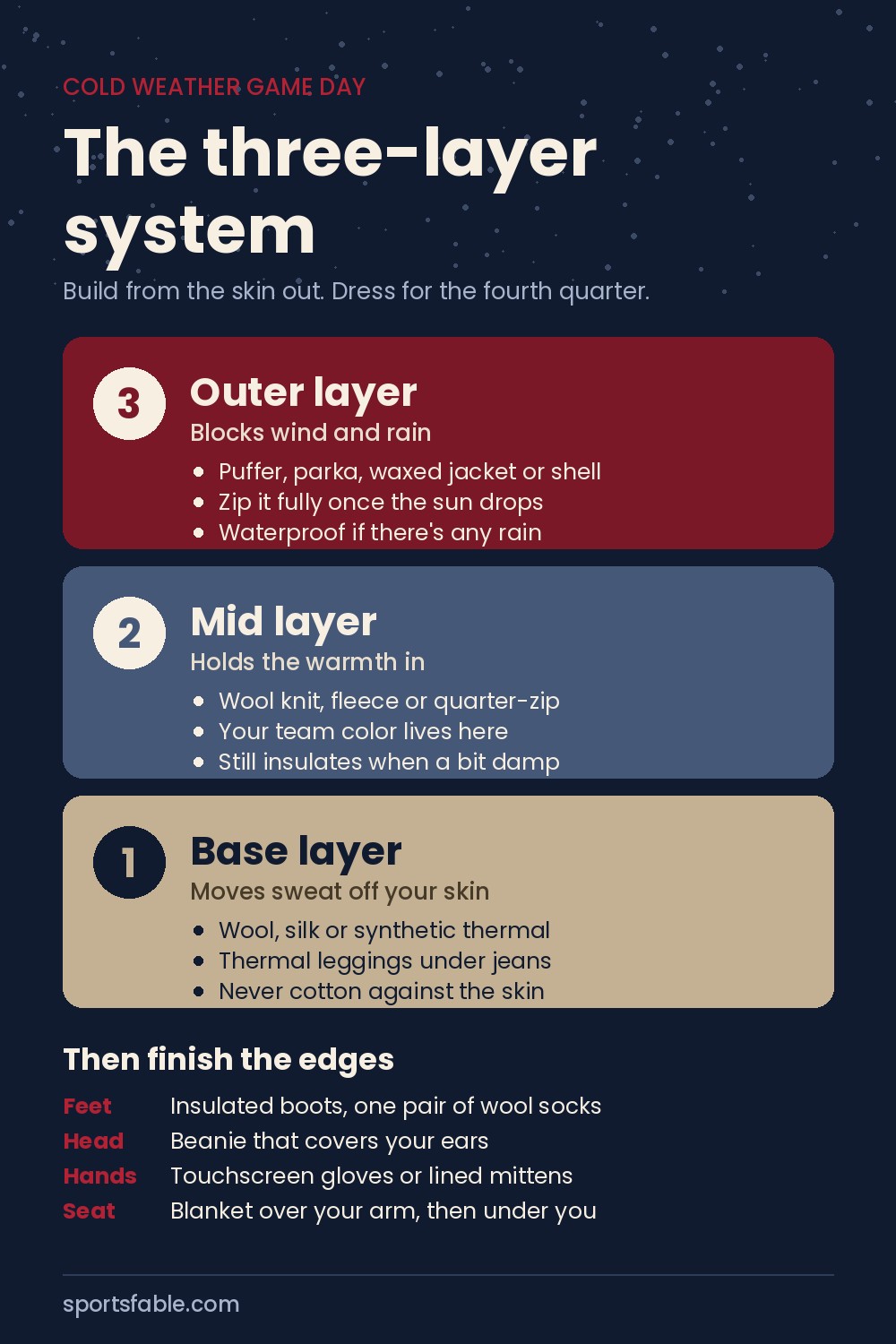
Every cold weather outfit that works is built the same way, and it isn’t a fashion rule. It’s the same approach OSHA recommends for people who work outside in winter:
- Base layer: wool, silk or synthetic, to move moisture away from your skin
- Mid layer: wool or synthetic insulation that still works when it’s damp
- Outer layer: wind and rain protection that still lets a little air out
The part most outfits get wrong is the base. A cotton tee under a cute sweater feels fine at the tailgate. Then you sweat walking up the stadium ramps, the cotton holds on to that moisture, and it sits against your skin for three hours. Wool, silk and synthetics hold more body heat than cotton, which is the whole reason they exist.
Three thin layers also beat one thick one for a practical reason: you can take one off. A single heavy parka is either on or off, and there’s no room to put it anywhere.
Dress for the temperature on your ticket
Check the forecast for kickoff and for the final whistle, then dress for the lower one. These bands assume a normal breeze; add a band if it’s windy or you’re in the upper deck.
50s: the easy cold
A long sleeve base, one mid layer you can tie around your waist, jeans and sneakers. This is the one band where a sweatshirt alone genuinely works. Bring a light jacket for after sunset.
40s: the classic November Saturday
Now the three layers start earning their place. A thin long sleeve, a knit or quarter-zip, and a puffer vest or a shacket. Jeans are fine. Swap sneakers for boots, because this is when cold feet start to decide how long you stay.
30s: where most outfits fail
This is the band that catches people out, because it doesn’t look dramatic on a forecast. A proper thermal base top and leggings or long johns under your jeans, a warm knit, a full puffer or a lined coat, a hat that covers your ears, gloves and wool socks. If you only upgrade one thing, make it the layer under your jeans. Denim on its own is cold, and it’s cold for hours.
Below freezing and night games
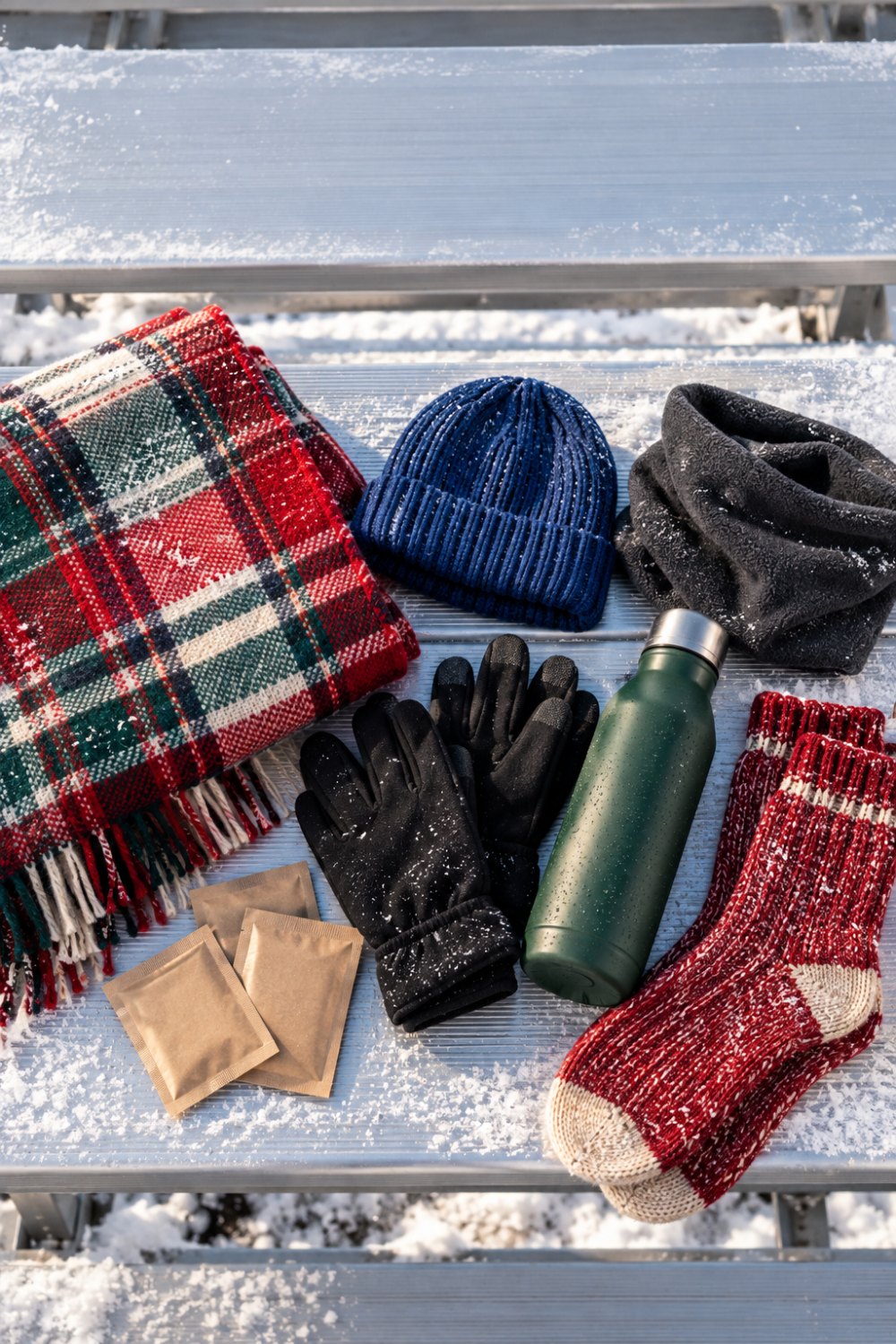
Everything from the 30s, plus a neck gaiter or a scarf you can pull over your nose, insulated waterproof boots, and something between you and the seat. A folded blanket works. Air-activated hand warmers in your gloves and boots make a bigger difference than another sweater.
If the forecast wind chill is heading toward the minus numbers, cover every bit of skin you can. The CDC notes that frostbite most often affects the nose, ears, cheeks, chin, fingers and toes, which is a fairly exact list of what a beanie, a scarf and good gloves are for.
Cold and raining
The worst game day weather isn’t the coldest. It’s 38°F and drizzling. Wet clothing stops insulating, and the CDC puts it bluntly: wet feet lose heat 25 times faster than dry feet.
So waterproof boots stop being optional, a packable rain shell goes over your puffer, and a clear poncho is worth the slightly silly look. Skip suede in the rain. It’s the one boot material that fails exactly when you need it.
Cold weather game day outfits for women
Every formula here follows the same rule as our sporty outfit ideas: one statement piece, everything else quietly doing its job.
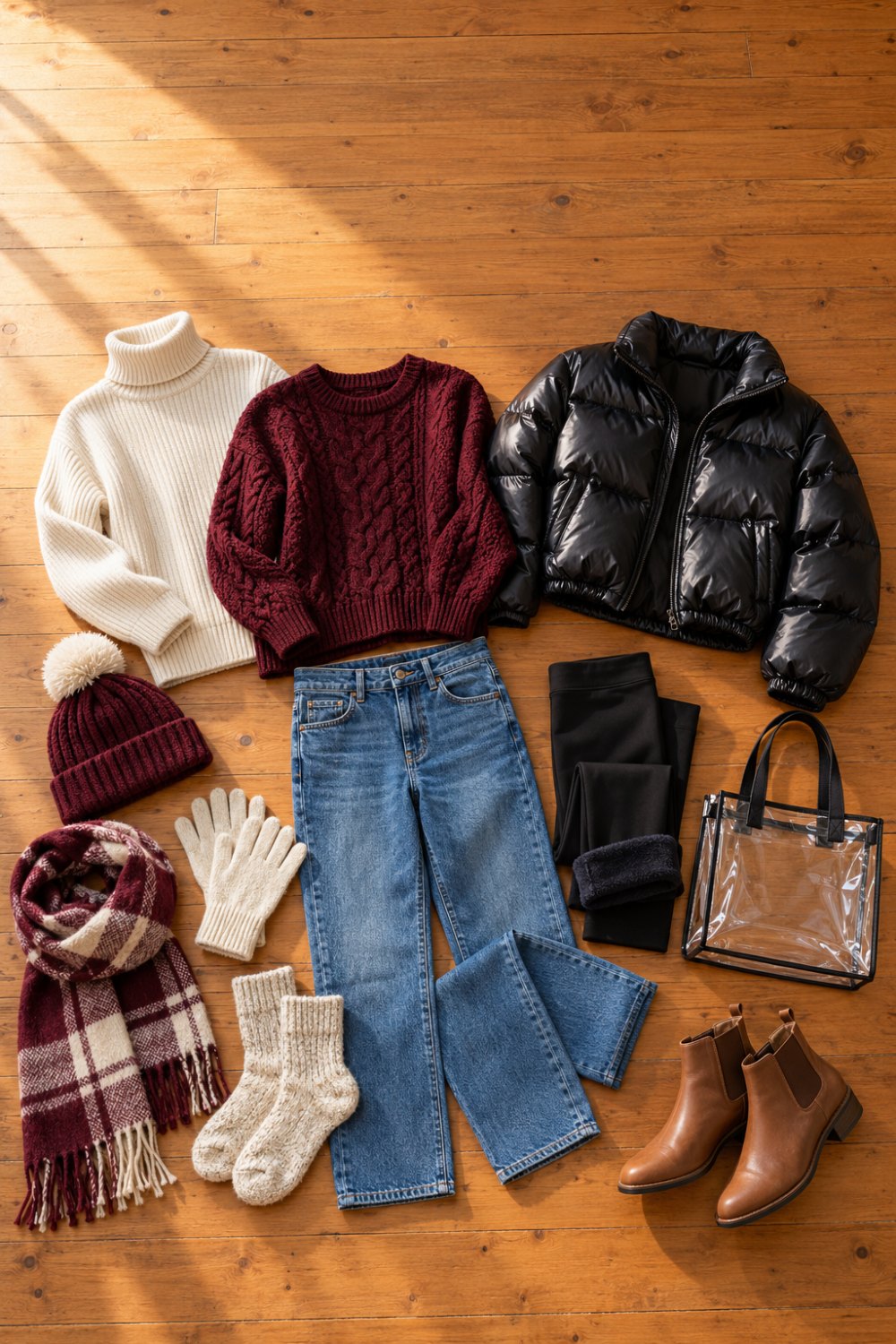
1. The puffer vest classic
Cream turtleneck, team-color knit or quarter-zip, glossy black puffer vest, straight jeans, and flat leather boots. It’s the most-pinned cold game day look for a reason. The vest keeps your core warm while your arms stay free for cheering and holding a drink.
2. The long coat and knit
A chunky knit in your main team color, dark jeans with thermal leggings underneath, and a long wool or padded coat in camel, black or cream. Finish with a plaid scarf that picks up the second team color. It photographs well and it covers the backs of your legs, which bleacher seats go straight for.
3. The leggings and oversized layer
Fleece-lined leggings, a thermal base top, an oversized crewneck in team colors and a cropped puffer jacket. Add chunky boots or weatherproof sneakers. It’s the comfiest option in the stands and the warmest per pound.
4. The jersey, winterized
A fitted long sleeve or a thin hoodie under a football jersey, sized up so it sits over your mid layer, then a puffer on top when it gets properly cold. The jersey still reads from across the stadium. Our guide to sports jersey outfit ideas covers how different jersey cuts behave.
5. The cowboy boot version
Denim, a sherpa-lined jacket, a knit and cowboy boots. It’s popular for a reason and we’d never talk you out of it. Just know the cost: most western boots are unlined leather with a thin sole, and by the third quarter on cold concrete you’ll feel it. Wear thick wool socks and put a warmer in the toe.
Cold weather game day outfits for men
Men’s game day searches lean heavily on the NFL, and the approach is the same whether it’s a college Saturday or a pro Sunday.
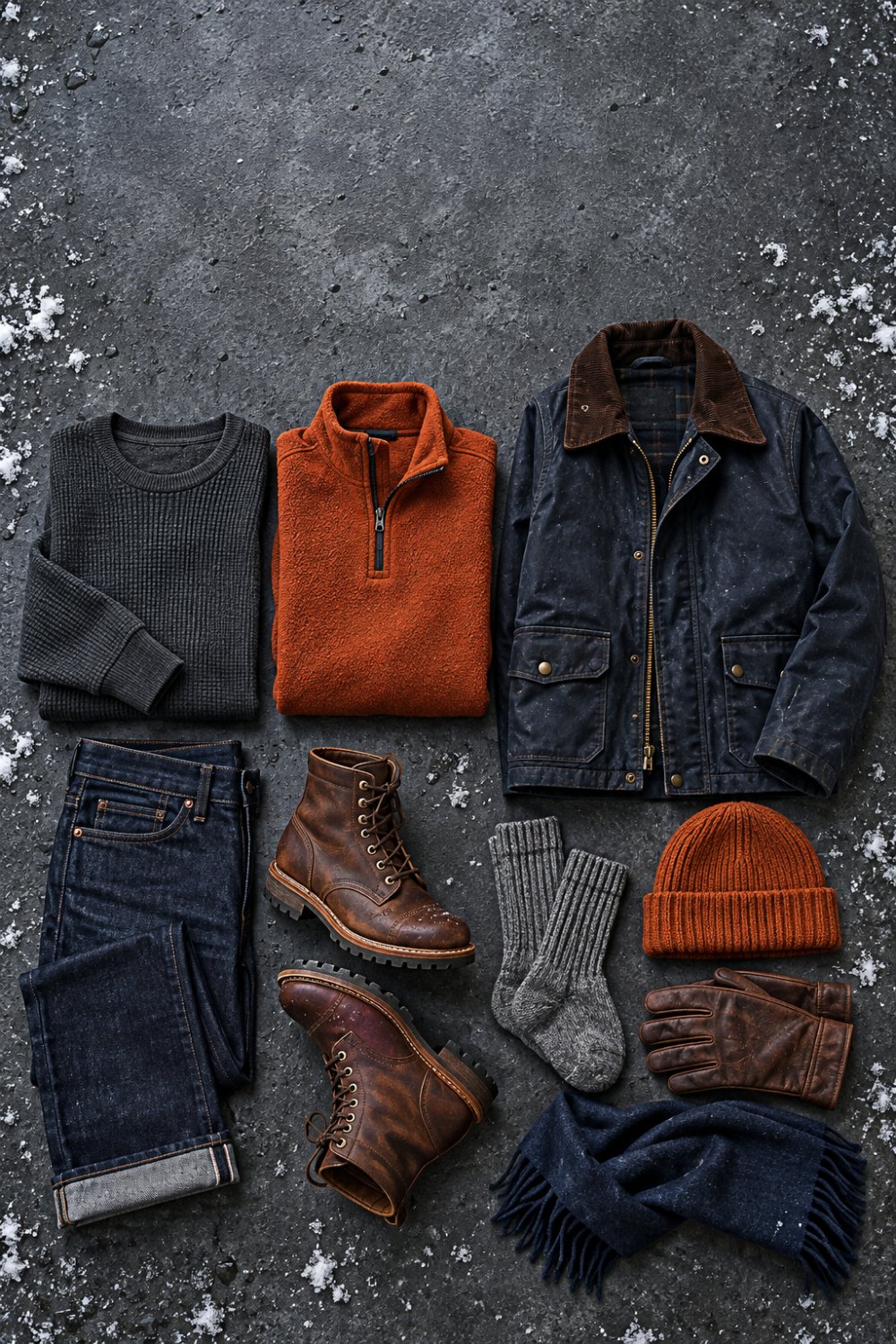
1. The quarter-zip standard
Waffle-knit base layer, a fleece or merino quarter-zip in team color, dark jeans and leather boots. Add a waxed or canvas jacket once it drops below 45°F. It’s the easiest outfit to get right and the hardest to get wrong.
2. The puffer and hoodie
Thermal base, team hoodie, a black or navy puffer jacket with the hood out over the collar, joggers with long johns underneath, and waterproof sneakers. Built for night games and long tailgates.
3. The jersey over layers
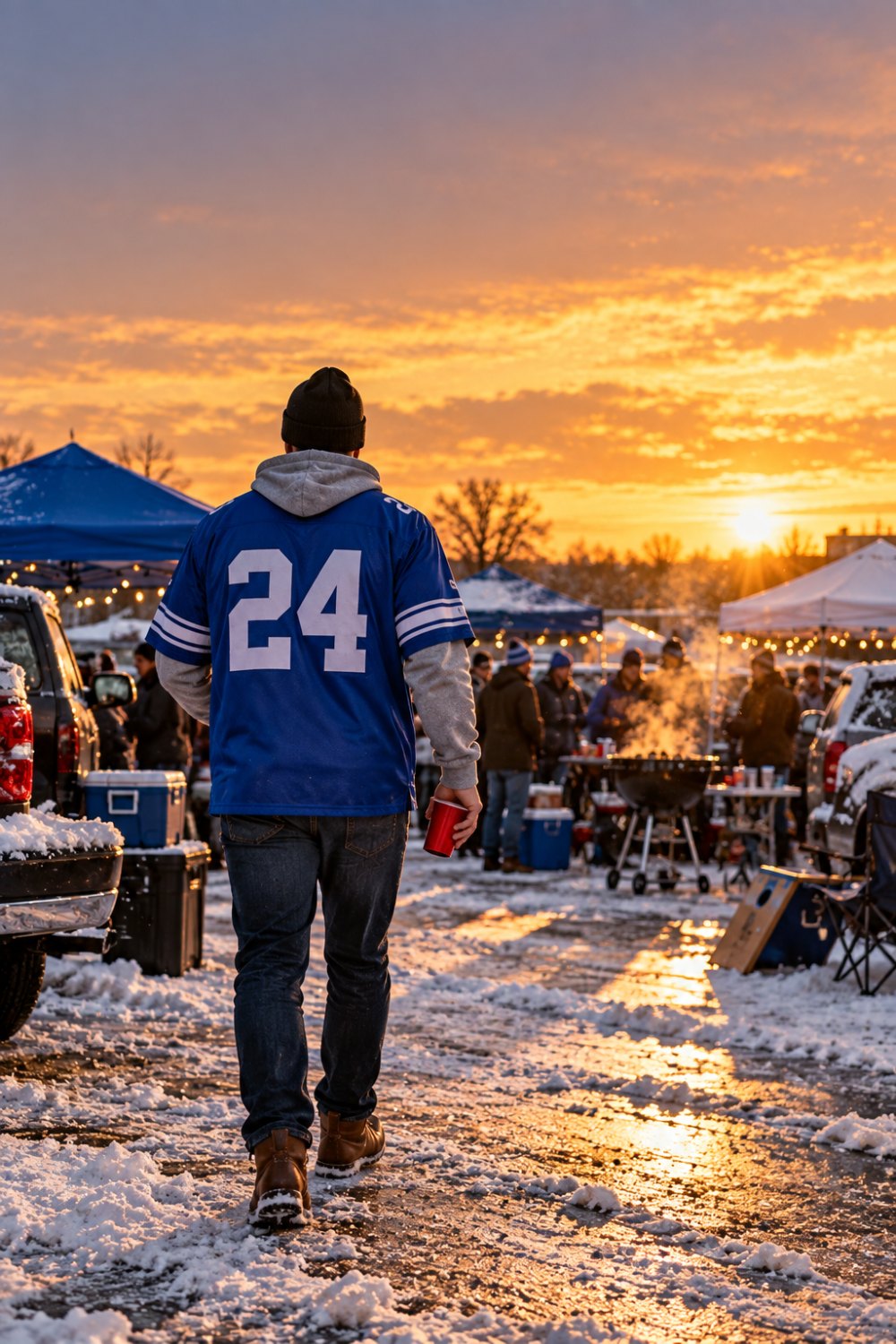
A long sleeve thermal and a thin hoodie, with the jersey on top, sized up one size. Beanie, gloves, dark jeans, boots. It’s the same idea as the women’s version, and it fixes the classic mistake of wearing a jersey over a single tee in November.
4. The smart cold game
For a suite, a pre-game dinner or a date: merino roll-neck, a wool overcoat, dark chinos with a thin thermal underneath, and leather boots. Team color goes on the scarf or the beanie only. It looks deliberate and it’s warmer than it looks.
Start with your feet
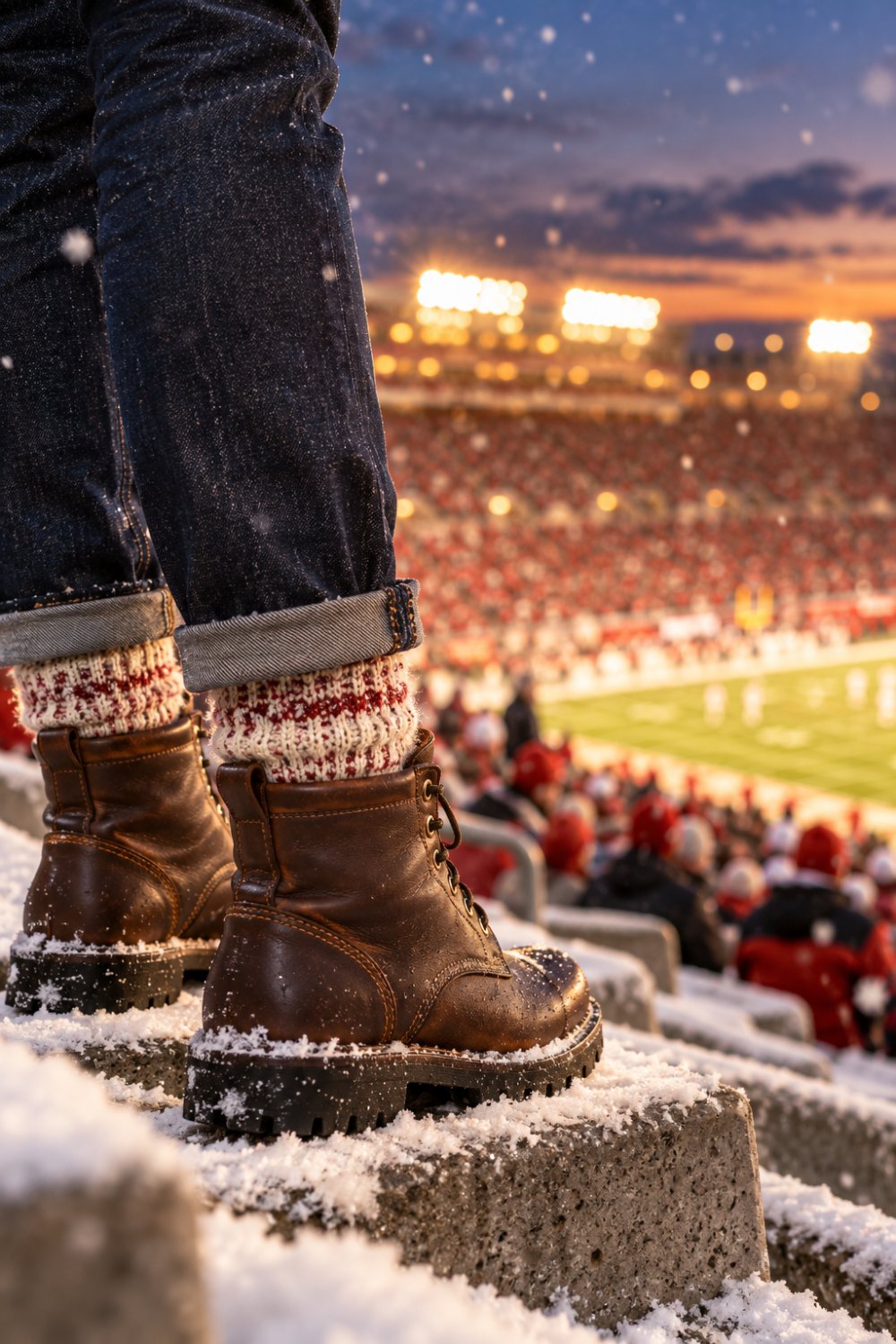
If you remember one section of this, make it this one. Cold feet are what send most people home at halftime, and they’re the part of the body in direct contact with cold concrete for hours.
What works:
- Boots with a thick sole. Thickness matters more than height, because the ground is where the cold comes from.
- Wool socks, one pair. Two cotton pairs squeeze your feet and cut circulation. One proper wool pair is warmer.
- Room in the boot. A tight boot is a cold boot. If you’re wearing thick socks, try your boots on with them before game day.
- A toe warmer. The adhesive kind that sticks to your sock, not the hand warmer shoved in by your ankle.
And if you’re choosing between a cute sneaker and a warm boot for a below-freezing game, the boot wins. Nobody sees your shoes in a crowd of 90,000. Everybody sees you leave early.
Hats, hands and the heat-loss myth
You’ve probably heard that you lose most of your body heat through your head. You don’t. In the BMJ’s 2008 review of medical myths, Vreeman and Carroll traced the claim back to an old military cold-weather study where the subjects were wearing survival suits that covered everything except their heads. Uncovered heads lose roughly 10% of body heat, about what you’d expect for their size.
Wear the hat anyway. Your ears are small, exposed and on the frostbite list, and a warm head simply feels better for hours. The point is that a beanie won’t rescue a cotton base layer. Every layer matters, not just the top one.
Hands are the other weak spot, mostly because you keep taking your gloves off to use your phone. Touchscreen gloves solve that. Mittens are warmer than gloves if you don’t need your fingers, and a thin liner glove inside a mitten gives you both.
How to wear team colors when you’re mostly coat
Once you’re in three layers, your team colors can disappear under a black puffer. The fix is to move the color to the pieces people actually see.
- Beanie and scarf in your main color. They’re at eye level, so they do the most work.
- The mid layer in your team color, with the outer layer open or in a neutral.
- The jersey on top, sized up, when it’s too cold to show anything underneath.
Keep the rest neutral: black, cream, camel, denim. As we say in the game day outfit guide, one team color plus neutrals always looks better than both colors everywhere.
What the bag rules mean for a cold game
Layering matters even more once you know how little you can carry. Under the NFL clear bag policy, you’re limited to one clear bag up to 12″ × 6″ × 12″ or a one-gallon clear freezer bag, plus a small clutch up to 4.5″ × 6.5″. There’s no room in that for a spare fleece.
Two details are especially useful in winter. Blankets are allowed if you carry them over your shoulder or arm through screening. Most traditional seat cushions with pockets, zips or covers aren’t. So a blanket doubles as your seat insulation.
College stadiums set their own rules, and they vary a lot. Ohio State runs a no-bag policy, while LSU allows clear totes. Our Ohio State game day outfits and LSU game day outfits guides list the exact limits. For anywhere else, check the stadium’s own page the week of the game.
The cold game checklist
- Checked the forecast for the final whistle, not kickoff
- No cotton against your skin
- A thermal layer under your jeans or leggings
- Insulated boots, one pair of wool socks, room to wiggle your toes
- Hat that covers your ears
- Touchscreen gloves or mittens with liners
- Scarf or neck gaiter you can pull over your nose
- Hand and toe warmers
- Blanket carried over your arm
- Rain shell or poncho if there’s any chance of rain
- Bag that meets your stadium’s policy
Keep building the look
Cold games are one situation out of six in our game day outfit ideas hub, which also covers hot openers, rain and tailgate-only days. Going to a specific stadium? Start with the LSU and Ohio State guides. And for the jersey itself, our jersey styling guide breaks it down by cut.
Questions people ask
What should I wear to a football game in cold weather?
Three layers: a wool or synthetic base, a warm knit or fleece, and a wind-resistant outer layer. Add thermal leggings under jeans, insulated boots with wool socks, a hat, gloves and a scarf. Dress for the temperature at the end of the game.
What do you wear to a freezing night game?
Everything above, plus a neck gaiter you can pull over your nose, hand and toe warmers, waterproof boots and a blanket to sit on. Cover as much skin as you can once the wind chill drops below zero.
Can I wear cowboy boots to a cold football game?
Yes, but most are thin-soled and unlined. Wear thick wool socks, add a toe warmer, and keep your feet off the concrete where you can.
How do I wear a jersey to a cold game?
Size up one size and wear it over a thermal long sleeve and a thin hoodie. When it gets very cold, wear a puffer over it, or put the puffer under a larger jersey.
What should men wear to a cold NFL game?
A waffle-knit base, a fleece quarter-zip or team hoodie, a puffer or waxed jacket, jeans with long johns underneath, insulated boots, a beanie and gloves.
What should I wear if it’s cold and raining?
Waterproof boots, a rain shell over your insulated layer, and a clear poncho. Wet feet lose heat far faster than dry ones, so keeping them dry matters more than adding another sweater.
Can I bring a blanket into the stadium?
At NFL stadiums, yes, carried over your shoulder or arm. College stadiums set their own rules, so check the venue’s page before you go.
We’re not meteorologists and this isn’t medical advice. If the forecast is extreme, follow your stadium’s weather guidance, and if someone in your group is shivering hard, confused or unusually clumsy, get them somewhere warm.
About the images on this page. The photographic illustrations in this article were generated with AI by the SportsFable team, and the three-layer graphic was designed by us. None are photographs of real people, real events or real products, no image depicts an identifiable individual, and no team marks are shown. Our full approach to sourcing is on our About page.
Related Post