
Six days a week sounds like the kind of plan people quit by February. And for a lot of people, it is. If your week is already packed, a six-day schedule turns the gym into a second job, and the first missed session makes the whole thing feel broken.
But there’s a type of lifter it suits perfectly: the person who actually likes being in the gym most days, who has an hour to spare, and who wants each session short and focused instead of long and exhausting. For that person, splitting the work across six days makes every workout easier, not harder.
This 6 day workout split runs push, pull and legs twice a week with one full rest day. It hits every muscle twice, keeps sessions around 50 to 60 minutes, and comes with versions for women who want more glute work, for training at home with dumbbells, and for fitting cardio in without wrecking your legs.
Who a six-day split is for (and who it isn’t)
Here’s the cost up front: six days is a big commitment, and more days don’t build more muscle on their own. What matters is how much quality work each muscle gets across the week, and whether you recover from it.
A six-day split makes sense if you’ve trained consistently for six months or more, you enjoy the routine of daily sessions, and you’d rather do 50 focused minutes than 90 grinding ones. It’s also useful if you’re chasing a specific goal, like more shoulder width or stronger glutes, because there’s room to add extra work.
It’s not the best place to start. If you’re new, the 3-day workout split for beginners builds the habit with less to recover from. If you can only reliably make four days, the 4-day upper lower split will beat a six-day plan you do half of.
How the week works
The structure is push, pull, legs, then repeat, with Sunday off. Push days train chest, shoulders and triceps. Pull days train back, rear shoulders and biceps. Leg days train quads, hamstrings, glutes and calves, with core work wherever it fits.
The research supports the two big ideas behind it. A 2016 meta-analysis by Schoenfeld and colleagues in Sports Medicine found that training a muscle twice a week produced better muscle growth than once a week. A separate meta-analysis on training volume found growth rising with weekly sets per muscle, with 10 or more sets producing the biggest gains. A six-day push pull legs plan lands both targets without any single day running long.
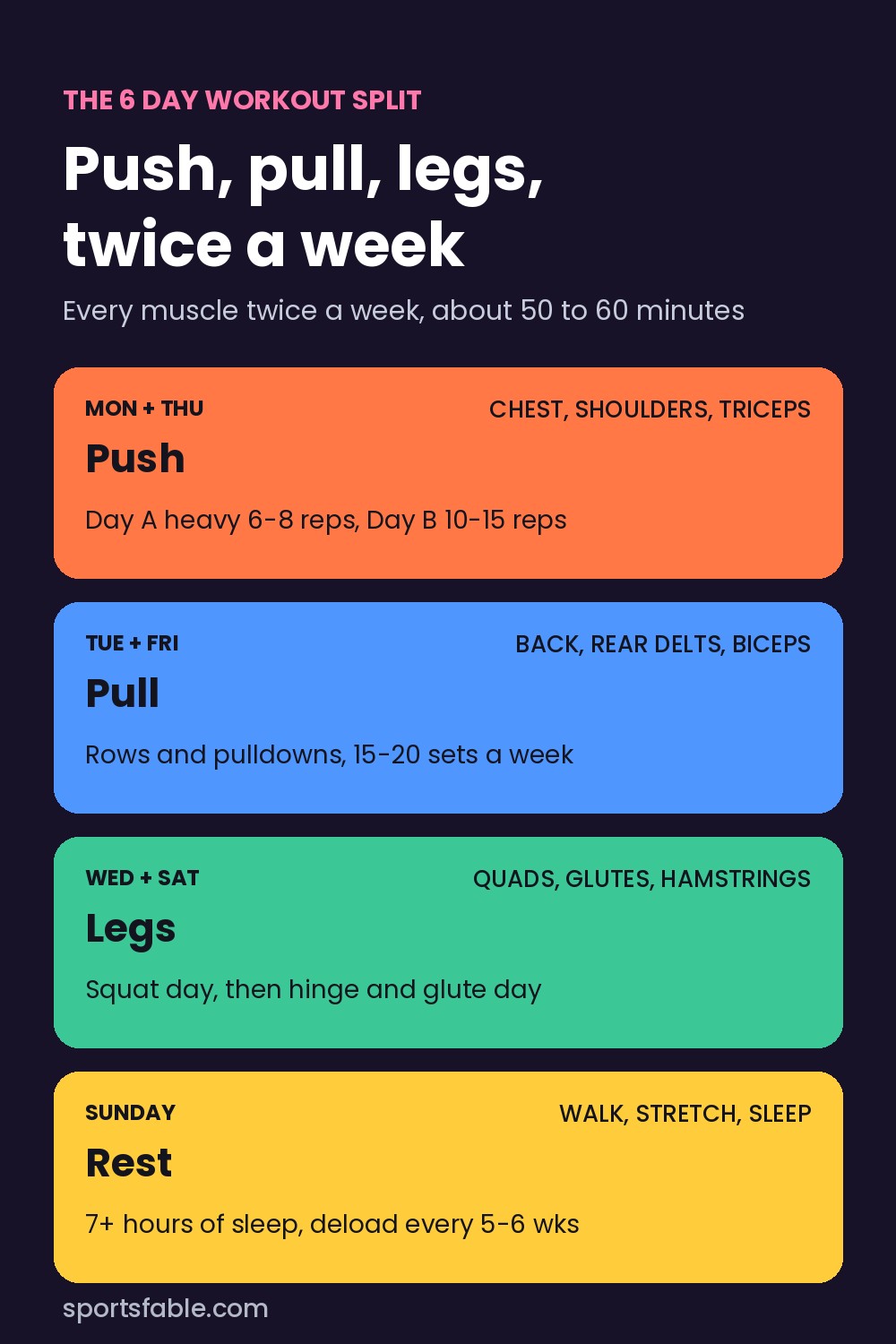
The full 6 day workout split
Rest 2 to 3 minutes on the big lifts and 60 to 90 seconds on the rest. Pick a weight that leaves 1 to 3 good reps in the tank on every set. Warm up with two lighter sets before the first exercise each day.
Day 1: Push A (strength focus)
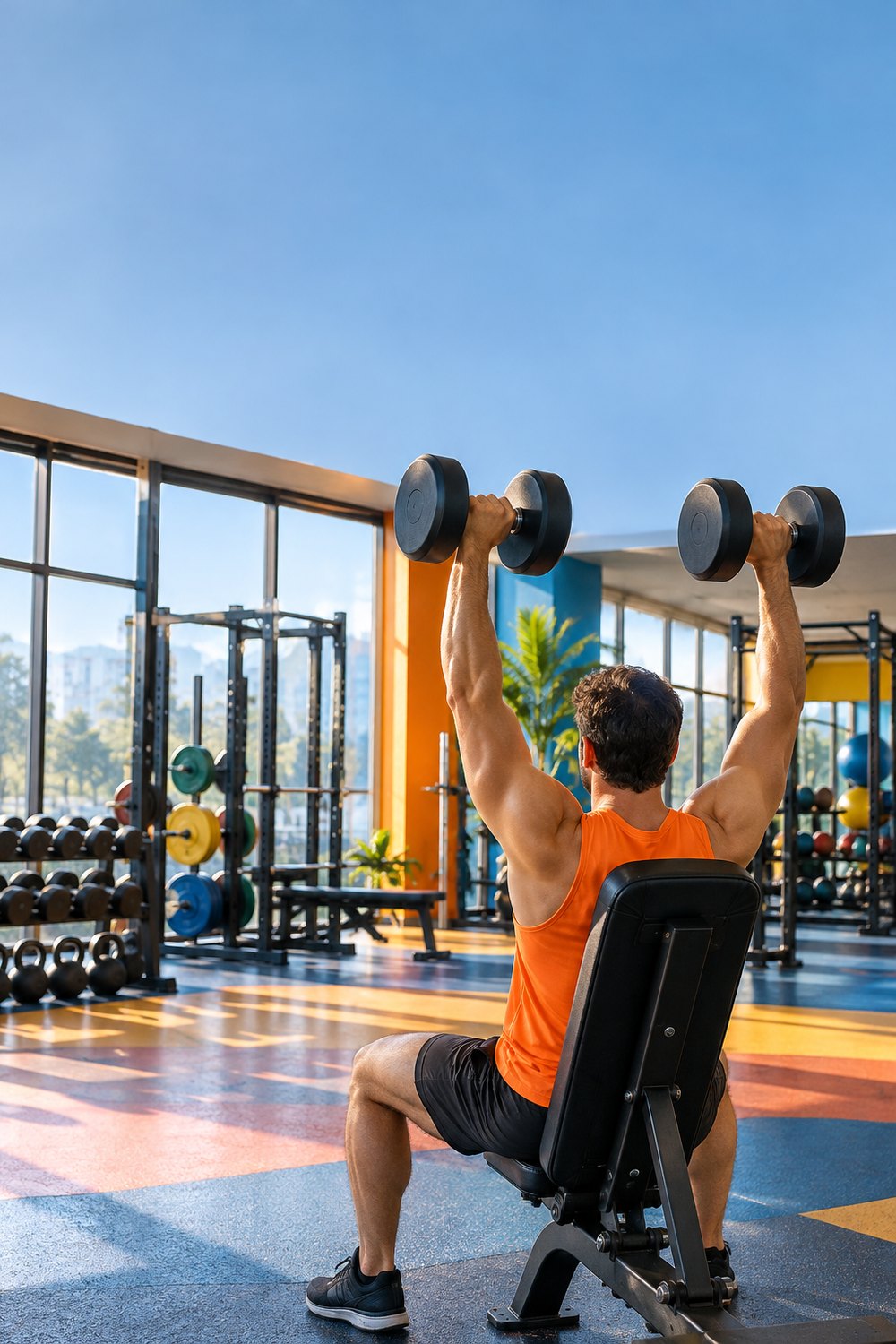
- Barbell or dumbbell bench press: 4 sets of 6 to 8
- Seated dumbbell shoulder press: 3 sets of 8 to 10
- Incline dumbbell press: 3 sets of 8 to 12
- Cable or dumbbell lateral raise: 3 sets of 12 to 15
- Rope triceps pushdown: 3 sets of 10 to 12
Day 2: Pull A (strength focus)
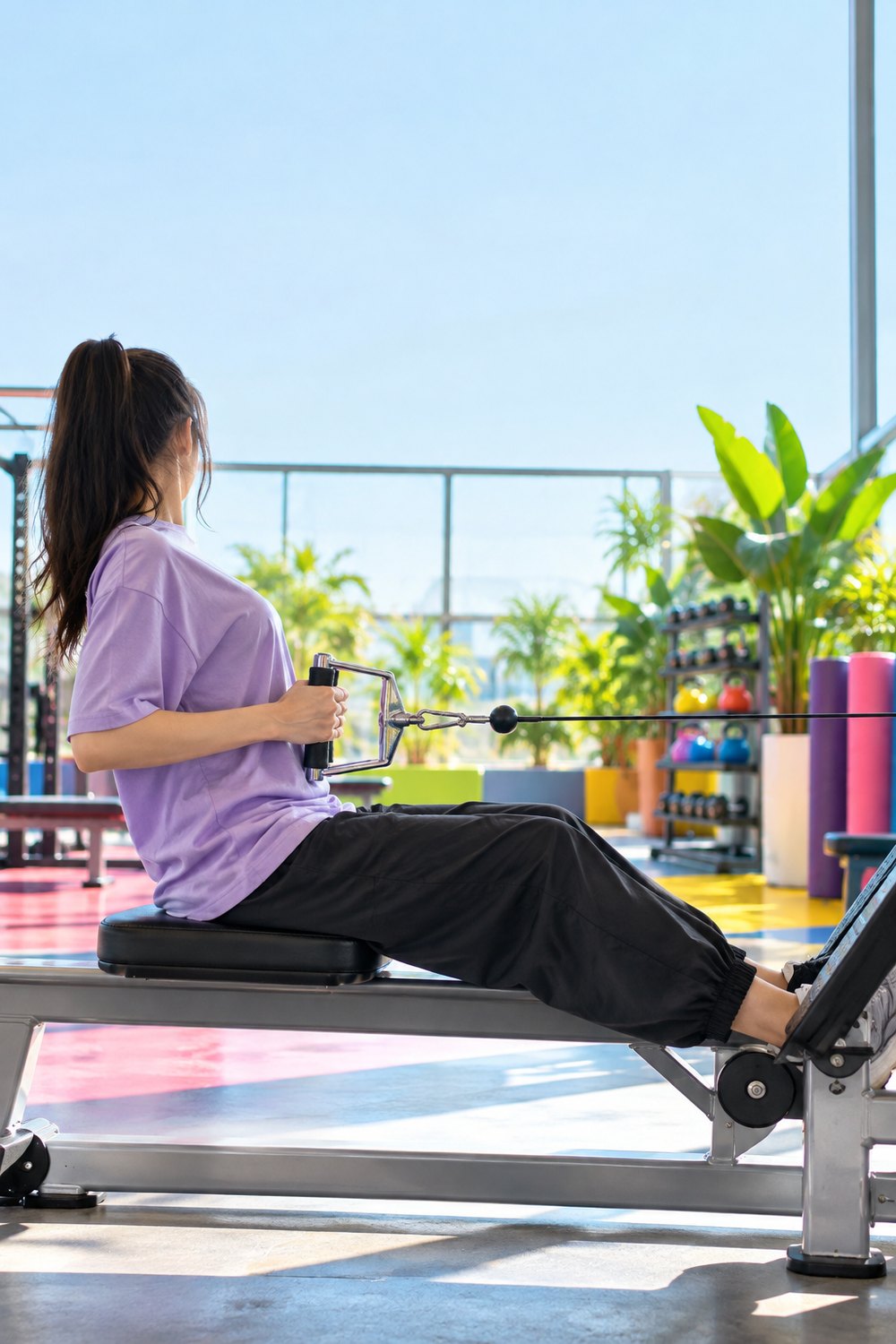
- Lat pulldown or pull-ups: 4 sets of 6 to 10
- Seated cable row: 3 sets of 8 to 10
- One-arm dumbbell row: 3 sets of 10 to 12 per side
- Face pull: 3 sets of 12 to 15
- Dumbbell curl: 3 sets of 10 to 12
Day 3: Legs A (quad focus)
- Back squat or goblet squat: 4 sets of 6 to 8
- Leg press: 3 sets of 10 to 12
- Walking lunge: 3 sets of 10 per leg
- Leg extension: 3 sets of 12 to 15
- Standing calf raise: 3 sets of 12 to 15
- Plank: 3 holds of 30 to 45 seconds
Day 4: Push B (volume focus)
- Incline barbell or dumbbell press: 4 sets of 8 to 10
- Machine or dumbbell chest press: 3 sets of 10 to 12
- Arnold press: 3 sets of 10 to 12
- Lateral raise: 3 sets of 15 to 20
- Overhead triceps extension: 3 sets of 12 to 15
Day 5: Pull B (volume focus)
- Chest-supported row: 4 sets of 8 to 10
- Wide-grip lat pulldown: 3 sets of 10 to 12
- Straight-arm cable pulldown: 3 sets of 12 to 15
- Reverse fly: 3 sets of 15
- Hammer curl: 3 sets of 10 to 12
Day 6: Legs B (glute and hamstring focus)
- Romanian deadlift: 4 sets of 6 to 8
- Hip thrust: 4 sets of 8 to 12
- Bulgarian split squat: 3 sets of 8 to 10 per leg
- Lying or seated leg curl: 3 sets of 10 to 12
- Seated calf raise: 3 sets of 15
- Hanging knee raise: 3 sets of 10 to 15
Day 7: Rest
Walk, stretch, sleep in. Rest day is part of the plan, not a reward for finishing it.
Versions for different goals
For women who want more glute focus
Swap Push B for a third lower-body day: hip thrusts, cable kickbacks, step-ups and a light leg curl. You’ll train upper body three times a week and lower body three times, which is the “3 leg days” setup a lot of women search for. Keep Legs A for quads so your knees and quads don’t fall behind. The 5-day workout split for women uses the same idea with one fewer session.
At home with dumbbells
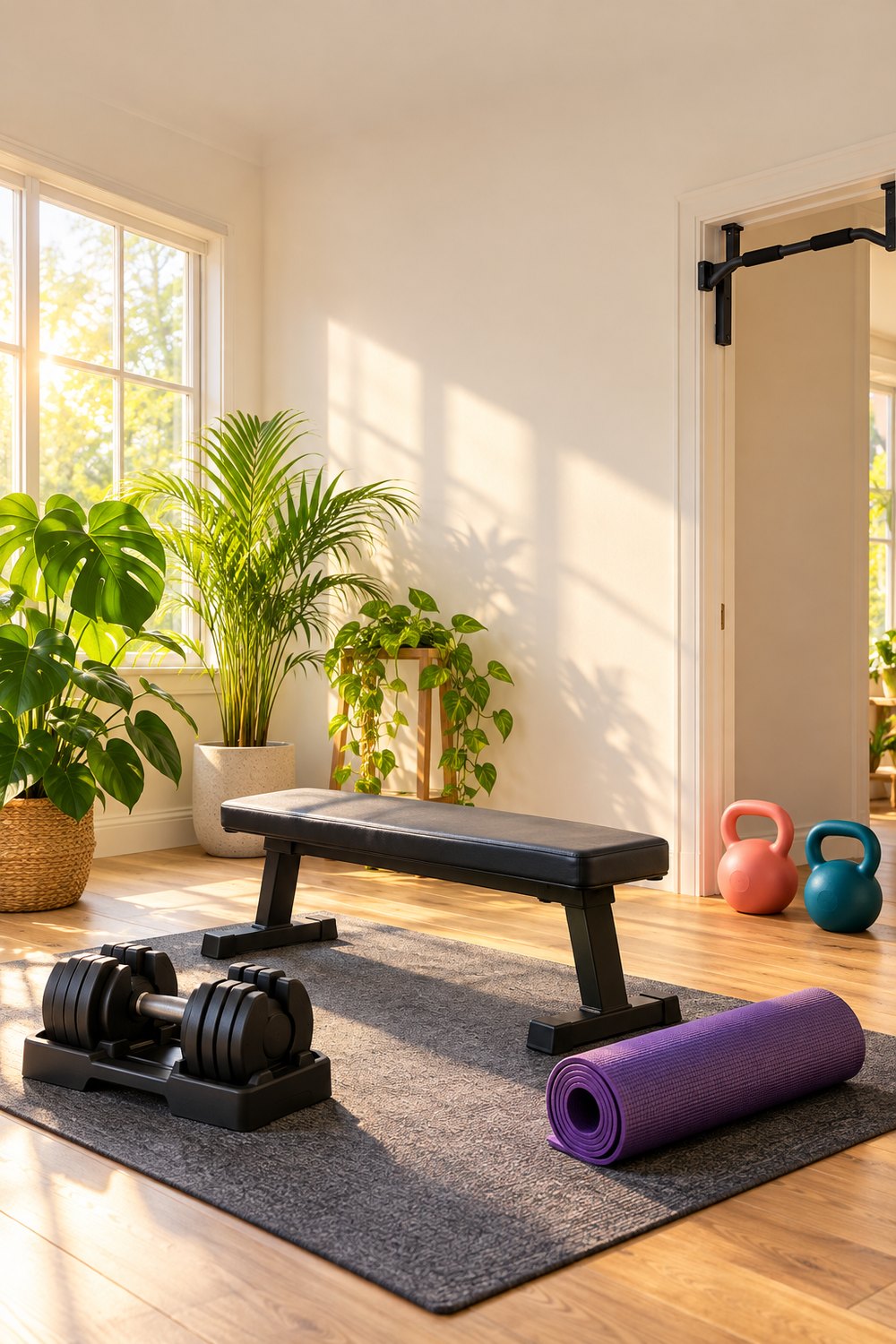
Adjustable dumbbells and a bench cover almost everything. Use floor or bench presses for push days, one-arm rows and pullovers for pull days, and goblet squats, split squats, dumbbell Romanian deadlifts and single-leg hip thrusts for legs. When the dumbbells get too light, slow the lowering phase to three seconds and add reps before you add sets.
Adding cardio
Put easy cardio after upper-body days or on the rest day as a walk. Keep hard intervals away from the day before a leg session. The CDC’s adult activity guidelines call for 150 minutes of moderate activity a week alongside muscle-strengthening work, and three 20-minute rides or brisk walks plus daily walking gets you most of the way.
How to progress without burning out
Use double progression. When you hit the top of the rep range on every set, add a small amount of weight next week and start again at the bottom. Log every session, because six days of training is too much to remember.
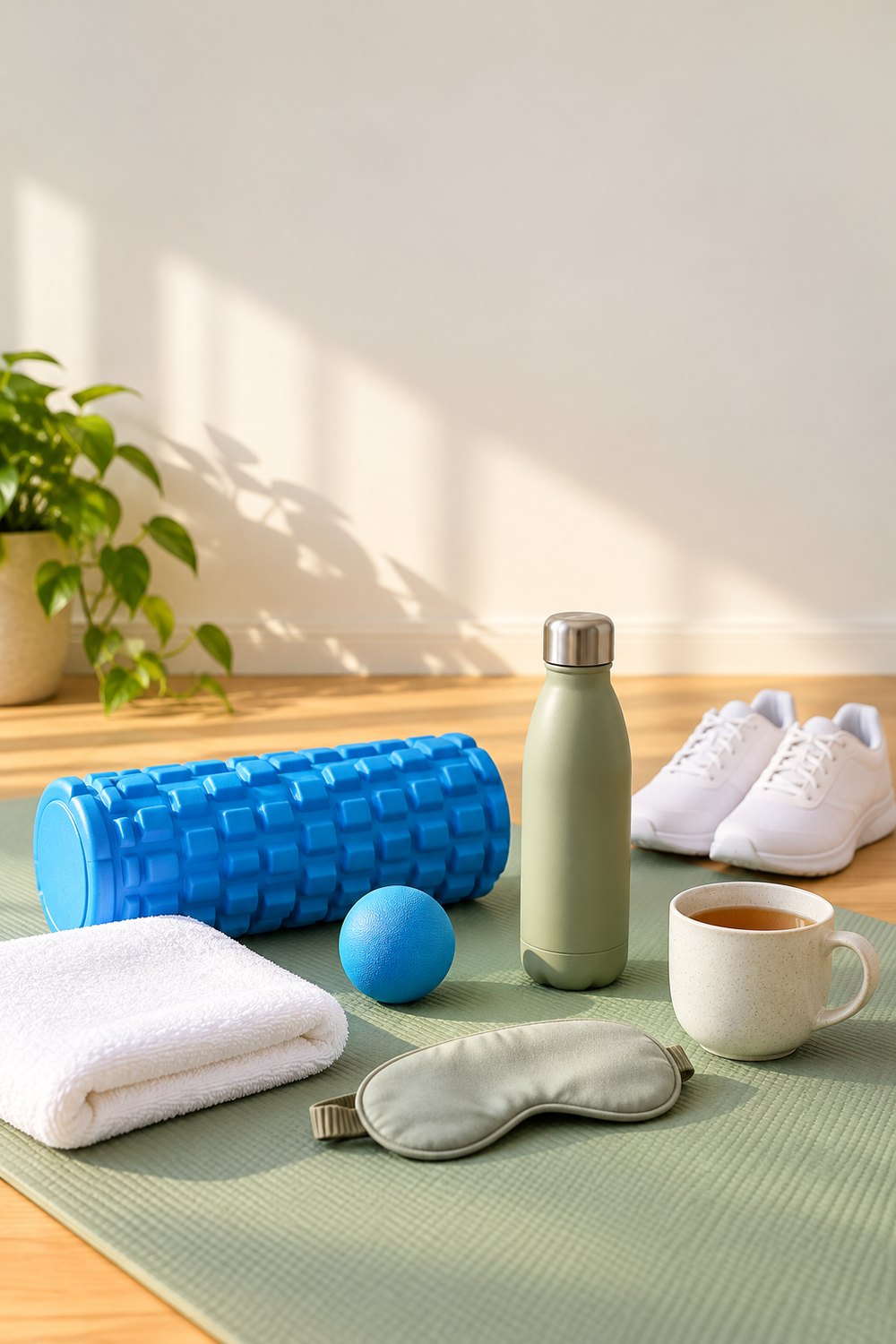
Recovery is the limiting factor on a plan like this. Adults need at least seven hours of sleep a night, and the CDC has reported that more than a third of American adults don’t regularly get it. If you’re in that third, a six-day split will show it fast. Every five or six weeks, take an easier week with about half the sets.
Signs the plan is too much right now:
- Your main lifts stall or go backward for two weeks running
- Joints ache in a way that doesn’t fade with a warm-up
- You dread most sessions instead of just some of them
- Sleep gets worse even though you’re tired
If you tick two of those, drop to five days or move to a four-day plan for a month. That’s not quitting. It’s managing the dose.
Keep building the plan
Not sure which structure fits? The push pull legs vs bro split comparison lays out the trade-offs, and the weekly workout plan template helps you map sessions around work. If you also run or want to, the hybrid athlete training plan shows how to combine the two, and the gym bag essentials list makes six trips a week less of a scramble.
Questions people ask
Is a 6 day workout split good for beginners?
Usually not. Beginners grow fine on three full-body days and recover better. Move to six days once you’ve trained consistently for at least six months and want more volume.
What’s the best 6 day workout split?
For most people, push pull legs twice a week. It trains every muscle twice, keeps sessions short and leaves one full rest day.
What does a 6 day split look like for women?
The same push pull legs plan works, or swap one push day for a third lower-body day if glutes are the priority. That gives three upper and three lower sessions.
Can I do a 6 day split at home with dumbbells?
Yes. Adjustable dumbbells and a bench cover every day of the plan. Use slower reps and higher rep ranges once the weights feel light.
Where does cardio fit in a 6 day split?
Easy cardio after upper-body days or as a walk on the rest day. Avoid hard intervals the day before legs.
Is a 6 day split good for muscle gain or body recomposition?
It can be, as long as you eat enough protein and sleep well. For recomposition, keep the lifting the same and adjust food slowly.
Can a workout split give me an hourglass shape?
Training can build your shoulders, back and glutes, which changes how your shape looks. It can’t change your bone structure or where your body stores fat, so judge progress by strength and how clothes fit.
This plan is general fitness information, not medical advice. If you have an injury or health condition, check with a qualified professional before starting a new program.
Images in this article are AI-generated illustrations and original graphics created by SportsFable. They show workout setup ideas, not real people, teams or events.
Related Post