
Most training plans don’t fail in week one. They fail on a Thursday in week three, when a five-day schedule meets a late meeting, a sick kid or a bad night of sleep, and one missed session turns into a missed week.
Four days is the number that survives that Thursday. It’s enough to train every major muscle twice a week, and it still leaves three days for rest, a long walk, a run or simply having a life. You give up a little: each session runs closer to an hour, and you can’t skip one without shuffling the week.
This 4 day workout split is an upper and lower plan you can run in a commercial gym, at home with dumbbells, or on the machines at a budget gym. It works the same for women and men, and there’s a glute-focused tweak further down if that’s your priority.
Why four days is the sweet spot
The research case for a 4-day split is simple. A 2016 meta-analysis in Sports Medicine led by Brad Schoenfeld found that training a muscle group at least twice per week produced better muscle growth than once a week when total volume was similar. An upper and lower split hits that number automatically: every muscle gets two sessions, with at least 48 hours between them.
It also clears the public health bar with room to spare. The CDC recommends muscle-strengthening activity on two or more days a week that works all major muscle groups, plus 150 minutes of moderate cardio. Four lifting days covers the first part twice over and leaves three open days for the second.
Here’s the honest cost. A three-day full body plan forgives a missed session. A four-day split asks you to show up on four specific days, and each session holds about 18 to 20 working sets. If you can only promise three days, the 3-day workout split for beginners will get you further.
The weekly schedule
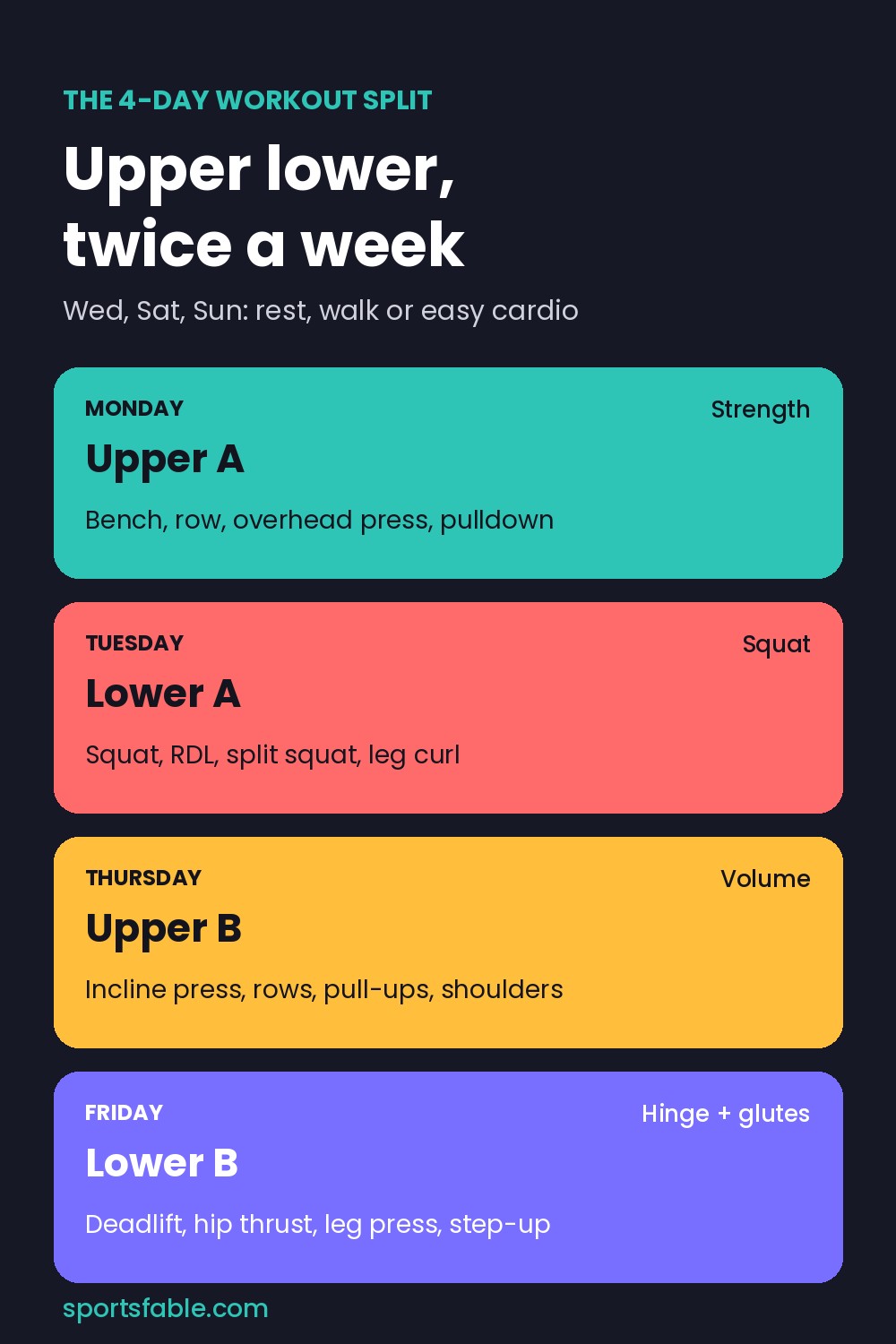
The classic layout is Monday, Tuesday, Thursday and Friday. Two days on, one off, two on, then the weekend free.
- Monday: Upper A (strength focus)
- Tuesday: Lower A (squat focus)
- Wednesday: Rest, walk or easy cardio
- Thursday: Upper B (volume focus)
- Friday: Lower B (hinge and glute focus)
- Saturday and Sunday: Rest, sport, a longer cardio session
Weekends work better for you? Run Monday, Wednesday, Friday and Saturday instead. The only rule is that the same session never lands on back-to-back days, so Upper A and Upper B need at least one day between them.
The four workouts
Rest 2 to 3 minutes on the first two lifts of each day and 60 to 90 seconds on the rest. Pick a weight that leaves 1 to 3 reps in the tank on every set. That’s close enough to failure to grow, and far enough away that you’ll recover by the next session.
Upper A: strength focus
- Bench press or dumbbell bench press: 3 sets of 6 to 10
- Barbell or chest-supported row: 3 sets of 6 to 10
- Standing overhead press: 3 sets of 8 to 10
- Lat pulldown: 3 sets of 10 to 12
- Dumbbell lateral raise: 2 sets of 12 to 15
- Biceps curl and triceps pushdown: 2 sets of 10 to 15 each

Lower A: squat focus
- Back squat, goblet squat or hack squat: 3 sets of 6 to 10
- Romanian deadlift: 3 sets of 8 to 10
- Bulgarian split squat: 2 sets of 10 per leg
- Seated or lying leg curl: 3 sets of 10 to 12
- Standing calf raise: 3 sets of 12 to 15
- Plank: 3 holds of 30 to 45 seconds

Upper B: volume focus
- Incline dumbbell press: 3 sets of 8 to 12
- One-arm dumbbell row: 3 sets of 10 to 12 per side
- Pull-up or assisted pull-up: 3 sets of 6 to 10
- Seated dumbbell shoulder press: 3 sets of 8 to 12
- Cable face pull: 2 sets of 15
- Hammer curl and overhead triceps extension: 2 sets of 10 to 12 each
Lower B: hinge and glute focus
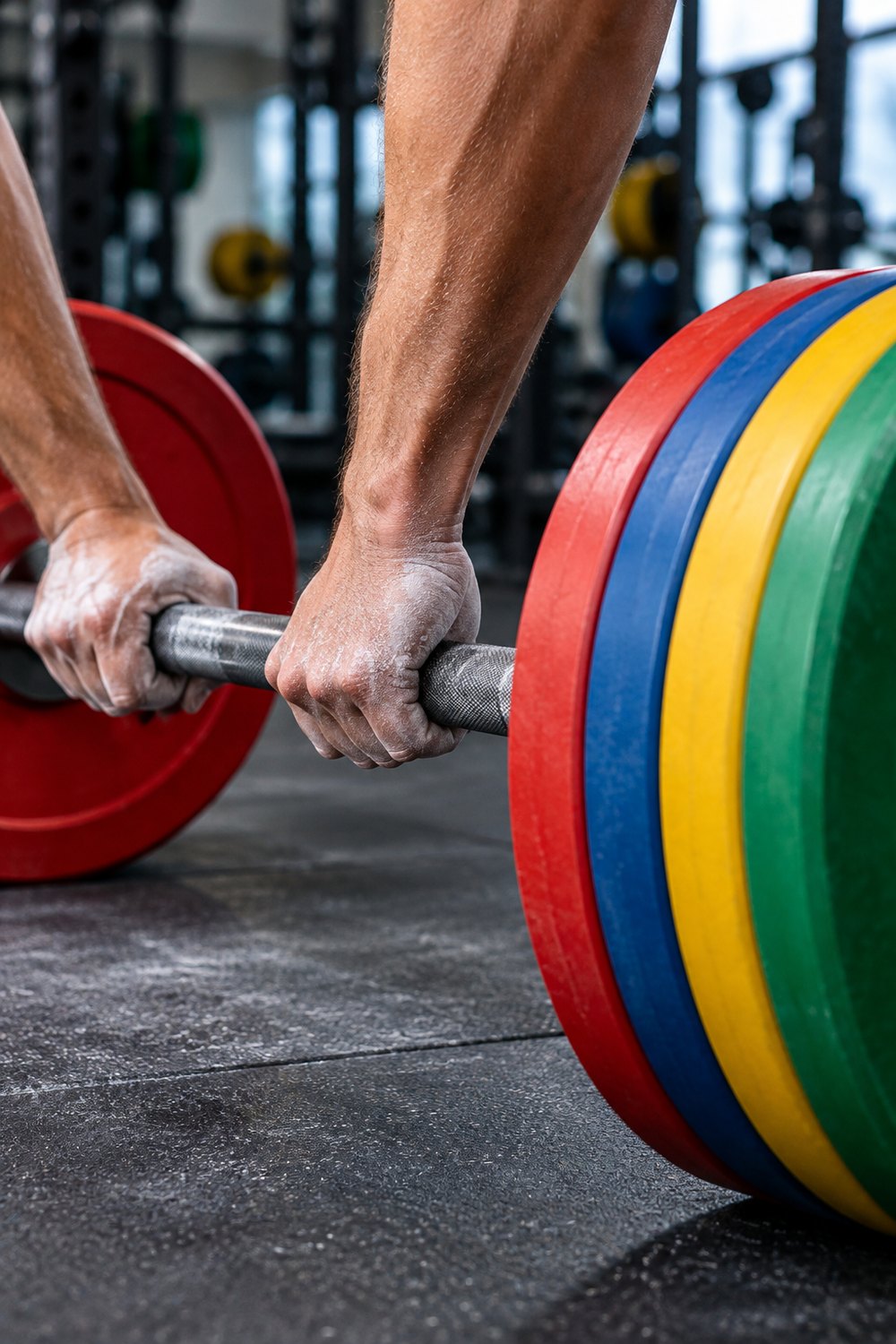
- Trap bar deadlift or conventional deadlift: 3 sets of 5 to 8
- Barbell or machine hip thrust: 3 sets of 8 to 12
- Leg press: 3 sets of 10 to 12
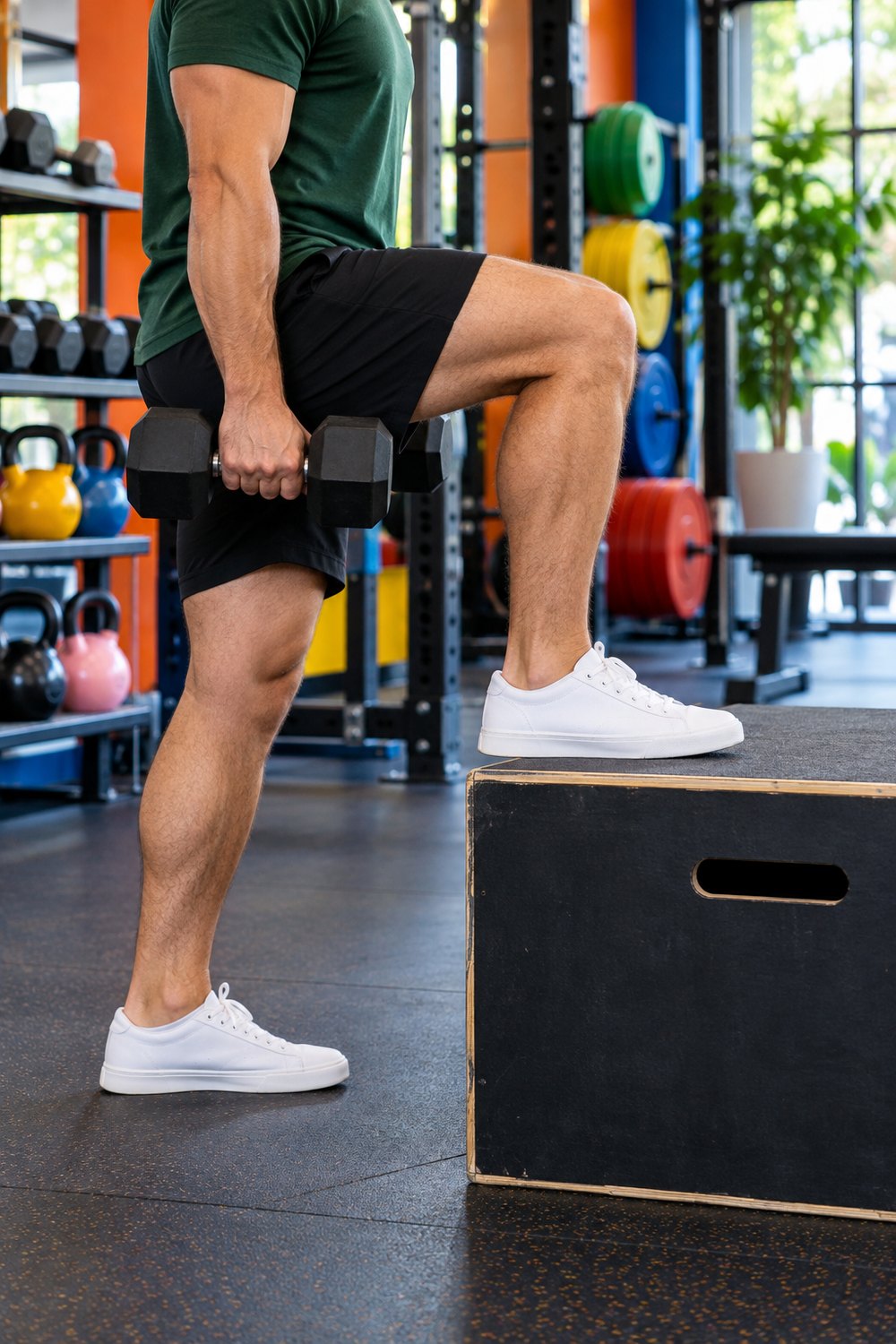
- Dumbbell step-up: 2 sets of 10 per leg
- Leg extension: 2 sets of 12 to 15
- Dead bug: 3 sets of 8 per side
How much volume, and how to progress
Across the week, this plan gives most major muscles 10 or more hard sets. That matters: Schoenfeld’s team also pooled the studies on weekly volume and found that 10 or more sets per muscle per week produced about 9.8% growth, against 5.4% for fewer than five sets. More isn’t always better, but under five sets a week is leaving results on the table.
Progress with the double progression method. Every lift has a rep range. Stay at the same weight until you hit the top of the range on every set, then add the smallest jump the gym allows (usually 2.5 kg or 5 lb on barbells, one dumbbell size up) and start again at the bottom of the range.
Run the plan for 8 to 12 weeks before changing exercises. Every fifth or sixth week, if your joints ache or the weights stall across the board, take a lighter week: same exercises, half the sets.
The dumbbell-only version
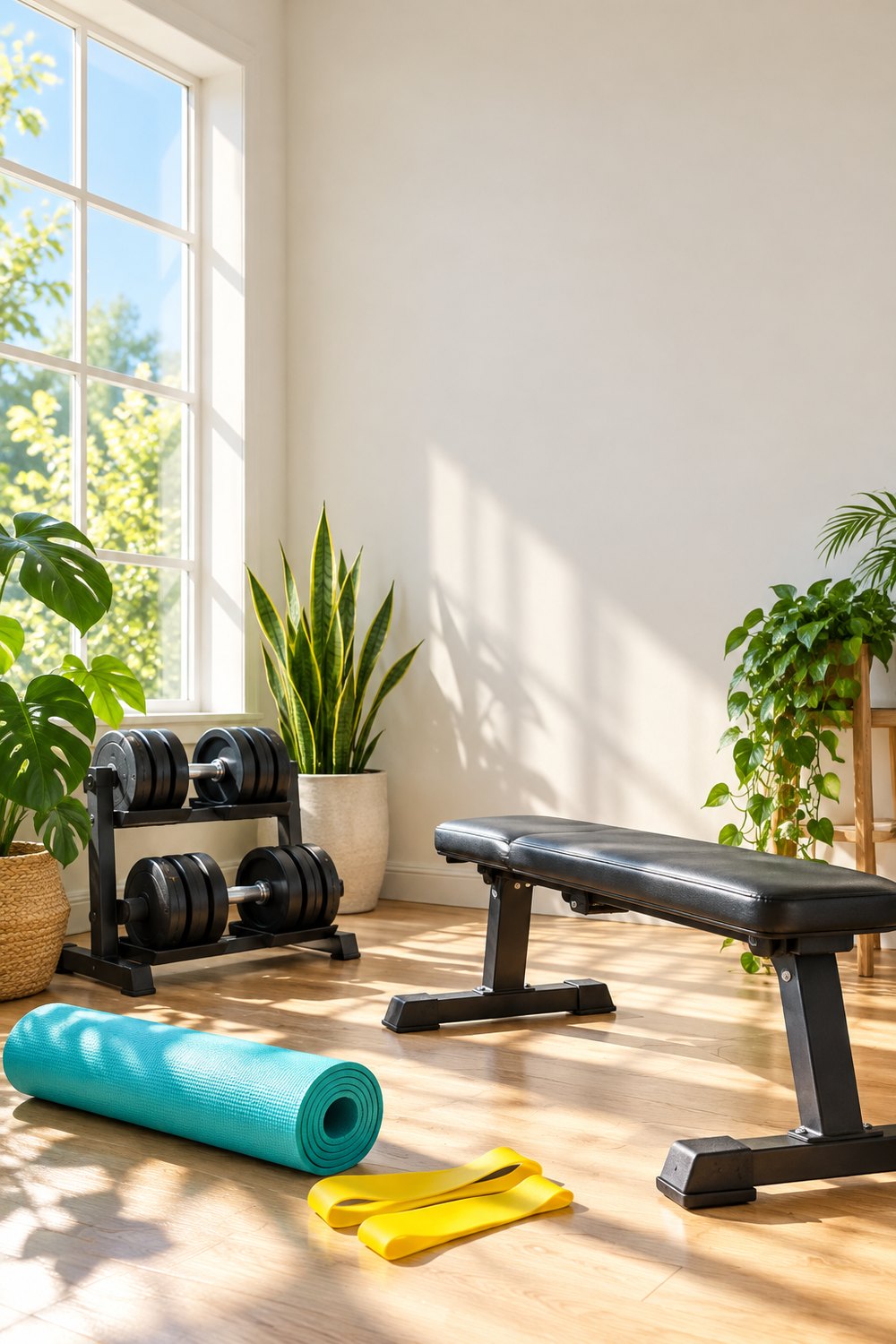
A pair of adjustable dumbbells and a bench covers almost the whole plan. Swap the barbell lifts like this:
- Bench press becomes dumbbell floor press or bench press
- Lat pulldown and pull-ups become a heavier one-arm row plus a band pulldown anchored on a door
- Back squat becomes a goblet squat with a 3-second lowering phase
- Deadlift becomes a dumbbell Romanian deadlift
- Hip thrust becomes a single-leg dumbbell hip thrust off the sofa or bench
- Leg curl becomes a slider or towel hamstring curl on a smooth floor
The catch with home dumbbells is the ceiling. Once a goblet squat for 12 reps feels easy at your heaviest dumbbell, slow the tempo, add a pause at the bottom or move to single-leg work before buying more weight.
The glute-focused version
Glute focused is the most searched tweak for women running a 4-day split, and it’s easy to build in without wrecking the balance of the plan. Keep both upper days exactly as written, then adjust the lower days:
- Lower A: add 2 sets of 12 to 20 cable kickbacks or banded side-lying abductions
- Lower B: move the hip thrust to first in the session and do 4 sets
- Both days: swap leg extensions for a second set of step-ups or reverse lunges
One honest note on the “hourglass” and “toning” pins. You can build your glutes, shoulders and back, which changes your shape. You can’t choose where you lose fat, and no exercise targets your waist. Muscle plus patient eating is the whole recipe.
Where cardio fits
Put cardio on the three off days, or right after the upper sessions. Brisk walking, cycling and swimming all count toward the CDC’s 150 minutes and won’t interfere much with your leg days. If you’re training for a race, keep the hard runs away from Lower A and Lower B, and read our hybrid athlete training plan for how to stack both.
Mistakes that stall a 4-day split
- Treating every set as a max. Grinding to failure on the first lift ruins the next five.
- Changing exercises every week. You can’t track progress on a lift you did once.
- Doubling up after a missed day. Skip the session and pick the schedule back up. Never stack two lower days.
- Ignoring the off days. Sleep and walking do more for your next session than an extra workout.
Your 4-day split checklist
- Four fixed training days, with the same session never on consecutive days
- 18 to 20 working sets per session, 1 to 3 reps in reserve
- Rep ranges written down, weight goes up only after you hit the top of the range
- A light week every fifth or sixth week, or when everything stalls
- Cardio on off days, 150 minutes across the week
- Water bottle, towel and a notebook or app in the bag
Keep building the plan
If you’re still deciding between splits, our push pull legs vs bro split comparison explains when six days beats four. Women who want five sessions with extra glute work can step up to the 5-day workout split for women. For the full-season view, the 12-week workout plan shows how to run blocks back to back, and our gym bag essentials checklist keeps four trips a week painless.
Want more volume once four days feels easy? The 6 day workout split runs push, pull and legs twice a week with one full rest day.
Questions people ask
Is a 4 day workout split good for beginners?
Yes, if you can reliably train four days. Start at the bottom of every rep range with light weights for the first two weeks while you learn the lifts. If four days feels like too much, a three-day full body plan builds the same habits with less pressure.
Is upper lower the best 4 day split?
For most people, yes. It trains every muscle twice a week, which the research favors, and it balances recovery better than a four-day bro split where each muscle only gets one session.
Should a 4 day workout split for women be different from one for men?
Not really. Muscle responds to the same training in both. The differences come from goals: many women add glute volume, many men add arm or chest volume. Use the glute-focused version or add two sets for whatever you want to bring up.
Can I do this split at Planet Fitness or with machines only?
Yes. Use the Smith machine for squats and presses, the leg press and hack squat for lower days, the chest press and seated row machines for upper days, and dumbbells for everything else. Machines are great for beginners because the path is fixed.
Will a 4 day split help with toning?
“Toning” is building some muscle while losing some fat. This plan handles the muscle side. The fat side comes from eating slightly below maintenance and keeping your daily steps up.
Can I add Pilates or cardio on the other days?
Yes. Pilates, easy runs, cycling and long walks all fit on the three off days. Just keep anything that leaves your legs sore away from the day before a lower session.
How long should each workout take?
About 50 to 70 minutes, including a 5-minute warm-up. If sessions drag past 75 minutes, shorten the rest on the last three exercises to 60 seconds.
Images in this article are AI-generated illustrations and original graphics created by SportsFable. They show workout setup ideas, not real people, teams or events.
Related Post