


You’re sitting on the bottom stair with one shoe on, pulling the laces tight on the other, and the dog is watching from the hallway like it knows something you don’t. The plan says run for one minute. You’re not totally sure you’ll make it to the end of the street, and you’re even less sure about the walk back.
That uncertainty is normal, and it’s exactly who a couch to 10K plan is written for. Not people who already jog on weekends, but people who haven’t run since school and want a real finish line: 6.2 miles, or about an hour of moving without stopping.
The cost first: this takes 14 weeks, three sessions a week, about 30 to 70 minutes each. That’s slower than most of what you’ll see online, and it’s on purpose. The plans that promise a 10K in 4 or 6 weeks from zero mostly produce sore shins and quitters.

How this couch to 10K plan works
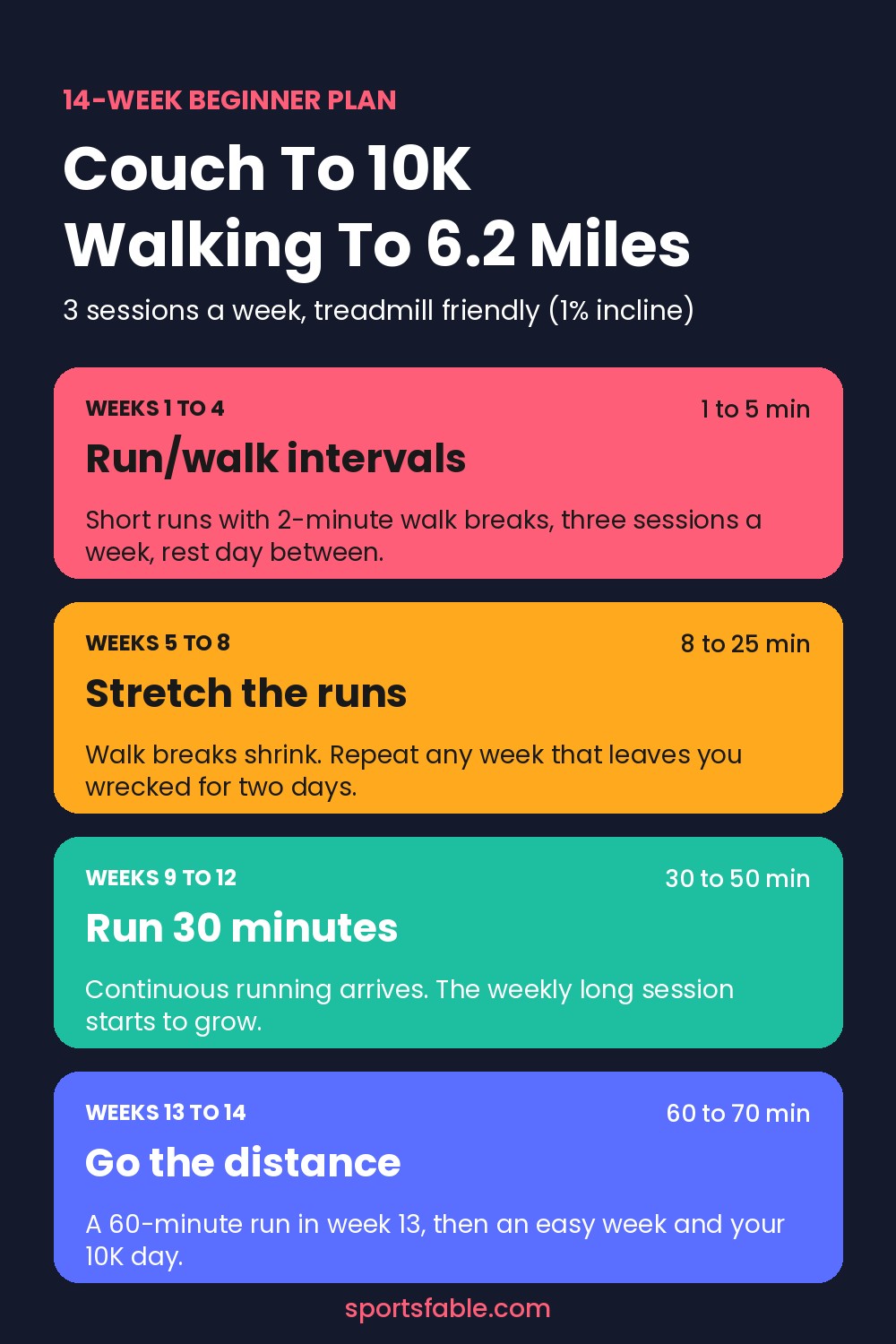
Every session starts with a 5-minute brisk walk and ends with a 5-minute easy walk. In between, you alternate running and walking, with the running slices growing each week until you can run 30 minutes straight around week 9. From there, the third session of each week (your “long” day) stretches toward 60 to 70 minutes, which is roughly what most beginners need to cover 10 km.
Run every other day: Monday, Wednesday, Saturday works well. The rest days are where your legs adapt, so don’t stack sessions back to back to “catch up”. And if you have a heart condition, are carrying an injury, or haven’t been active in years, a quick check with your doctor before week 1 is worth the appointment.
Already finished a couch to 5K schedule? Then you can skip ahead, and there’s a faster path further down.
The 14-week couch to 10K schedule
Times below are the main part of the session, not counting the warm-up and cool-down walks. “Run” means an easy, conversational jog, slow enough that you could talk in short sentences.
| Week | Session 1 | Session 2 | Session 3 (long) |
|---|---|---|---|
| 1 | Run 1 min, walk 2 min, x7 | Run 1 min, walk 2 min, x7 | Run 1 min, walk 2 min, x8 |
| 2 | Run 2 min, walk 2 min, x6 | Run 2 min, walk 2 min, x6 | Run 2 min, walk 2 min, x7 |
| 3 | Run 3 min, walk 2 min, x5 | Run 3 min, walk 2 min, x5 | Run 3 min, walk 2 min, x6 |
| 4 | Run 5 min, walk 2 min, x4 | Run 5 min, walk 2 min, x4 | Run 5 min, walk 2 min, x4 |
| 5 | Run 8 min, walk 2 min, x3 | Run 8 min, walk 2 min, x3 | Run 8 min, walk 2 min, x3 |
| 6 | Run 10 min, walk 2 min, x3 | Run 10 min, walk 2 min, x3 | Run 12 min, walk 2 min, x2 |
| 7 | Run 15 min, walk 2 min, x2 | Run 15 min, walk 2 min, x2 | Run 18 min, walk 2 min, run 10 min |
| 8 | Run 20 min, walk 2 min, run 5 min | Run 20 min, walk 2 min, run 8 min | Run 25 min, walk 2 min, run 5 min |
| 9 | Run 25 min | Run 28 min | Run 30 min |
| 10 | Run 30 min | Run 30 min | Run 35 min |
| 11 | Run 30 min | Run 35 min | Run 45 min |
| 12 | Run 35 min | Run 35 min | Run 50 min |
| 13 | Run 35 min | Run 40 min | Run 60 min |
| 14 | Run 30 min | Run 20 min | 10K: 60 to 70 min (walk breaks allowed) |
Week 14 is lighter on purpose. You want fresh legs for the 10K, whether that’s an organized race or your own route around the neighborhood.

The repeat-a-week rule
This is the rule that makes the whole plan work: if you couldn’t finish the final session of a week, or you finished it but felt wrecked for two days after, repeat that week. No guilt. Most people repeat at least one week, usually week 5 (the first 8-minute runs) or week 8, when the walk breaks almost disappear.
Repeating a week costs you 7 days. Pushing through and picking up shin splints can cost you 4 to 6 weeks. Those are the real numbers behind “listen to your body”, which most plans say without explaining. Soreness that fades in a day is fine; pain that sharpens during a run or lingers is a stop sign.
Pace: slower than you think
The single most common mistake on a couch to 10K program is running the jog intervals too fast. If you’re gasping at the end of a 3-minute run, slow down until it’s almost a shuffle. Speed comes later and mostly on its own. If you like numbers, a running pace chart will show you what a 60 to 70 minute 10K looks like per mile and per kilometer (roughly 9:40 to 11:15 per mile).

Doing it on a treadmill
Every session works on a treadmill, which is handy in the dark winter months. Set the incline to 1% to roughly match the effort of running outside, pick a speed you could hold while talking, and use the same speed for every run interval in a session. For walk breaks, drop to a brisk walking pace rather than stopping the belt.
One honest downside: treadmill running feels easier on the legs than pavement. If race day is outdoors, do at least one session a week outside from week 9 onward. For bored days, a few of these treadmill workouts can replace session 1 once you’re past week 10.
Why 4 or 6 weeks from zero is unrealistic
Here’s what other sites gloss over. Your breathing improves fast, often within 2 to 3 weeks, so you’ll feel like you could do more. Your shins, knees and Achilles tendons take much longer to toughen up. Plans that go from zero to 6.2 miles in 4 to 6 weeks let your lungs write checks your legs can’t cash.
If you only have 4 or 5 weeks before an event, the realistic option is a brisk walking plan with short jog intervals, then walk most of the 10K. That’s a real finish. An 8-week path only makes sense if you can already run 20 to 30 minutes.

The faster 10-week path
If you can already run 20 minutes without stopping (say you’ve finished a 5K plan), start at week 5. That makes this a 10-week plan, and you’ll reach the 60-minute session in week 13 like everyone else. If 30 minutes is already easy, start at week 9 and you’re looking at about 6 weeks, then move on to a proper 10K training plan if you want a time goal.

Sources worth reading
- CDC adult physical activity overview: 150 minutes of moderate activity a week (brisk walking counts), plus muscle strengthening on 2 days.
- Emory Healthcare’s running injury prevention tips: build distance gradually, run every other day as a beginner, and see a doctor for pain that lingers or worsens.
- American Academy of Orthopaedic Surgeons injury prevention tips: start slow, use supportive shoes and talk to your doctor before a new routine.
Before every session
- Shoes that fit and aren’t worn flat.
- Interval timer or app set for this week’s run/walk split.
- 5-minute brisk walk warm-up planned in.
- A route or treadmill setting (1% incline) picked in advance.
- A rest day between sessions.
- A note of how it felt, so you know whether to repeat the week.

Keep building the plan
If your old sneakers are older than your gym membership, start with how to choose running shoes before week 3. Add two short sessions a week from our strength training for runners guide to keep your knees and hips happy. And once the 10K is done, a half marathon training plan is the natural next finish line.
Also worth a look: a 10-minute stretching routine and a 6-week 5K training plan.
Questions people ask
Can a total beginner do 10K training?
Yes, that’s what this plan is for. Start at week 1 with 1-minute runs, repeat any week that feels too hard, and expect 14 to 16 weeks from the couch to 6.2 miles.
Can I do couch to 10K in 8 weeks?
Only if you can already run 20 to 30 minutes continuously. From zero, 8 weeks rushes the stage where your legs adapt. Start at week 5 or week 7 of the table if you have that base.
Is there a 10 or 12 week version?
Yes. Start at week 5 for a 10-week plan or week 3 for a 12-week plan. Both need some existing running: roughly 20 minutes for the 10-week path and comfortable 2-minute run intervals for the 12-week one.
Can I do this as a walking plan?
Absolutely. Swap every “run” for brisk walking and every “walk” for an easy stroll. A brisk-walking 10K takes most people around 90 minutes to 2 hours, so stretch the long sessions toward that by the end.
What about 4, 5 or 6 week plans?
From zero, they’re not realistic for running the whole 10K. With 4 to 6 weeks, train with brisk walking and short jog intervals, then run/walk the event without a time goal.
Does treadmill training count?
Yes. Use a 1% incline and keep the speed conversational. If your 10K is outdoors, mix in some outside runs from week 9 so your legs get used to pavement and hills.
Images in this article are AI-generated illustrations and original graphics created by SportsFable. They show training scenes, not real people, teams or events.
Related Post