


The medal from your first 5K is still hanging off the bathroom mirror when someone in the group chat sends a link to a fall 10K. “Same distance twice, basically,” they write. It isn’t, and you know it isn’t, but the part of you that finished that 5K is already reading the course map.
Here’s the honest version before you sign up. Doubling your distance takes about eight weeks of three runs a week, and by week seven you’ll be out the door for over an hour on a Saturday. Your legs will feel heavy on some days. Most runs will be slow on purpose, and slow is the part people quit over.
This 10k training plan is built for exactly that jump: from a comfortable 5K to a finished 10K in eight weeks, three runs a week, with optional cross-training on the days in between. There’s also a 6-week option if you already run 4 miles, and one small change that turns it into an intermediate plan if you want to get faster rather than just get there.

Who this plan is for and what you need first
This plan assumes you can already run 5K (3.1 miles) without stopping, or close to it, and that you’ve been running about three times a week for at least a month. If you’re not there yet, start with a couch to 5K schedule and come back.
Before week one, sort out three things:
- Shoes that fit and aren’t worn flat.
- Three fixed run days with a rest or cross-training day between them, such as Tuesday, Thursday and Saturday.
- A way to time your runs. A phone or basic watch is enough, because this plan runs on minutes, not pace.
The 8-week 5K to 10K plan
Every run is written in minutes. Run 1 and Run 2 are easy runs. The long run is the one that grows. Easy means conversational: you can say a full sentence without gasping. If you can’t, slow down, and walk for 30 to 60 seconds if you need to. The approximate miles assume an easy pace of around 11 to 12 minutes per mile, so yours may be a little more or less.
| Week | Run 1 (easy) | Run 2 (easy) | Long run | Weekly total |
|---|---|---|---|---|
| 1 | 25 min | 25 min | 35 min (about 3 mi) | 85 min |
| 2 | 25 min | 30 min | 40 min (about 3.5 mi) | 95 min |
| 3 | 30 min | 30 min | 45 min (about 4 mi) | 105 min |
| 4 (lighter) | 25 min | 25 min | 35 min (about 3 mi) | 85 min |
| 5 | 30 min | 35 min | 50 min (about 4.5 mi) | 115 min |
| 6 | 30 min | 35 min | 55 min (about 5 mi) | 120 min |
| 7 | 35 min | 35 min | 65 min (about 5.5 to 6 mi) | 135 min |
| 8 (race week) | 25 min | 20 min + 4 x 20 sec pickups | Race: 10K (6.2 mi) | Race day |
Week 4 is lighter on purpose. Week 8 is race week: two short runs to keep your legs awake, a rest day before the race, then the 10K itself. On the days between runs, you can rest, walk, cycle, swim, or do 20 to 30 minutes of strength work. None of that is required, and none of it should leave you sore for the next run.

How each week should feel
Weeks 1 to 3 should feel almost too easy. You’re adding a few minutes at a time, and that’s the point. Weeks 5 to 7 are the real work: the long run goes from 50 to 65 minutes, and the day after it you’ll probably feel it in your calves and hips. That’s normal. Sharp pain that changes how you run is not, and it’s a reason to rest.
The 6-week option if you already run 4 miles
If you can run 4 miles comfortably and you’ve done it a few times in the last month, you can skip the first two weeks of building. This version is written in miles because you probably already know your routes.
| Week | Run 1 (easy) | Run 2 (easy) | Long run | Weekly total |
|---|---|---|---|---|
| 1 | 3 mi | 3 mi | 4 mi | 10 mi |
| 2 | 3 mi | 3.5 mi | 4.5 mi | 11 mi |
| 3 | 3.5 mi | 3.5 mi | 5 mi | 12 mi |
| 4 (lighter) | 3 mi | 3 mi | 4 mi | 10 mi |
| 5 | 3.5 mi | 4 mi | 6 mi | 13.5 mi |
| 6 (race week) | 3 mi | 2 mi + 4 x 20 sec pickups | Race: 10K (6.2 mi) | Race day |
Week 4 drops back so your legs can absorb weeks 2 and 3. The 6-mile run in week 5 is your dress rehearsal: if you finish it at an easy effort, race day is just another 0.2 miles.

The intermediate tweak: one easy speed session
If you’ve run a 10K before and want to run it faster, keep the 8-week plan exactly as written but turn Run 2 into a speed session from week 3 to week 7. Nothing else changes. One quality session a week is enough at this level, and two is where tired legs start to pile up.
| Week | Run 2 becomes | Total time |
|---|---|---|
| 3 | 10 min easy, 4 x 2 min comfortably hard (2 min easy jog between), 8 min easy | about 32 min |
| 4 (lighter) | 10 min easy, 4 x 1 min comfortably hard (2 min easy between), 10 min easy | about 32 min |
| 5 | 10 min easy, 5 x 2 min comfortably hard (2 min easy between), 8 min easy | about 36 min |
| 6 | 10 min easy, 3 x 4 min comfortably hard (2 min easy between), 8 min easy | about 34 min |
| 7 | 10 min easy, 4 x 4 min comfortably hard (2 min easy between), 6 min easy | about 38 min |
“Comfortably hard” means you could say a few words but not hold a conversation. It is not a sprint. If the last rep is much slower than the first, start the next session a touch slower.

Where cross-training and strength fit
Cross-training is optional, but strength work is the one extra most runners skip and later wish they hadn’t. The Mayo Clinic’s strength training guide says two sessions a week of about 20 to 30 minutes each is enough to notice stronger muscles, and that a single set of 12 to 15 repetitions with the right weight can work for most people. For runners, that means squats, lunges, step-ups, calf raises, glute bridges and planks on two non-running days. Our strength training for runners routine fits straight into this plan.
For context, the CDC adult activity guidelines list 75 minutes a week of vigorous activity, such as jogging or running, plus at least 2 days of muscle strengthening. By week 5 of this plan you’re well past that running total, so the strength days are the part to protect.
If you want running to be one piece of a broader routine, our beginner hybrid athlete training plan shows how to balance runs and lifting across the same week.
The free printable includes the full 8-week grid with a checkbox and a notes line for every run, plus the 6-week option and the speed sessions on page 2.
Free printable
Printable 8-week 5K to 10K grid with checkboxes and notes, plus the 6-week option and speed sessions.
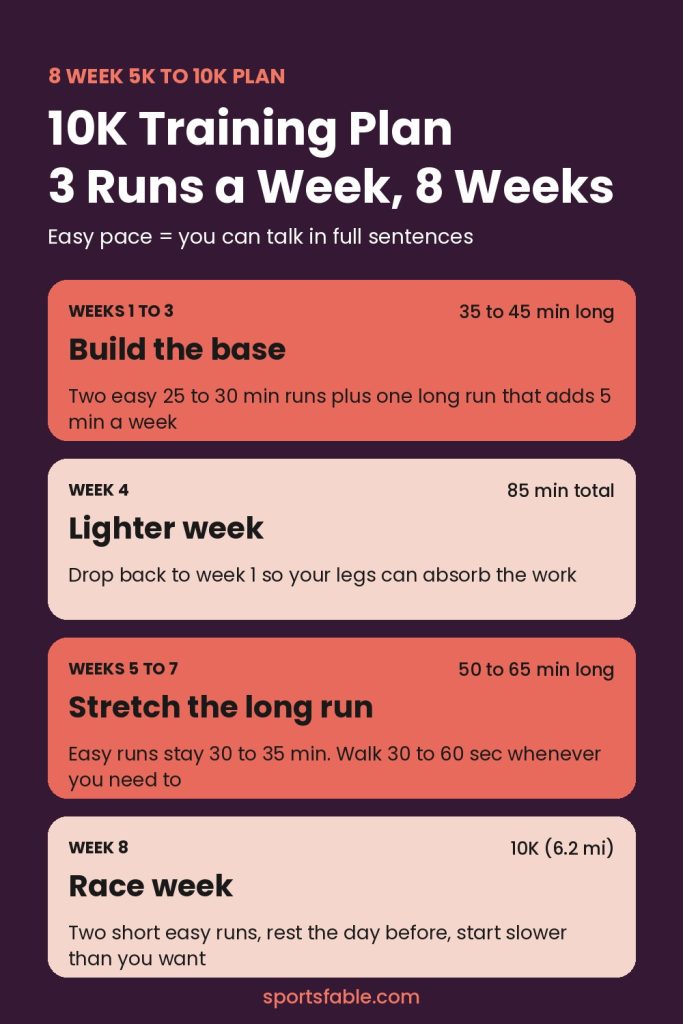
Download the free 8-week 10K plan (PDF)Save or pin this 8-week overview card so the plan is on your phone when you head out the door.
How to adjust it and the mistakes that cost people the race
You’ll read everywhere that you should never increase your weekly mileage by more than 10 percent. Here’s what other sites won’t tell you: the evidence for that exact number is thin. A 2018 systematic review on training load and running injuries found very limited evidence linking sudden changes in load to injury, and a randomized trial it covered found no difference in injuries between novice runners progressing about 10 percent and about 24 percent a week. That doesn’t mean anything goes. It means the 10 percent rule is a sensible guardrail, not a law, and how your body responds matters more than the math. This plan grows by roughly 10 to 15 percent most weeks with a lighter week in the middle.
The common mistakes:
- Running every run too fast. If your easy runs and long runs feel like races, you’ll arrive at week 6 cooked. Most of this plan should feel easy.
- Making up missed runs. Missed a Tuesday? Skip it. Don’t stack two runs on Wednesday. If you miss a full week, repeat the previous week before moving on.
- Skipping the lighter week. Week 4 isn’t wasted. It’s where your legs catch up.
- Trying new things on race day. New shoes, new breakfast, a new gel: test them on a long run first.
- Starting the race too fast. Run the first 2 miles a little slower than feels natural. You’ll pass people in the last 2.
If life gets in the way, stretch the plan rather than compress it. Squeezing two weeks into one is how a sore shin becomes a missed race.
Your pre-race checklist
- Long run of at least 60 minutes (or 6 miles on the 6-week option) done in the last 2 weeks
- Race shoes worn on at least three runs
- Race-morning breakfast tested before a long run
- Bib, safety pins and weather layers laid out the night before
- A plan to start slower than you want to
Keep going
Once the 10K is done, the half marathon training plan is the natural next step. Use the running pace chart to see what finish time your pace adds up to, try a few treadmill workouts for rainy weeks, log every session in the printable workout tracker, and check our guide on how to choose running shoes before your long runs pass the hour mark.
New training plans: the couch to 10K plan, a 6-week 5K training plan and our 18-week marathon training plan.
Questions people ask
Can you train for a 10K in 4 weeks?
Only if you’re already close. If you can run 5 miles or about 50 minutes at an easy pace, 4 weeks (about 1 month) is enough to get ready to finish. If you can only run a 5K today, four weeks is too short to build safely, and you’d be better off picking a later race or planning to walk parts of it.
Is 8 weeks enough to go from 5K to 10K?
Yes, for most people who can already run a 5K without stopping. Eight weeks, or about 2 months, gives you time to build the long run gradually and still have a lighter week and a race week. If you’re starting from a run/walk 5K, add 2 to 4 weeks.
How do I turn this into a 10, 12 or 16 week plan?
Repeat weeks rather than add new ones. For a 10 week plan, repeat weeks 3 and 6. For a 12 week plan, repeat weeks 1, 3, 5 and 6. A 16 week plan usually makes sense only if you’re starting from scratch, which means doing a couch to 5K first and then this plan.
Can beginners walk during a 10K plan?
Yes. Walk breaks are a tool, not a failure. A pattern like 9 minutes running and 1 minute walking works well on long runs, and plenty of people finish 10K races that way. Keep the total time the same as the plan says.
How long does couch to 10K take?
For a true beginner, expect about 16 to 17 weeks: roughly 8 to 9 weeks to reach a continuous 5K, then this 8-week plan.
What does a 60 minute 10K take?
A 60 minute 10K means averaging about 9:40 per mile (6:00 per kilometer). If your current easy pace is 11 minutes a mile, finish this plan first, then use the intermediate speed sessions on your next build.
If you have a medical condition, are pregnant, or are coming back from injury, check with a doctor before starting a new training plan.
Images in this article are AI-generated illustrations and original graphics created by SportsFable. They show training ideas, not real people or events. The printable is free for personal use.
Related Post