

The rain started on the walk to the gym, and by the time you’ve got your earbuds in, it’s coming down sideways. Your outdoor run is off. So you step onto the treadmill, stare at a console with thirty buttons, press Quick Start, and spend 25 minutes nudging the speed while the clock refuses to move.
That’s the real problem with the treadmill. It isn’t the machine, it’s the lack of a plan. These treadmill workouts fix that: ten original sessions, each written minute by minute with a speed, an incline and an effort note, so you never have to make a decision mid-stride.
The honest cost: a treadmill is more boring than a trail, and some of these sessions are hard. But a written plan turns 30 minutes of drifting into work you can repeat and track.

Who this is for and what you need
These sessions cover complete beginners walking their first 20 minutes all the way to runners who want a tempo run or a rainy day long run. If you’ve been inactive, start with workout 1 or 8 and stay there for two weeks. Mayo Clinic Health System’s guide to interval training suggests waiting at least two weeks after starting an exercise program before adding intervals, and swapping intervals in for your regular workout on two to three days a week.
You need a treadmill with an incline setting, shoes you can walk or run in (replace them if the soles are worn flat), water and a towel. That’s it.
How to read the speeds and effort notes
Every speed here is a starting point, not a test. The effort note is what matters. The CDC’s guide to measuring activity intensity lists brisk walking at 3 miles per hour or faster as moderate intensity, and describes the talk test: at moderate effort you can talk but not sing. If a listed speed feels harder than the note says, slow down. If it feels easier, add 0.2 mph next time.
The 10 treadmill workouts
Walking workouts for beginners
1. Beginner 20 minute walk. Your first week. Repeat it three times before changing anything.
| Minutes | Speed (mph) | Incline | Effort |
|---|---|---|---|
| 0 to 5 | 2.8 | 0% | Easy warm-up, could sing |
| 5 to 10 | 3.2 | 1% | Brisk, can talk |
| 10 to 15 | 3.4 | 2% | Brisk, short sentences |
| 15 to 18 | 3.2 | 1% | Brisk, can talk |
| 18 to 20 | 2.8 | 0% | Easy cool-down |
2. 30 minute incline walk. Same speed, rising hill. Hands off the rails. The speed barely changes, the hill does the work. If 8% makes you grab the handrails, cap it at 6% for now.
| Minutes | Speed (mph) | Incline | Effort |
|---|---|---|---|
| 0 to 5 | 3.0 | 1% | Easy warm-up |
| 5 to 10 | 3.2 | 4% | Moderate, can talk |
| 10 to 15 | 3.2 | 6% | Moderate, breathing deeper |
| 15 to 20 | 3.0 | 8% | Somewhat hard, short sentences |
| 20 to 25 | 3.0 | 6% | Moderate |
| 25 to 30 | 2.8 | 1% | Easy cool-down |

The glute-focused incline walk
Let’s be straight about the glute claims you’ve seen on Pinterest. Incline walking does change which muscles work hardest. A 2024 study in the International Journal of Exercise Science measured muscle activity during high-incline walking and found integrated activity rose in the gluteus maximus, the soleus and the lateral gastrocnemius (your calves), among others, and foot impact was lower than during low-incline jogging. What it doesn’t do is replace squats, hip thrusts or lunges if building muscle is the goal. Pair this walk with strength work, such as two or three short lower-body sessions a week.
7. Glute-focused incline walk. Slower speed, steeper hill, tall posture, push through the whole foot. Expect your calves to talk to you for the first week.
| Minutes | Speed (mph) | Incline | Effort |
|---|---|---|---|
| 0 to 5 | 3.0 | 2% | Easy warm-up |
| 5 to 10 | 2.8 | 8% | Moderate, can talk |
| 10 to 15 | 2.6 | 10% | Somewhat hard, short sentences |
| 15 to 20 | 2.8 | 6% | Moderate, recover |
| 20 to 25 | 2.6 | 10% | Somewhat hard |
| 25 to 30 | 2.8 | 8% | Moderate |
| 30 to 35 | 2.8 | 1% | Easy cool-down |
About the 12-3-30 incline walk
You’ve probably seen the 12-3-30 format online: 12% incline, 3 mph, 30 minutes, no breaks. It’s a popular community format, not something we invented, and it’s a genuinely tough walk. Don’t open with it. Start at 5 to 6% for 15 to 20 minutes, add 1% or 5 minutes a week, and only stay at 12% while you can walk tall without holding the rails. Tight calves or a sore Achilles mean you’ve jumped too quickly.

Quick sessions: 15 and 20 minutes
3. 15 minute quick session. For days you almost skipped. Walkers use the incline option. It won’t transform anything alone, but it keeps the habit alive.
| Minutes | Speed (mph) | Incline | Effort |
|---|---|---|---|
| 0 to 3 | 3.0 | 1% | Easy warm-up |
| 3 to 11 | 5.5 to 6.5 run or 3.5 walk at 8% | 1% or 8% | 4 rounds: 1 min hard, then 1 min at 3.2 mph, 1% |
| 11 to 13 | 4.5 jog or 3.4 walk | 1% or 4% | Moderate, steady |
| 13 to 15 | 2.8 | 0% | Easy cool-down |
4. 20 minute interval run. Classic 1:1 intervals. Use the quick-set speed buttons. Pick a fast speed you could hold for about two minutes if you had to, then run it for one.
| Minutes | Speed (mph) | Incline | Effort |
|---|---|---|---|
| 0 to 5 | 3.2 walk, then 5.0 jog | 1% | Easy, build gradually |
| 5 to 15 | 6.5 to 7.5 fast, then 3.5 walk | 1% | 5 rounds: 1 min hard (few words), 1 min easy |
| 15 to 17 | 5.0 | 1% | Easy jog |
| 17 to 20 | 3.0 | 0% | Easy cool-down walk |
Treadmill HIIT and the beginner run/walk
5. 30 minute HIIT. Short, sharp efforts with long recoveries. Twice a week at most. Never jump off a moving belt during recoveries. Let the belt slow down and walk it out. The 30-second efforts should feel very hard.
| Minutes | Speed (mph) | Incline | Effort |
|---|---|---|---|
| 0 to 6 | 3.2 walk, then 5.0 jog | 1% | Easy, build gradually |
| 6 to 24 | 7.0 to 8.5 fast, then 3.0 walk | 1% | 6 rounds: 30 sec very hard, 2 min 30 sec easy |
| 24 to 27 | 4.5 | 1% | Easy jog or brisk walk |
| 27 to 30 | 2.8 | 0% | Easy cool-down |
8. Beginner run/walk. Add 30 seconds to each jog every week you finish feeling good. This is the bridge from walking to running. When you can jog 3 minutes and walk 1, you’re ready for our couch to 5K schedule.
| Minutes | Speed (mph) | Incline | Effort |
|---|---|---|---|
| 0 to 5 | 3.2 | 1% | Brisk walk warm-up |
| 5 to 21 | 4.5 to 5.0 jog, then 3.3 walk | 1% | 4 rounds: 1 min jog, 3 min walk |
| 21 to 25 | 3.0 | 0% | Easy cool-down |
Running workouts: progression, tempo and long run
6. 45 minute progression. Start slower than you think. Finish faster than you started. Each block is only 0.3 mph quicker, so the final push feels earned.
| Minutes | Speed (mph) | Incline | Effort |
|---|---|---|---|
| 0 to 5 | 3.2 | 1% | Easy walk |
| 5 to 15 | 5.0 | 1% | Easy jog, full sentences |
| 15 to 25 | 5.3 | 1% | Easy to moderate |
| 25 to 35 | 5.6 | 1% | Moderate, can talk |
| 35 to 40 | 6.0 | 1% | Comfortably hard, short sentences |
| 40 to 45 | 3.0 | 0% | Easy cool-down walk |
9. Tempo run. For runners who can already jog 30 minutes without stopping. Tempo effort means comfortably hard: you could speak a few words but wouldn’t want to chat. To turn mph into minutes per mile, check our running pace chart.
| Minutes | Speed (mph) | Incline | Effort |
|---|---|---|---|
| 0 to 3 | 3.5 | 1% | Brisk walk |
| 3 to 10 | 5.0 to 5.5 | 1% | Easy jog |
| 10 to 30 | 6.0 to 7.0 | 1% | Comfortably hard, a few words at a time |
| 30 to 35 | 3.0 to 4.5 | 0% | Easy jog into a walk |
10. Rainy day long run. Your outdoor long run, moved inside. Easy effort the whole way. Anywhere from 50 to 75 minutes works. The short 3% blocks break the monotony. Following a race plan? Swap it in for your weekend run when the weather turns.
| Minutes | Speed (mph) | Incline | Effort |
|---|---|---|---|
| 0 to 5 | 3.2 | 1% | Brisk walk |
| 5 to 15 | 5.0 | 1% | Easy jog, full sentences |
| 15 to 30 | 5.2 | 1% | Easy, conversational |
| 30 to 45 | 5.2 | 1% (3% for 1 min every 5) | Easy, rolling hills |
| 45 to 55 | 5.4 | 1% | Easy to moderate |
| 55 to 60 | 3.0 | 0% | Easy cool-down walk |

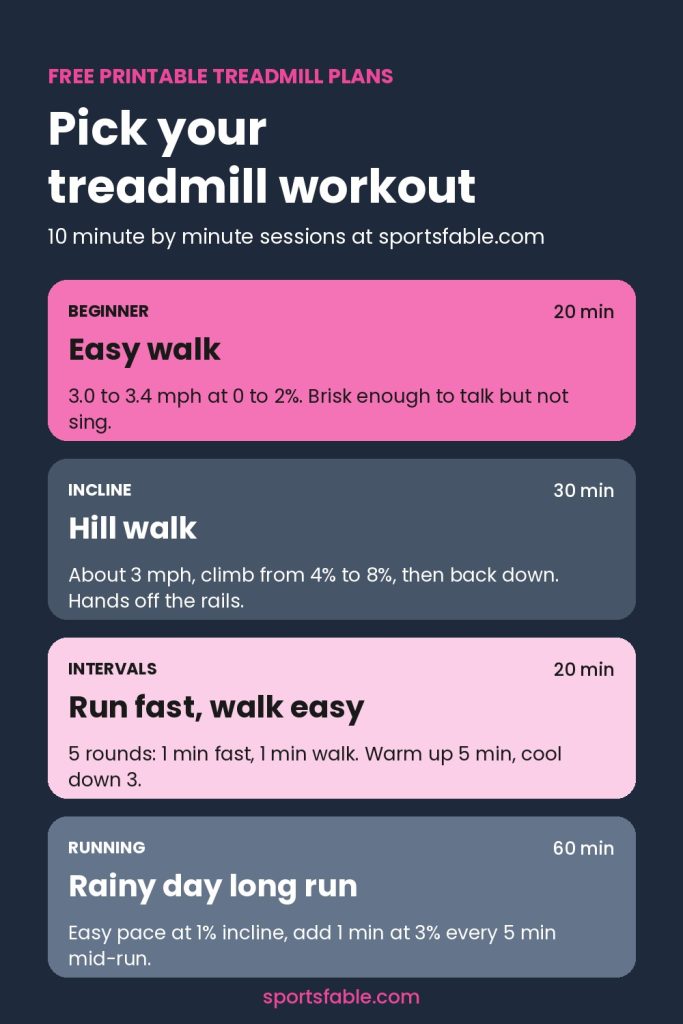
The printable puts all ten workouts on cards, each with the minute-by-minute table and a line to log the date and how it felt.
Free printable
All 10 treadmill workouts as printable cards with minute-by-minute speed, incline, effort and a log line.
Download the 10 treadmill workout cards (PDF)Want the short version? Save or pin this card and pull it up before your next session.
How to adjust it and common mistakes
To make any session harder, change one thing at a time: add 0.2 to 0.5 mph, add 1 to 2% incline, or add 5 minutes. Never all three in the same week. To make it easier, drop the incline first, then the speed.
- Holding the handrails on inclines. It takes load off your legs. If you need the rails, lower the incline.
- Making every session hard. Intervals and HIIT belong on two or three days a week at most, which lines up with Mayo Clinic Health System’s advice. Walks and easy runs fill the rest.
- Skipping the cool-down. Every workout ends with a slower walk. Keep it.
- Never progressing. Log each session. If the same workout felt easy three times in a row, move up a level.
If you’re building a full week around these, the beginner hybrid athlete training plan shows how to fit treadmill cardio next to lifting days without burning out.
Quick checklist
- Water and a towel within reach
- Safety clip attached, if your treadmill has one
- Workout card printed or saved on your phone
- Speed and incline buttons tested before the first hard block
- Hands off the rails on incline sections
- Date and effort logged after you finish
Keep going
Track every session in our printable workout tracker, train outdoors with the 10K training plan, add strength training for runners twice a week, build toward a race with the half marathon training plan, or set up a treadmill corner with our small home gym ideas.
New training plans: the couch to 10K plan and a 6-week 5K training plan.
Questions people ask
What is the best treadmill workout for beginners?
Start with the beginner 20 minute walk three times a week, then move to the beginner run/walk or the 30 minute incline walk. If you can talk but not sing, you’re working at the right level.
Is a 30 minute incline walk a good cardio workout?
Yes, for most people it’s solid moderate cardio with less pounding than running. The 30 minute incline walk above builds from 4% to 8% at about 3 mph. Raise the incline gradually rather than jumping straight to 12%.
Does incline walking work your glutes?
One 2024 study found muscle activity in the glutes and calves rose during high-incline walking. It isn’t the same as lifting, so pair the glute-focused incline walk with squats, lunges or hip thrusts.
What is a good 20 minute treadmill HIIT or interval workout?
Try the 20 minute interval run: a 5-minute warm-up, five rounds of 1 minute fast and 1 minute easy, then an easy jog and walk. Walkers can swap the fast running for 1 minute at 8% incline.
How should I build a treadmill workout plan for the week?
Pick two harder sessions (intervals, HIIT or tempo), two or three easy walks or runs, and one longer session. Keep an easy day between hard ones.
What should I put on a treadmill playlist?
Save calmer songs for warm-ups and easy runs and your most energetic tracks for the hard blocks. A playlist that roughly matches each block’s length makes a 45-minute session pass faster.
If you have a medical condition, are pregnant, or are coming back from injury, check with a doctor before starting a new training plan.
Images in this article are AI-generated illustrations and original graphics created by SportsFable. They show training ideas, not real people or events. The printable is free for personal use.
Related Post