

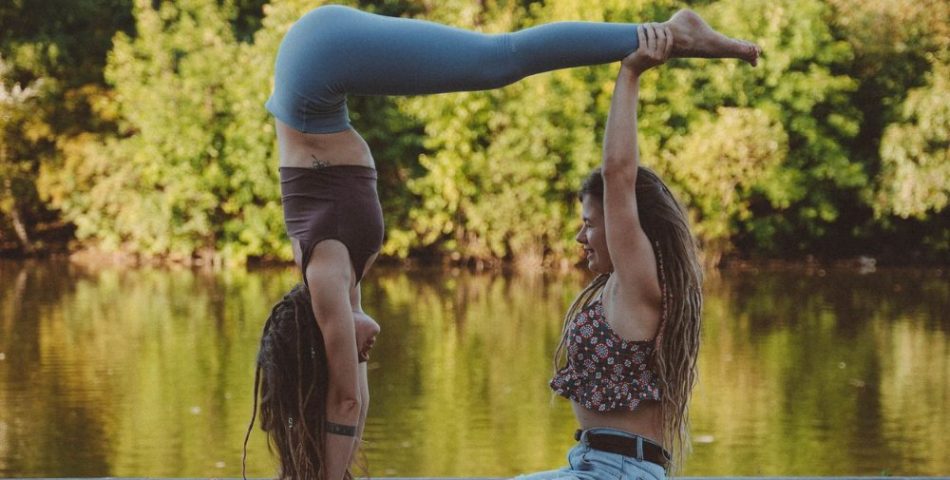
Two friends sit facing each other on a living room rug, knees bent, toes pressed together, hands gripped tight. On three, they lean back and try to straighten their legs into a double boat. For about two seconds it works, and then the toes start wobbling and they both roll sideways into the couch, laughing too hard to hold anything.
They try again anyway. That’s the whole charm of 2 person yoga poses: you can’t fake them alone, and the wobble is half the fun. You need your partner to lean when you lean, breathe when you breathe, and tell you the truth when a knee feels funny.
This guide covers 14 partner poses (plus a bonus breathing pose for couples), from simple and easy to hard challenge moves, with holds, cues, and the safety rules that keep a laughing fit from turning into a sore wrist. There’s a free printable set of challenge cards near the end, too.
Quick answer
Start with easy 2 person yoga poses like back-to-back breathing, a seated twist, a partner forward fold, and double tree, holding each for about 5 slow breaths. Warm up for 5 to 10 minutes first, work on a soft surface, and save hard moves like double plank, front plane, and a spotted handstand for when a third person can spot.
Before you start: warm-up, spotting, and trust rules
Partner yoga feels gentle, but you’re adding someone else’s weight and timing to your balance. A few minutes of setup pays off.
Mayo Clinic suggests warming up with light walking, jogging, or biking for 5 to 10 minutes, and it’s clear that stretching itself isn’t a warm-up. Its guide to stretching safely without bouncing also says you should feel tension, not pain.
A 5 to 10 minute warm-up for two
- March in place or walk around the room together for 2 to 3 minutes.
- Do 10 arm circles forward and 10 back, then roll your shoulders.
- Get on hands and knees for 5 slow rounds of cat and cow.
- Circle your wrists 10 times each way, since planks and handstands load them hard.
- Finish with 8 easy bodyweight squats and a few hip circles.
Trust rules that keep it fun
Pick one stop word, like “down,” and agree that either person can say it at any time with zero debate. When you hear it, you both come out slowly, together. Nobody drops anybody.
Talk through each pose before you try it: who leans, who holds, and how you’ll exit. Grip forearms or wrists rather than fingertips, because fingers slip the moment you start laughing. And you will start laughing.
Use a soft, non-slip surface such as two yoga mats, carpet, or flat grass, and add a third person as a spotter for any pose where someone’s feet leave the floor. Stop right away if either of you feels sharp pain, numbness, or dizziness. Talk to a doctor or physical therapist if it doesn’t settle.
Easy 2 person yoga poses for beginners
These four are simple enough for a first session and steady enough for a tired pair. For most beginners, about 5 slow breaths (roughly 30 seconds) per pose is plenty. Do both sides of anything that twists or balances on one leg.
| Pose | How to do it | Beginner hold |
|---|---|---|
| Back-to-back breathing | Sit cross-legged, spines touching, and match your inhales and exhales | 5 breaths |
| Seated twist | Back to back, both twist right, right hand on your partner’s left knee | 5 breaths per side |
| Partner forward fold | Sit facing in a wide V, feet touching, hold forearms; one leans back as the other folds | 5 breaths each |
| Double tree | Stand side by side, inside palms pressed overhead, outside foot on calf or thigh | 5 breaths per side |
Back-to-back breathing
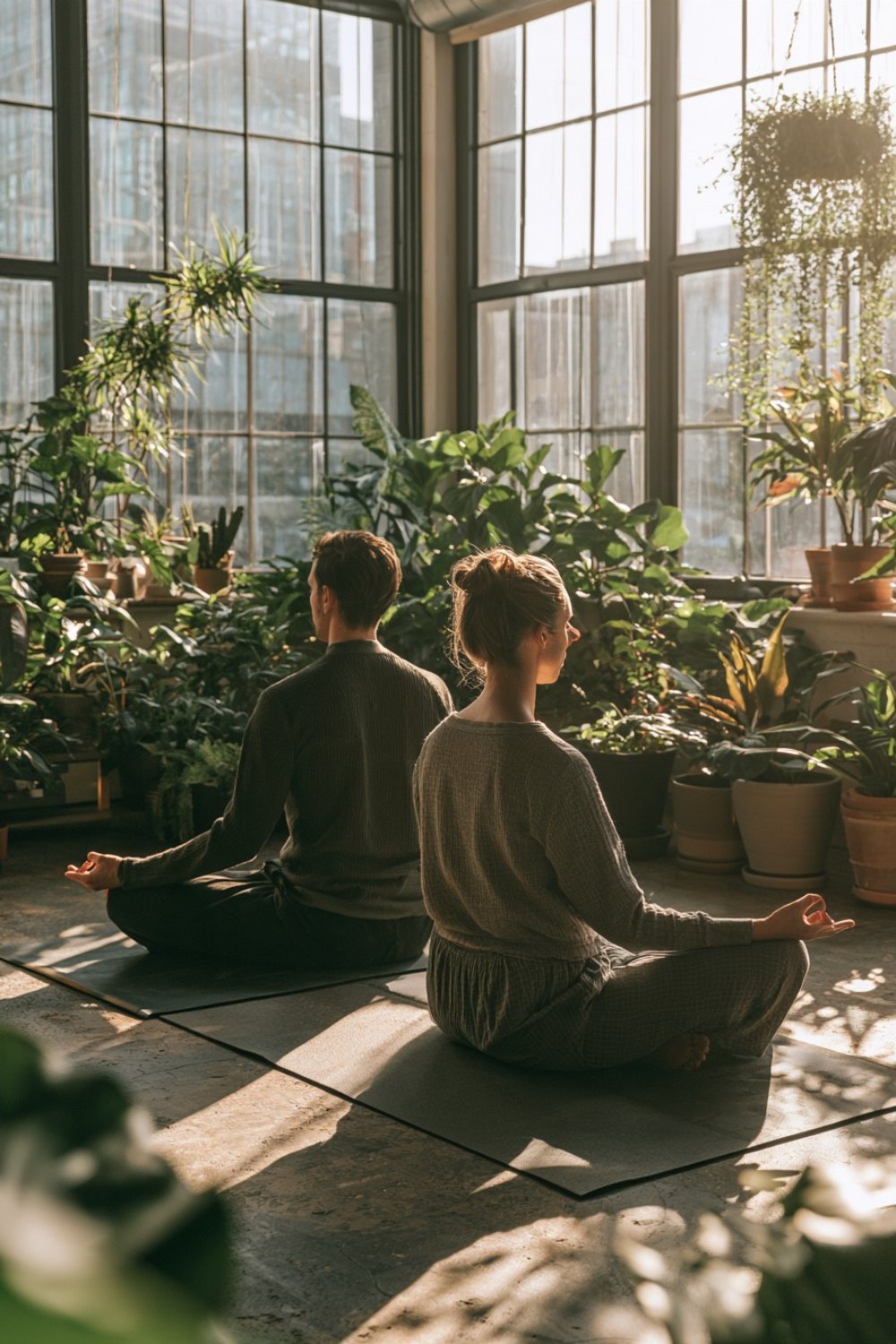
Sit tall, backs touching, eyes closed, and notice your partner’s breath against your back. After a few rounds, try to sync up. It sounds too simple to count, but it sets the tone.
Seated twist
Stay back to back and sit taller as you both inhale. As you exhale, twist right, with your right hand on your partner’s left knee and your left hand on your own right knee. Twist from the ribs, not by cranking the neck, then switch.
Partner forward fold
Sit facing each other with legs in a wide V and the soles of your feet touching (bend your knees if your hamstrings are tight). Hold forearms. One person leans back slowly while the other folds forward from the hips, then you trade, like a slow seesaw.
Double tree
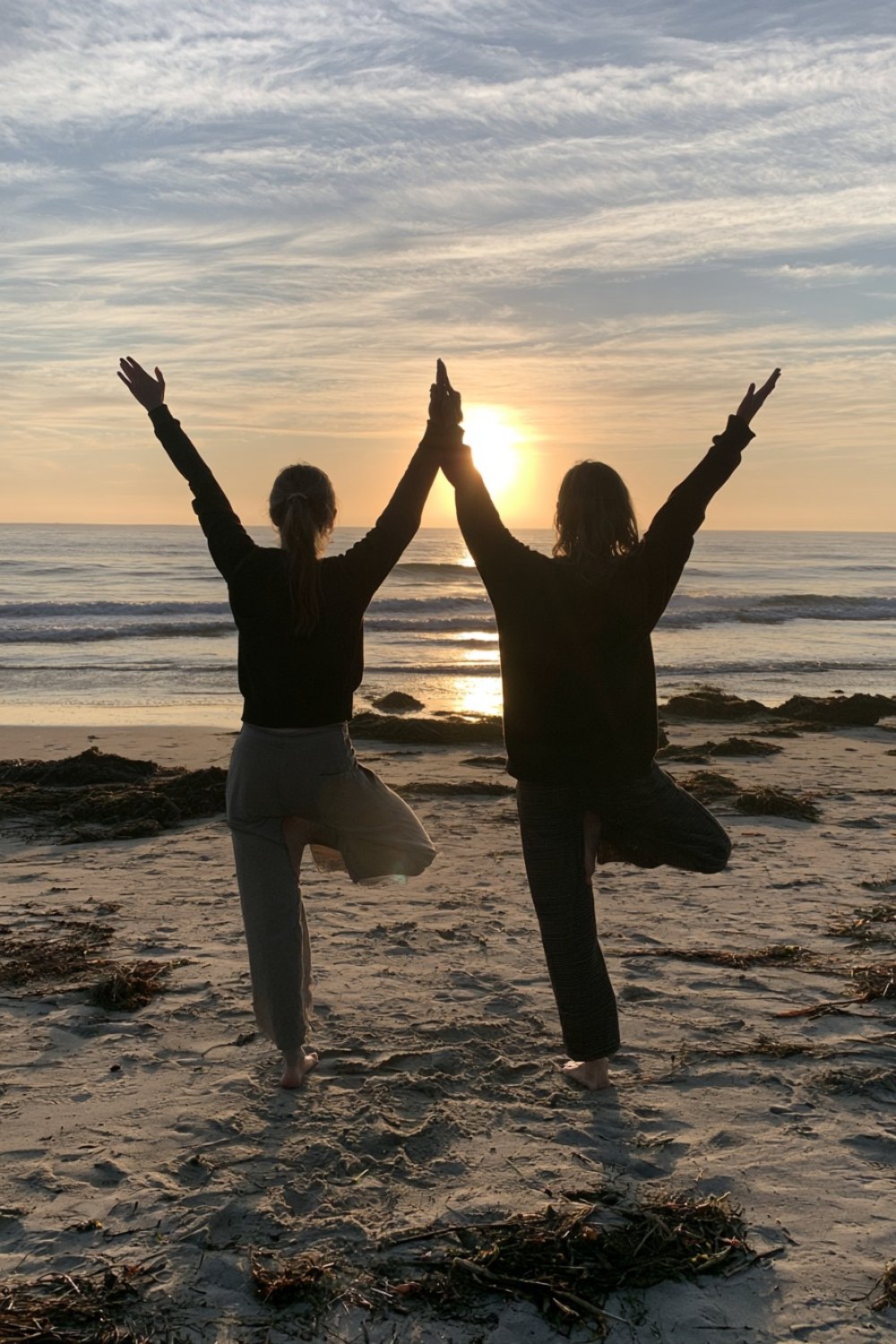
Stand side by side, hips a few inches apart, and press your inside palms together overhead. Lift your outside foot to your calf or inner thigh, never the side of the knee, and keep a toe down if balance is new to you.
If kids want to join in, keep them to floor and standing poses with an adult close by, and skip anything where someone gets lifted.
Fun and funny poses for friends
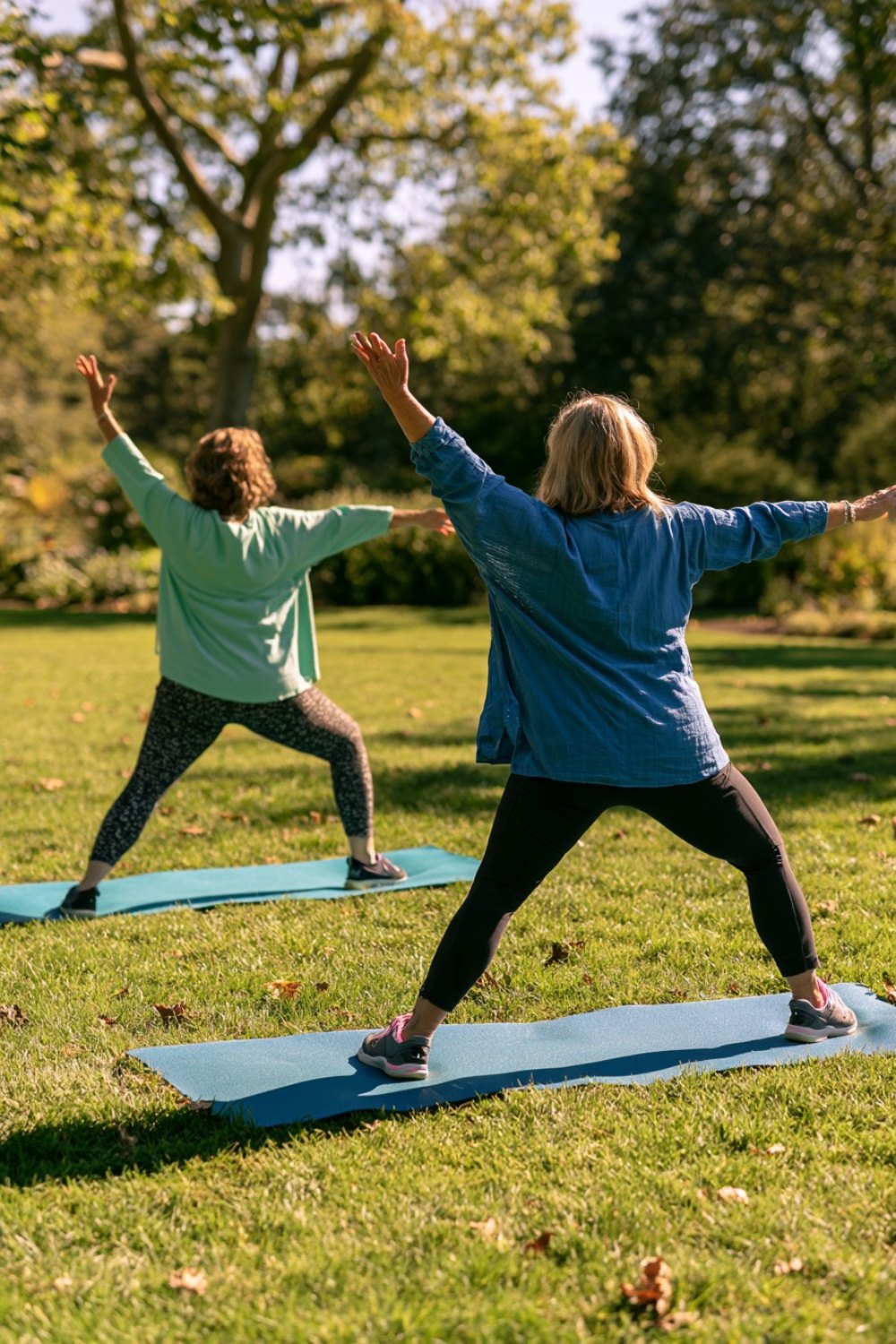
This is where the giggles live. These four are still beginner-friendly, but they need more teamwork, and a couple look delightfully weird in pictures. Aim for 3 to 5 breaths and expect a few collapses.
Partner chair
Stand back to back, link elbows, and walk your feet forward about one foot-length. Bend your knees together until you’re both sitting in an invisible chair. It only works if you both push back equally, so if one person gives up, you both slide down a wall that isn’t there.
Temple
Face each other about an arm’s length apart, raise your arms, and hinge forward so your palms meet overhead in an arch. Step back a little at a time until your backs are flat. It looks like you’re bowing to each other, which tends to get a laugh.
Side-by-side warrior two
Stand hip to hip facing the same way, step your outside feet wide, and bend the front knee over the ankle. Reach your inside arms toward each other until your fingertips touch. Try to match each other’s knee bend exactly; you won’t on the first try.
Plank high fives
Get into high planks facing each other, heads about 2 feet apart, feet a little wider than usual. Take turns lifting one hand to tap your partner’s opposite hand while your hips stay steady. For a longer core goal, our 30-day plank challenge builds holds gradually.
Couples yoga poses
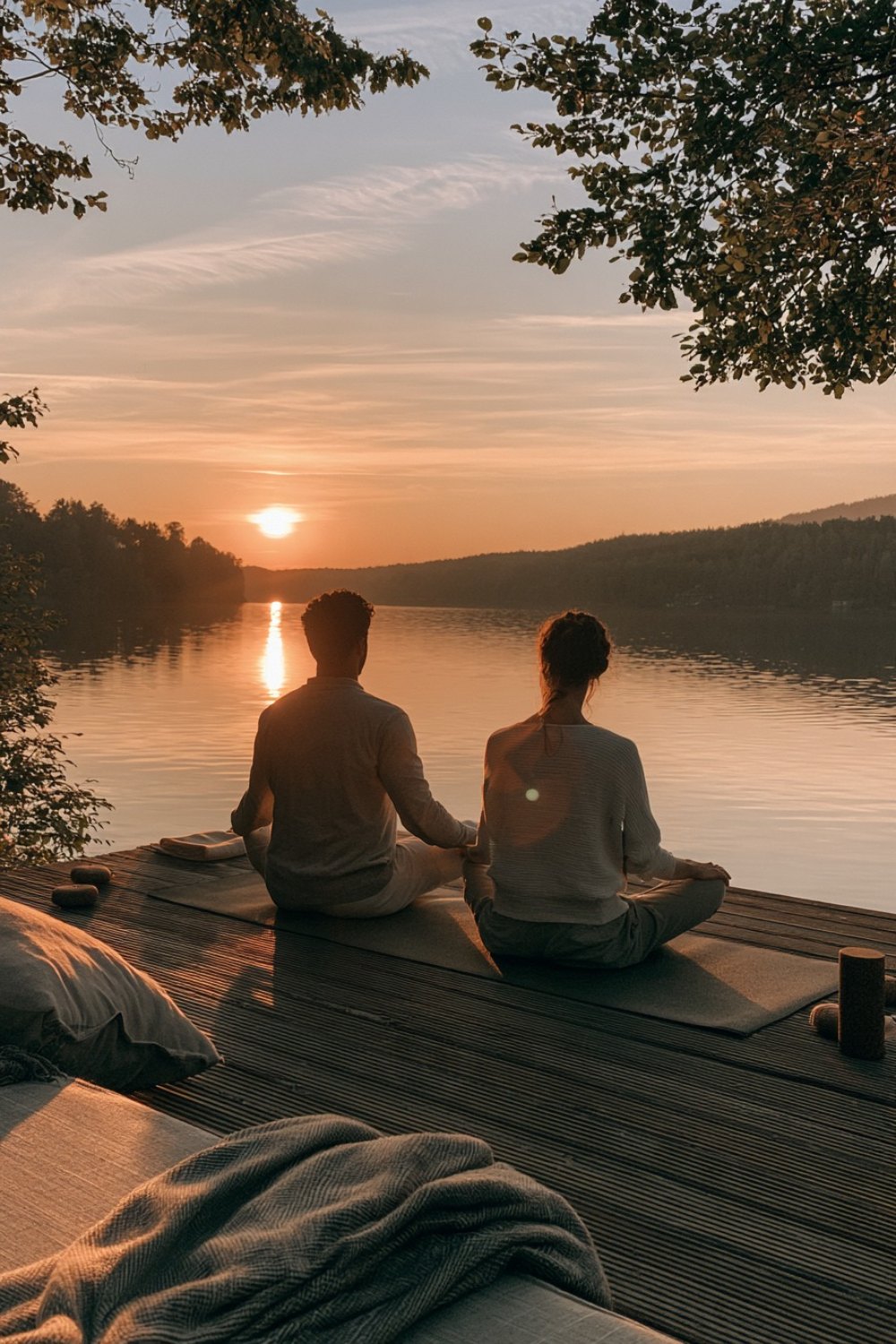
Couples yoga is mostly about slowing down together: two mats, clothes you can move in (here’s our guide to yoga outfits), and 20 minutes with phones away.
A calm couples flow can reuse the easy poses in order: back-to-back breathing, seated twist, partner forward fold, and double tree. Then add one more that’s just for the two of you.
Facing breath
Sit cross-legged facing each other, hands resting lightly on each other’s knees, and breathe slowly for 5 breaths while you hold eye contact. Most couples crack up somewhere around breath two. Start over and see if you can make it to five.
Forget perfect form. What sticks is knowing the other person will hold steady when you lean back, even when you’re both a little clumsy.
Medium and hard challenge poses
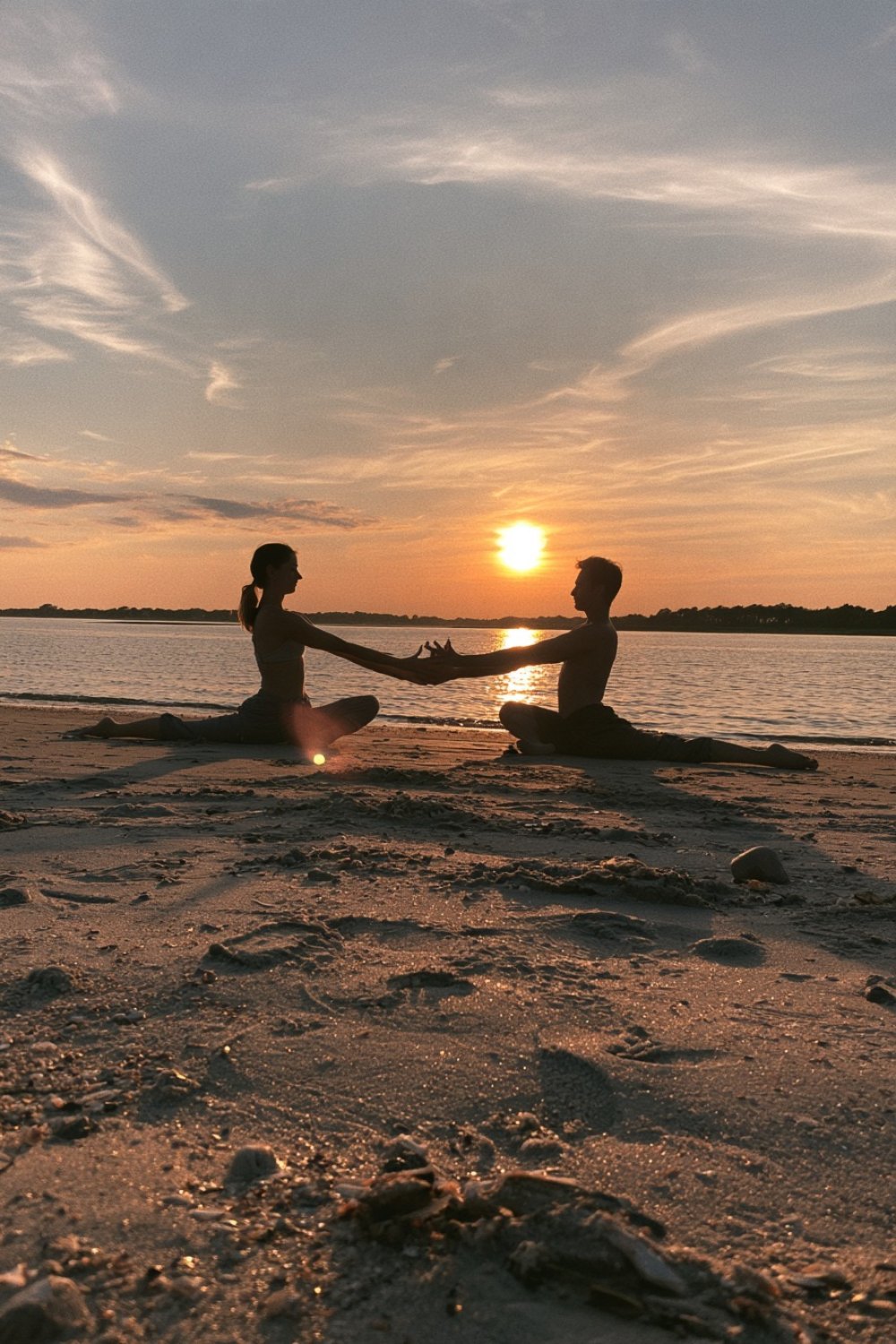
Here’s the honest part: these poses look great on a phone screen, and they’re also where people tweak wrists, shoulders, and lower backs. The National Center for Complementary and Integrative Health notes that sprains and strains are the most common yoga injuries and that practicing without supervision has been linked to more risk. If either of you is injured or pregnant, skip this section and check with your doctor first.
Use a soft surface, warm up fully, and move to the next step of a progression only when the current one feels solid over several sessions. For the hard poses, a third person spots every time.
Medium: double boat
Sit facing each other, knees bent, toes touching, and grab each other’s wrists outside your legs. Press your soles together and straighten one leg at a time into a big W shape, chest lifted. Bent knees are a perfectly good version; hold 3 to 5 breaths.
Medium: partner dancer
Face each other at arm’s length, stand on your right leg, and hold your left foot behind you with your left hand. Press your right palms together, hinge forward, and kick your back foot into your hand. Press the shared palm rather than grabbing it, and hold 3 to 5 breaths per side.
Medium: double downward dog
The base holds a strong downward dog while the flyer places their hands on the mat a foot or two ahead of the base’s hands, facing away. One at a time, the flyer walks their feet onto the base’s lower back near the top of the hips, never the middle of the spine. Hold 3 to 5 breaths and step down one foot at a time.
Hard: double plank
Progress in order: a solid solo high plank, then plank high fives, then double plank. The base holds a high plank, and the flyer stands at the base’s feet, grips their ankles, and places one foot, then the other, on the tops of the base’s shoulders. Hold 2 to 3 breaths with a spotter beside you.
Hard: front plane
The base lies on their back and places both feet on the flyer’s hip creases, toes turned out, while you hold hands. The flyer leans forward as the base straightens their legs, stacking ankles over hips, until the flyer floats in a plank shape. Keep hands held, hold 2 to 3 breaths, and have a spotter at the flyer’s side.
Hard: handstand with a spotter
Start at a wall and work up to an L-shaped hold, feet on the wall and hips over shoulders, before you ever kick up. Then the spotter stands to the side, you kick up one leg at a time, and the spotter catches your thighs. Hold 2 to 3 breaths and come down the way you went up.
What about extreme acro poses?
Stacked flips and tosses are real skills best learned in an acro yoga class with a trained teacher and crash mats. Your couch is not a crash mat, even if it caught your friends earlier.
Pick poses by level
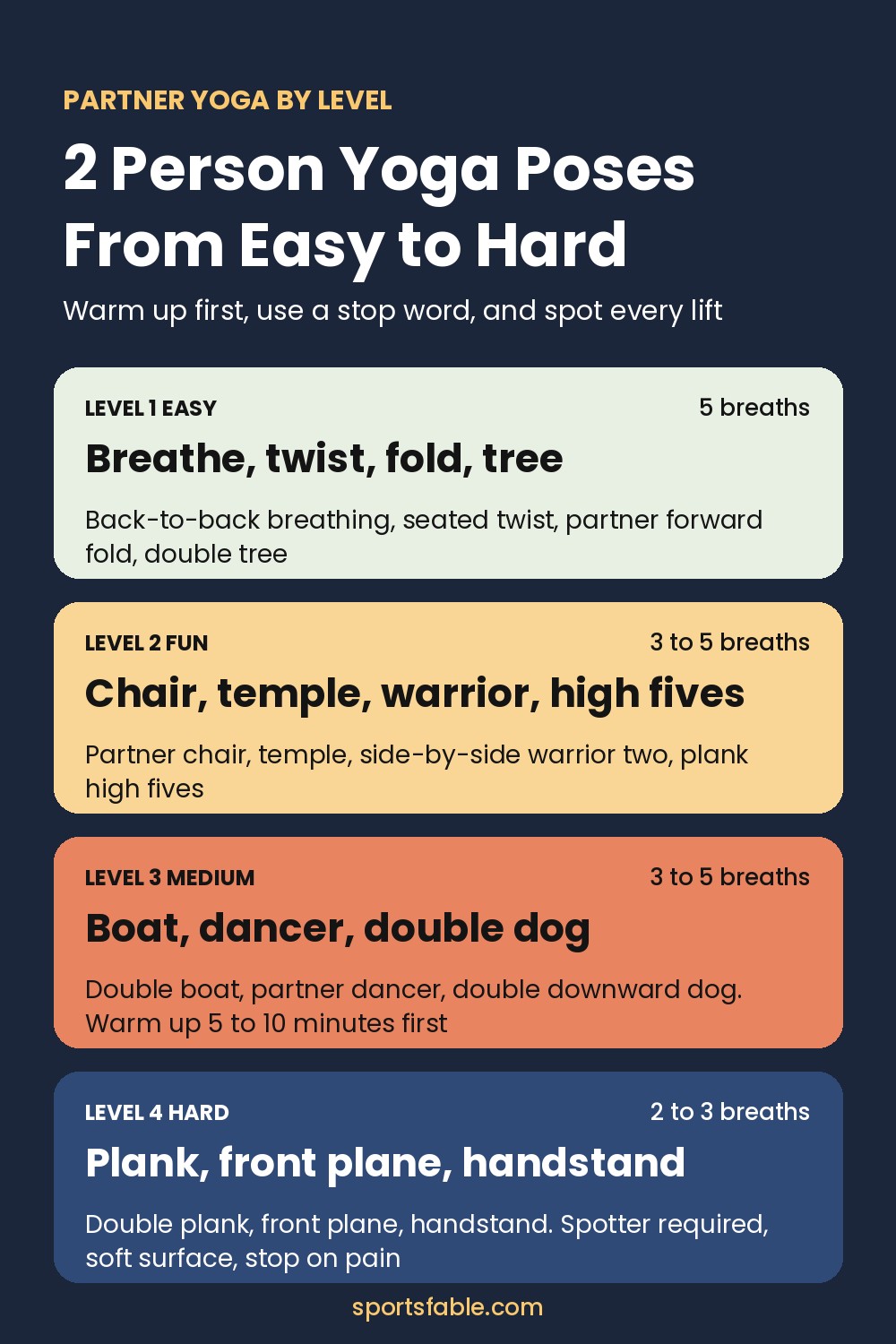
Use this as a menu. Spend a few sessions on easy and fun poses before medium ones, and try hard ones only with a spotter. Staying at level one or two forever is completely fine.
| Level | Poses | Hold |
|---|---|---|
| Easy | Back-to-back breathing, seated twist, partner forward fold, double tree | 5 breaths |
| Fun | Partner chair, temple, side-by-side warrior two, plank high fives | 3 to 5 breaths |
| Medium | Double boat, partner dancer, double downward dog | 3 to 5 breaths |
| Hard | Double plank, front plane, handstand with a spotter | 2 to 3 breaths, spotter required |
Advanced pairs still warm up, even after fifty front planes.
Turn it into a challenge night
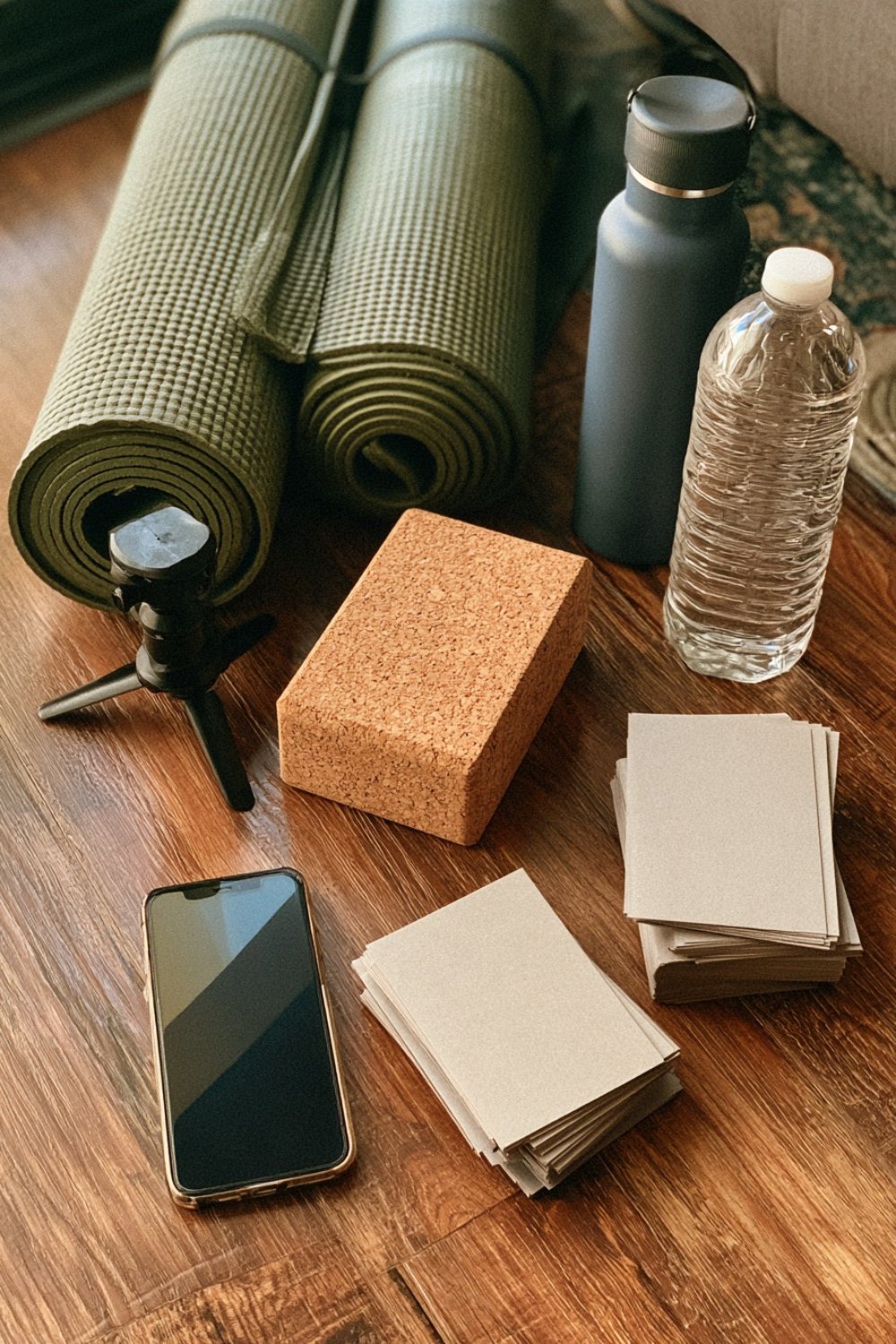
A challenge night works for a couple, two friends, or a few pairs. Write each pose on a card, sort by level, and play in rounds; it takes about 45 minutes.
- Round 1 is the warm-up: 5 to 10 minutes, no points.
- Round 2 draws 2 easy cards per pair.
- Round 3 draws 2 fun cards per pair.
- Round 4 draws 1 medium card per pair.
- Round 5 is an optional hard card, only with a spotter in the room.
| Result | Points |
|---|---|
| Held the target breaths cleanly | 3 |
| Held with one touch-down or regrip | 2 |
| Brave attempt, came out safely | 1 |
| Laugh bonus: both laughing and still holding | +1 |
The pair with the most points picks the snacks next time. Then wind down with a gentle stretching routine as the last, pointless, very pleasant round.
How to take good pictures of partner poses
Set your phone on a mini tripod at about hip height, a few steps away, and shoot from the side for boat, plank, and front plane so the shapes read clearly. Use a 10-second timer or burst mode to catch the one frame where nobody’s wobbling. Window light or a sunset sky with a plain background is the most forgiving.
Want the cards ready to go? Grab the free printable below: page one has every pose by level with cues and holds, and page two has a challenge night scorecard and safety checklist.
Free printable
2 Person Yoga Poses Challenge Cards
Page 1 has 14 partner pose cards by level with cues and holds. Page 2 has a 5-round challenge night scorecard and a safety checklist.
Download the free PDFKeep building
- Loosen up with these hip mobility stretches.
- Deepen your forward fold with this splits stretching routine.
- Log your sessions together with a printable workout tracker.
- Take on a 30-day workout challenge as a pair.
Questions people ask
What are the easiest 2 person yoga poses for beginners?
Back-to-back breathing, a back-to-back seated twist, a partner forward fold, and double tree are the easiest 2 person yoga poses for beginners. Hold each for about 5 slow breaths and do both sides of the twist and tree. Warm up for 5 to 10 minutes first and stop if anything hurts.
What is the hardest 2 person yoga pose?
Among common partner poses, double plank, front plane, and a spotted handstand are the hardest because someone’s feet leave the floor. Build up through solo planks and wall work, hold for only 2 to 3 breaths, and always have a third person spotting. Stacked or flipping acro moves belong in a class with a trained teacher.
How long should you hold 2 person yoga poses?
For most beginners, about 5 slow breaths (roughly 30 seconds) works for easy partner poses. Fun and medium poses usually feel right at 3 to 5 breaths, and hard poses at 2 to 3 breaths with a spotter. Come out together and slowly, and stop on any sharp pain.
What are fun 2 person yoga poses to try with friends?
Partner chair, temple, side-by-side warrior two, and plank high fives are fun 2 person yoga poses for friends because they need teamwork and usually end in laughter. Aim for 3 to 5 breaths each after a short warm-up.
Is partner yoga a good idea for couples?
Partner yoga can be a relaxed way for couples to spend time together and laugh at the wobbles. Start with easy floor poses like back-to-back breathing and facing breath, and agree on a stop word so either person can end a pose at any time. Skip anything that hurts.
Can you do partner yoga while pregnant?
Check with your doctor or midwife before doing any partner yoga while pregnant. The National Center for Complementary and Integrative Health says pregnant people should be evaluated by a health care provider first and adjust their practice. Skip balance-heavy, inverted, and lifted poses like double plank, front plane, and handstands.
Do you need a spotter for partner yoga?
You don’t need a spotter for easy floor and standing poses like back-to-back breathing or double tree. You do need a third person spotting for hard poses where someone’s feet leave the floor, such as double plank, front plane, and a handstand.
The featured photo is a licensed stock photo credited in its caption. The other images in this article are AI-generated illustrations and original graphics created by SportsFable. They show training scenes, not real people, teams or events. The printable is an original SportsFable resource.
Related Post