


Somebody at your gym signed up for a Hyrox race, and now everyone seems to be talking about sled pushes. It looks brutal on video: crowds, music, people crawling across the line after the wall balls. It also looks oddly doable. No ropes, no handstands, no barbell snatches. Just running and some heavy, honest work.
That’s the appeal. Hyrox rewards people who are fairly fit and fairly strong, not elite at either. The catch is that the format punishes anyone who only trains one side. Great runners die on the sleds. Strong lifters blow up on the fifth kilometer.
This hyrox training plan for beginners is a 12-week build for exactly that problem. You’ll get the race format and weights, a weekly schedule that fits around a normal job, the three phases of the plan, how to train the stations without specialist equipment, and the mistakes that cost beginners the most time.

What a Hyrox race actually involves
Every race follows the same format worldwide. According to the official Hyrox race page, you run 1 km, then complete one workout station, and repeat that eight times. In order, the stations are:
- 1,000 m SkiErg
- 50 m sled push
- 50 m sled pull
- 80 m burpee broad jumps
- 1,000 m row
- 200 m farmers carry
- 100 m sandbag lunges
- 100 wall balls
That’s 8 km of running plus eight stations. Finish times vary a lot, and most first-timers are out there well over an hour. The running alone is a decent 8K, and the stations add a big chunk of time on top.
Open division weights
Beginners race the Open division. The official weights (sled weights include the sled):
- Sled push: 102 kg women, 152 kg men
- Sled pull: 78 kg women, 103 kg men
- Farmers carry: 2 × 16 kg women, 2 × 24 kg men
- Sandbag lunges: 10 kg women, 20 kg men
- Wall balls: 4 kg women, 6 kg men
The 12-week plan at a glance
The plan uses four sessions a week. If you can only manage three, drop the Saturday session in phase one and the Tuesday session after that.
- Monday: Strength (lower body focus plus carries)
- Tuesday: Easy run, 30 to 45 minutes
- Thursday: Strength (upper body and pulling) plus a station skill block
- Saturday: Hyrox simulation: runs combined with stations
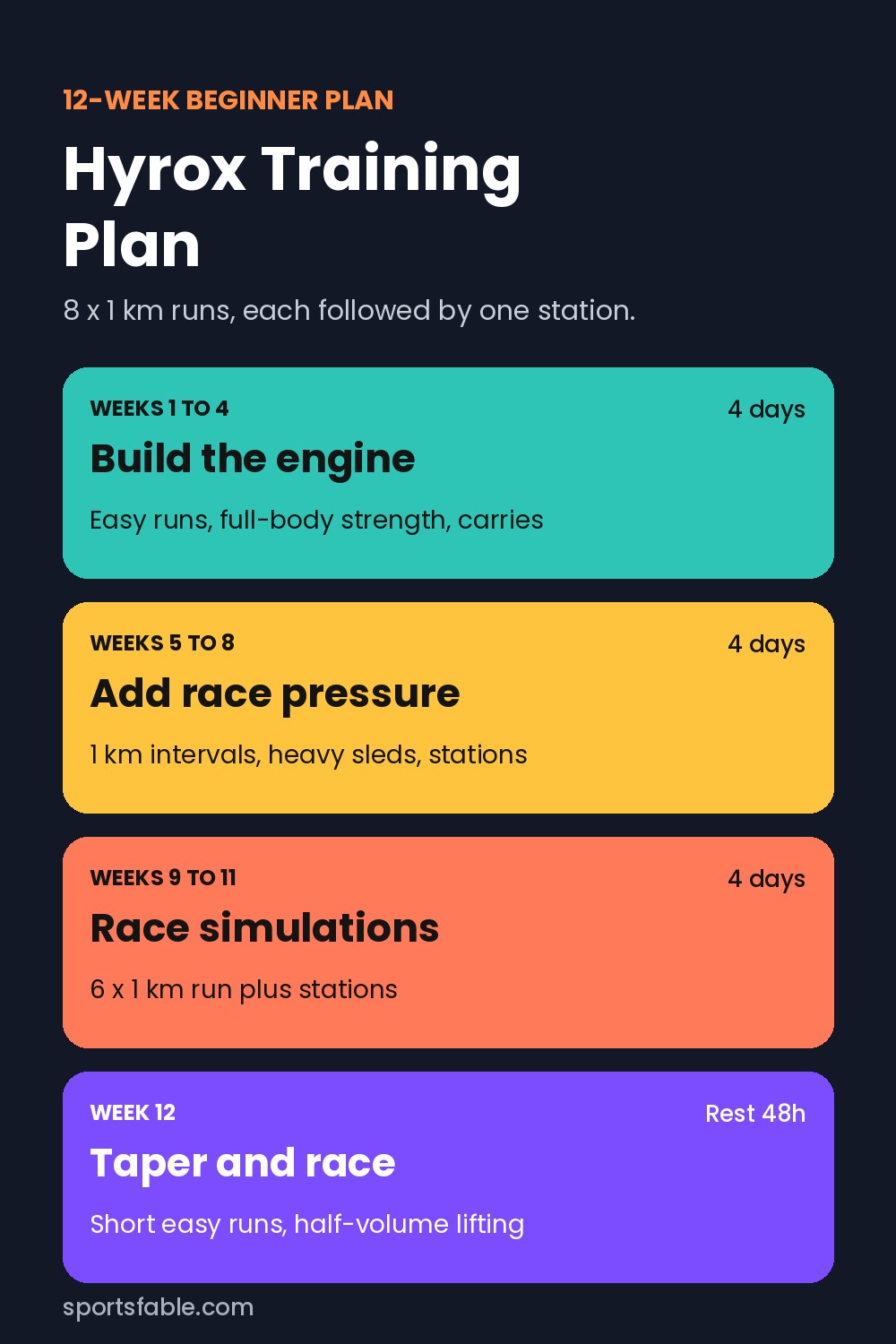
Weeks 1 to 4: build the engine
Running: two runs a week, both at a pace where you can talk in full sentences. Start at 20 to 30 minutes and add 5 minutes per week to the longer one.
Strength: 3 sets of 8 to 10 reps of goblet squats, Romanian deadlifts, walking lunges, push-ups and rows. Finish Monday with 4 × 40 m farmers carries using a weight you can hold without stopping.
Saturday: 4 rounds of 500 m run, then 250 m row or 20 wall balls. Keep it controlled. This is practice, not a test.

Weeks 5 to 8: add race pressure
Running: one easy run plus one interval session, such as 5 × 1 km at the pace you hope to race, with 90 seconds of walking between.
Strength: drop to 3 sets of 6 to 8 reps and push the weights. Add sled pushes if your gym has one (4 × 15 to 20 m, heavy), or the substitutions below if it doesn’t.
Saturday: 4 rounds of 1 km run plus one station at race distance or half distance. Rotate through all eight stations across the month.
Weeks 9 to 12: race-specific and taper
Weeks 9 and 10: your longest simulations. Try 6 × 1 km run with 6 stations at about 75% of race volume. Practise moving straight from station back to running, which is where most beginners lose time.
Week 11: one full-length simulation, then easy training.
Week 12: race week. Two short, easy runs, one light strength session at half volume, and rest for the 48 hours before the race.
How fast should the runs be?
Slower than you think, at least most of the time. Use the CDC’s talk test: at moderate intensity you can talk but not sing. Most of your weekly running should sit there. The interval days are the only time you should be unable to speak more than a few words.
The reason is simple: on race day your 1 km runs come after heavy work. A pace that felt fine fresh can feel very different after 50 meters of sled pull. Building a big easy base makes those compromised runs survivable.
Can you train for strength and running at the same time?
Yes, with a small trade-off. A 2012 meta-analysis in the Journal of Strength and Conditioning Research found that combining endurance and strength training slightly blunted strength and muscle gains compared with lifting alone (strength effect size 1.44 versus 1.76). Running interfered more than cycling. For Hyrox that trade-off is fine, because the race doesn’t need maximal strength. It needs both qualities at a good level. If you want more on balancing the two, our hybrid athlete training plan for beginners goes deeper.

Training the stations without special equipment
Not every gym has a sled or a SkiErg. Here’s what to use instead:
- Sled push: heavy treadmill push with the belt off, prowler-style plate pushes on turf, or heavy walking lunges.
- Sled pull: heavy seated cable rows, plus rope pulls with a band anchored to a rack.
- SkiErg: banded straight-arm pulldowns or cable pulldowns in fast sets of 20.
- Burpee broad jumps: practise them as they are. They need no equipment, just space.
- Farmers carry: dumbbells or kettlebells at race weight or slightly heavier.
- Sandbag lunges: a dumbbell held at the chest or a weight plate hugged close.
- Wall balls: a medicine ball at race weight and a target about 3 meters high.

Mistakes that cost beginners the most time
- Going out too fast. The first 1 km feels easy. If you run it much faster than your planned race pace, you’ll pay for it from the sleds onward.
- Skipping wall ball practice. 100 reps at the end of a race is a lot. Break them into planned sets (for example, 10 × 10) from the start instead of going to failure.
- Grip failure on the carry. Train your grip with heavy holds twice a week. A lot of beginners lose minutes dropping the kettlebells.
- Never practising transitions. Getting back to a run after a station is a skill. Practise it every Saturday.
Race-day checklist
- Shoes you’ve trained in for at least four weeks.
- Light gloves if you use them in training (and only then).
- Knee sleeves for lunges if you’re used to them.
- A pacing plan for the runs and a set plan for the wall balls.
- Breakfast you’ve tested before a hard session, two to three hours out.
- A warm layer for the start pen.

Keep building
New to running? Start with our couch to 5K schedule before week 1 of this plan. Already running but weak in the gym? Our guide to strength training for runners covers the lifts that transfer best. And for race morning, our gym bag essentials list doubles as a packing checklist.
Questions people ask
Is Hyrox good for beginners?
Yes. The movements are simple and the Open division weights are manageable for most regular gym-goers. You need roughly 12 weeks of consistent training if you can already run 5K and lift a few times a week.
Is there a Hyrox training plan for beginner women?
This plan works for women as written. Use the women’s Open weights for station practice and scale the carry and sled weights down at the start if needed.
Can I train for Hyrox at a regular gym?
Yes. Use the substitutions above for the sled and SkiErg. Everything else can be practised with standard equipment.
How many days a week should I train for Hyrox?
Three to four. Two strength sessions, one or two runs and one combined simulation is plenty for a first race.
What should week 1 look like?
Two easy runs of 20 to 30 minutes, two full-body strength sessions, and a short practice round of 500 m runs with light stations on the weekend. Nothing should feel close to maximal.
Should I do men’s or women’s Open or Doubles?
Doubles splits the stations with a partner (you both run every kilometer), which makes it a friendlier first race. Individual Open is the classic first challenge if you’re confident.
Images in this article are AI-generated illustrations and original graphics created by SportsFable. They show training ideas, not real people or events.
Related Post