


The clock over the finish arch says 26:41. You check your watch to be sure, then pull up last spring’s result on your phone while you’re still bent over your knees. It was 26:38. Six months of running, and you got three seconds slower.
That’s not a fitness problem as much as a structure problem. Most runners who stall at the 5K are running the same 3 or 4 miles at the same medium effort every time they lace up. It feels productive, it’s comfortable enough to repeat, and it teaches your body exactly one speed.
This 5K training plan fixes that with six weeks and four runs a week, each with a different job. It’s built for people who can already run 5K without stopping. If you’re not there yet, start with our couch to 5K schedule and come back here when you’ve finished it.

Who this plan is for (and what it costs you)
Here’s the honest price before the payoff. Two of your four runs each week will feel hard, and one of them (the intervals) will feel hard in a way your current routine never does. You’ll need about 3.5 to 4.5 hours a week, and you’ll have to run your easy days slower than your ego would like. That last part is where most people quietly break the plan.
In return, a runner who’s been doing the same loop for months can realistically take 15 to 45 seconds off a 5K in six weeks. Nobody can promise a number, and anyone who says a plan “guarantees” a PR is selling something.
You’re a good fit if you:
- Can run 5K continuously right now, at any pace.
- Have been running at least 3 days a week for the last month or so.
- Have a recent 5K time (a race, a timed solo run, or a watch estimate you trust).
- Aren’t nursing a current injury. If something hurts when you run, or you have a heart or other health condition, check with a doctor before adding speed work.
How to set your paces from your current 5K time
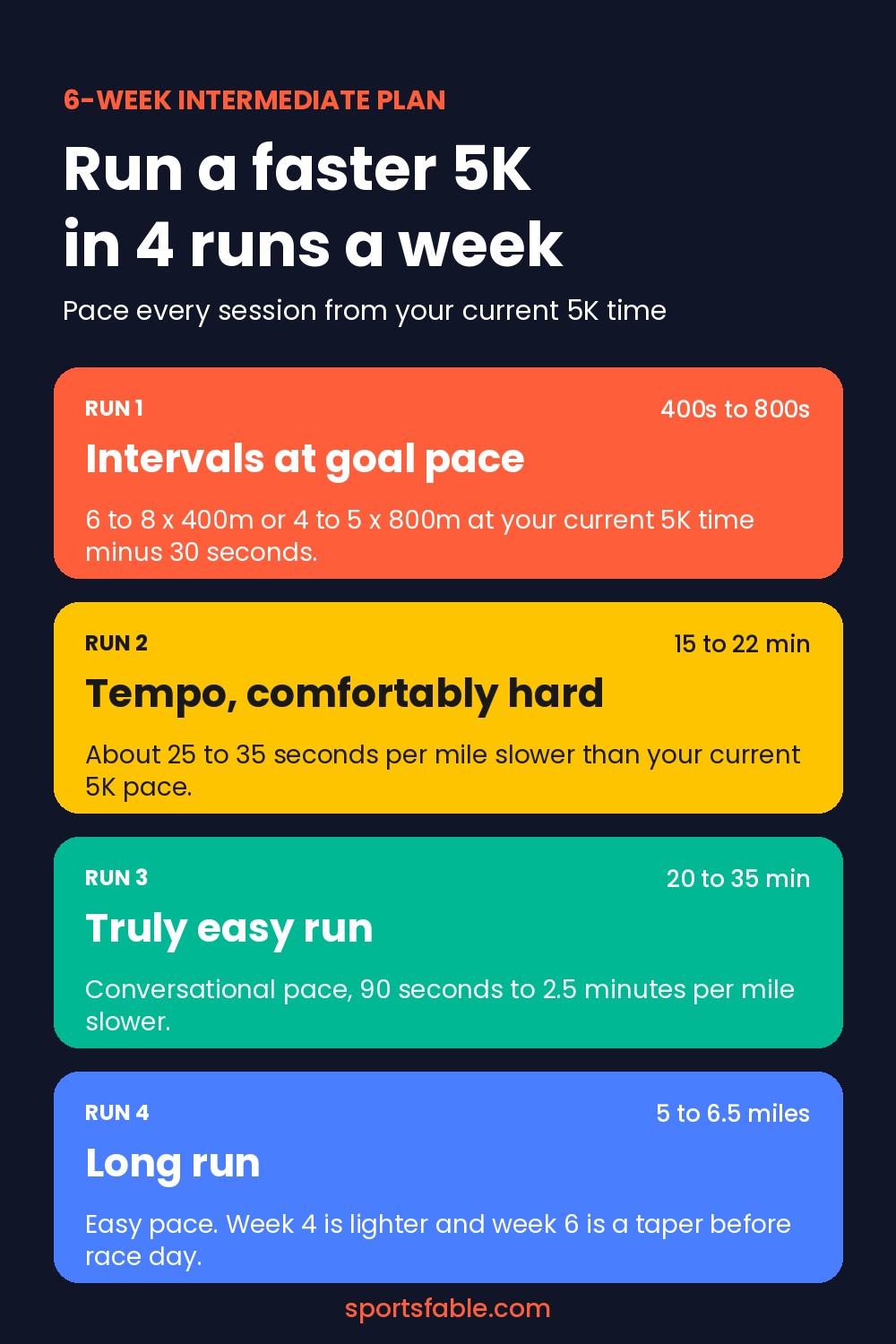
Every pace in this plan comes from one number: your current 5K time. Take it, knock off 30 seconds, and that’s your goal race pace. Intervals are run at that goal pace. Tempo runs sit about 25 to 35 seconds per mile slower than your current 5K pace. Easy runs sit 90 seconds to 2.5 minutes per mile slower. If you want the full conversion for other distances, our running pace chart lays it out mile by mile.
| Current 5K | Goal 5K | Goal pace per mile | 400m split | 800m split | Tempo pace per mile | Easy pace per mile |
|---|---|---|---|---|---|---|
| 20:00 | 19:30 | 6:17 | 1:34 | 3:07 | 6:51 to 7:01 | 7:56 to 8:56 |
| 25:00 | 24:30 | 7:53 | 1:58 | 3:55 | 8:28 to 8:38 | 9:33 to 10:33 |
| 30:00 | 29:30 | 9:30 | 2:22 | 4:43 | 10:04 to 10:14 | 11:09 to 12:09 |
| 35:00 | 34:30 | 11:06 | 2:46 | 5:31 | 11:41 to 11:51 | 12:46 to 13:46 |
If the easy pace looks embarrassingly slow, good. Easy days build the aerobic base that lets you hold goal pace in the third mile, and they let you show up fresh for the sessions that matter.

The four runs in this 5K training plan
Intervals: teaching your legs goal pace
Short repeats (400m or 800m) at goal pace, with easy jogging between. This is the session in any 5K training plan that does the most to make goal pace feel normal. A track is easiest, but any flat stretch you’ve measured works. Warm up for 10 to 15 minutes first and jog 10 minutes after.
Tempo: comfortably hard, not all-out
A tempo run is the effort where you could say a short sentence but wouldn’t want to chat. It trains you to hold a strong pace without falling apart, which is exactly what mile two of a 5K asks for. Run it too fast and it turns into a race, which leaves you flat for the weekend.
Easy run and long run
The easy run is 20 to 35 minutes at conversational pace. The long run grows from about 5 to 6.5 miles (8 to 10.5 km), also easy. A 5K is mostly an aerobic event, so the long run is quietly doing a lot of the work even though it never feels fast.
The 6-week schedule, week by week
Put the intervals and tempo on non-consecutive days (Tuesday and Thursday works for most people), the easy run on Friday or Monday, and the long run on the weekend. Every interval and tempo session includes a 10 to 15 minute easy warm-up and a 10 minute cool-down that aren’t listed below.
| Week | Intervals (goal pace) | Tempo | Easy | Long run |
|---|---|---|---|---|
| 1 | 6 x 400m, 90 sec jog | 2 x 8 min, 2 min jog | 25 min | 5 miles |
| 2 | 8 x 400m, 90 sec jog | 2 x 10 min, 2 min jog | 30 min | 5.5 miles |
| 3 | 4 x 800m, 2 min jog | 18 min steady | 30 min | 6 miles |
| 4 (lighter) | 6 x 400m, 90 sec jog | 15 min steady | 25 min | 5 miles |
| 5 | 5 x 800m, 2 min jog | 22 min steady | 35 min | 6.5 miles |
| 6 (taper) | 4 x 400m, 2 min jog | 10 min steady + 4 strides | 20 min + 4 strides | Race day 5K |
Week 4 is lighter on purpose. Fitness gets built in the recovery between hard weeks, and most runners who skip the down week end up running week 5 tired. In week 6, you keep the speed but cut the volume, so you arrive at the start line sharp rather than sore. Strides are 15 to 20 second relaxed pickups to near sprint, with a full walk back.

Two short strength sessions a week (squats, lunges, calf raises, a plank) will make the plan sturdier, and they fit on your easy run days. Our guide to strength training for runners has a 20-minute routine that doesn’t wreck your legs for the next interval day.
Only have 4 weeks? The compressed version
If your race is a month away, you can still sharpen up, but you have to give something up. Drop the build weeks and run this:
- Week 1: 6 x 400m, tempo 2 x 8 min, easy 25 min, long run 5 miles.
- Week 2: 4 x 800m, tempo 18 min, easy 30 min, long run 5.5 miles.
- Week 3: 5 x 800m, tempo 20 min, easy 30 min, long run 6 miles.
- Week 4: the taper week from the table above, then race.
The cost: there’s no lighter week, so swap any session for an easy run if your legs are unusually sore. A 4-week 5K training plan tends to produce a smaller gain than six weeks, mostly because you’re sharpening fitness you already have instead of building more.

How to pace race day
Most blown 5Ks are lost in the first 400 meters. Adrenaline makes goal pace feel slow, so you go out too fast and pay for it in mile three. The fix is boring and it works: run even splits, or a slight negative split where the second half is a few seconds quicker.
- Mile 1: right on goal pace, or up to 5 seconds slower. It should feel too easy.
- Mile 2: hold goal pace. This is the hard, lonely mile, so pick someone ahead and stay with them.
- Mile 3 to finish: start pushing at about 2.5 miles, then empty the tank for the final 200 meters.

What the sources say
A few points in this plan lean on outside guidance, so here’s where they come from. Mayo Clinic Health System describes interval training as alternating short harder efforts with easier recovery, suggests swapping 2 to 3 regular workouts a week for interval sessions, and advises checking with your health care team first if you have a health condition. Mayo Clinic’s guide to warming up and cooling down recommends about 5 to 10 minutes of gradually building warm-up before aerobic exercise. And the CDC’s adult physical activity guidelines call for at least 2 days a week of muscle-strengthening activity alongside aerobic work, which is why strength shows up here.
Your 5K training plan checklist
- Write down your current 5K time and your goal (30 seconds faster).
- Pull your interval, tempo and easy paces from the pace table.
- Find a track or a measured flat 400m stretch.
- Put intervals and tempo on non-consecutive days.
- Keep easy runs truly easy.
- Respect the week 4 down week and the week 6 taper.
- Plan race day: warm-up time, goal splits, and where you’ll start pushing.

Keep building the plan
Once you’ve run your faster 5K, the same structure stretches nicely into our 10K training plan, which keeps the intervals and adds longer tempo work. Logging each session on a printable workout tracker makes it easy to see whether your interval splits are actually dropping. And if your shoes are past 400 miles or so, our guide on how to choose running shoes will help you pick a pair that suits faster sessions.
Also worth a look: the couch to 10K plan and our 18-week marathon training plan.
Questions people ask
Is this 5K training plan good for beginners?
Only if “beginner” means you can already run 5K without walking. If you can’t yet, the intervals and tempo runs will be too much too soon. Finish a couch to 5K program first, run for a few more weeks, then start here.
How do I run a faster 5K?
Stop running every run at the same medium effort. Add one interval session at goal pace and one tempo run each week, slow your easy runs down, and pace race day evenly. Those four changes do most of the work.
Is 6 weeks long enough to get faster?
For most runners who’ve been doing unstructured running, yes. Six weeks is enough to get used to goal pace and build some tempo strength. Gains of 15 to 45 seconds are common, though your result depends on your starting point.
What makes this an intermediate plan?
Two quality sessions a week and a long run of up to 6.5 miles. A beginner plan usually has none of that. An advanced plan would add more mileage, a fifth or sixth day, and harder repeats.
Can I do a 4 week or 1 month version?
Yes, use the compressed version above. You lose the lighter recovery week, so be strict about easy days. Expect a smaller improvement than the full six weeks.
What about a 12 week or 8 week plan?
For 8 weeks, repeat weeks 2 and 3 before moving on to week 4. For 12 weeks, run the full six weeks twice, resetting your paces from a time trial at the end of the first block. Longer blocks suit runners who want to build mileage as well as speed.
How should I approach my first 5K race?
Start a little behind where you think you belong and let the first mile feel easy. Your first race is your baseline, so finishing strong matters more than any single split.
Images in this article are AI-generated illustrations and original graphics created by SportsFable. They show training scenes, not real people, teams or events.
Related Post