


It’s 5:50 a.m. on a Saturday and the kitchen is still dark except for the light over the stove. There’s a banana on the counter, a gel you’ve never tried tucked next to it, and your shoes waiting by the door. Today’s the first 10-mile run of your life, and you’re doing the math on whether you can turn around at mile 5 and still call it a win.
That morning is where a marathon actually gets built. Not on race day, not in the finish photo, but in 18 weeks of Saturdays that each ask for a little more than the last. A good marathon training plan makes those Saturdays boring in the best way: you know the number, you run it slowly, and you go home.
Here’s the honest cost up front. This plan asks for four runs a week for four and a half months, with the longest Saturdays taking 3 to 4 hours for most beginners. If that sounds like too much right now, that’s useful information, not a failure. If it sounds doable, keep reading.

Who this 18-week plan is for
This schedule assumes you can already run about 3 miles (5 km) without stopping and have been running 2 to 3 times a week for at least a couple of months. Week 1 starts with a 6-mile long run, so if 3 miles still feels like a fight, you’re not behind, you’re just earlier in the line. Spend 10 to 12 weeks on a beginner half marathon training plan first. The half builds the same habits with about half the time cost, and most first marathons go better after one.
If you have a heart condition, joint problems, or any pain that changes how you walk, check with your doctor before you start. That’s not a disclaimer for the sake of it: 18 weeks is long enough for a small issue to become a big one.
The 18-week marathon training plan, week by week
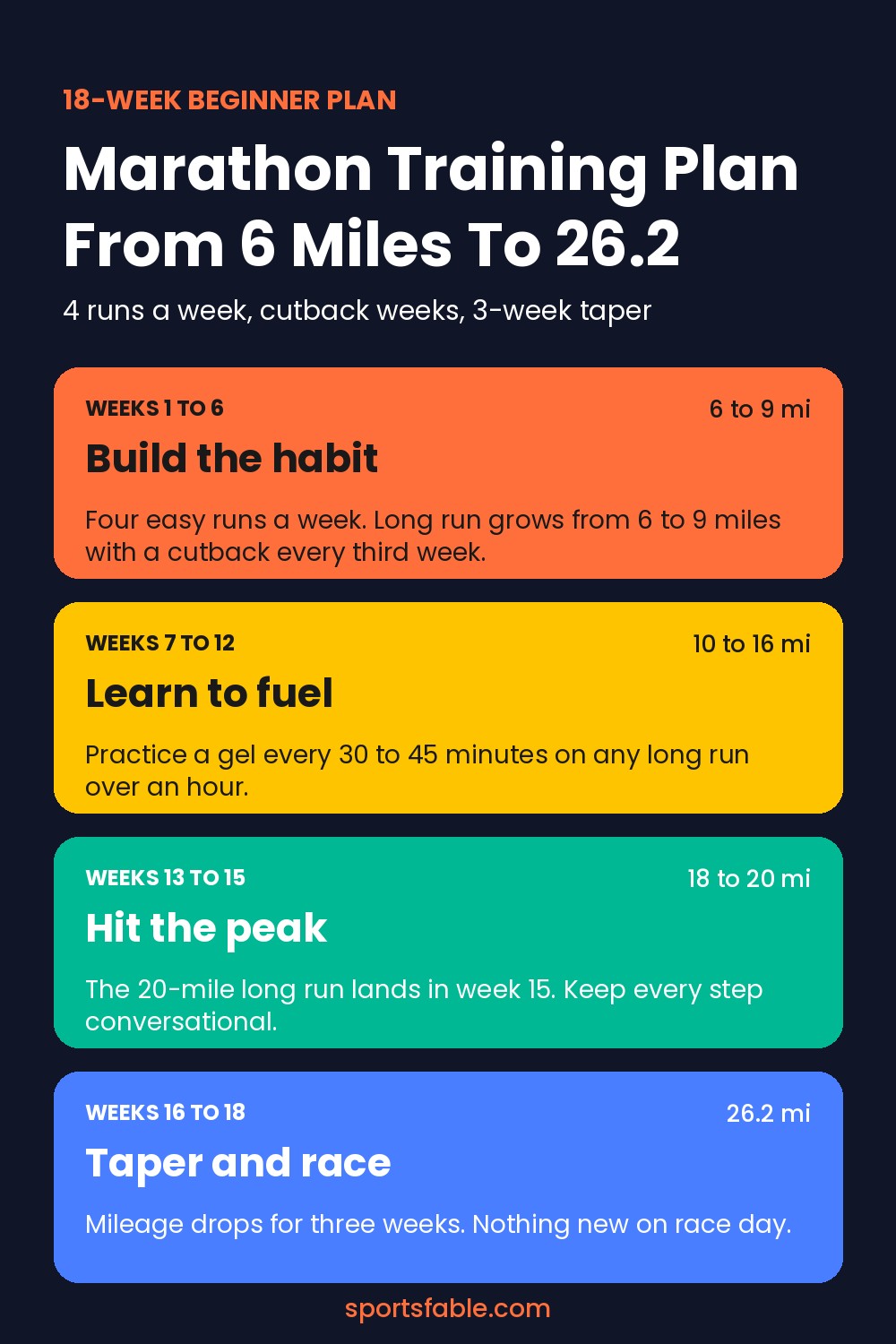
Four runs a week: three weekday runs (Tuesday, Wednesday, Thursday works for most people) and one long run on Saturday. Monday and Friday are rest days, Sunday is rest or an easy 30-minute walk or bike. Weekday distances are in miles; the long run shows miles and kilometers. Every third week or so is a cutback week where the long run drops, and the last three weeks are the taper.
| Week | Tue | Wed | Thu | Saturday long run |
|---|---|---|---|---|
| 1 | 3 | 3 | 3 | 6 mi (10 km) |
| 2 | 3 | 4 | 3 | 7 mi (11 km) |
| 3 (cutback) | 3 | 3 | 3 | 5 mi (8 km) |
| 4 | 3 | 4 | 3 | 8 mi (13 km) |
| 5 | 4 | 4 | 4 | 9 mi (14.5 km) |
| 6 (cutback) | 3 | 4 | 3 | 7 mi (11 km) |
| 7 | 4 | 5 | 4 | 10 mi (16 km) |
| 8 | 4 | 5 | 4 | 12 mi (19 km) |
| 9 (cutback) | 4 | 4 | 4 | 9 mi (14.5 km) |
| 10 | 4 | 6 | 4 | 14 mi (22.5 km) |
| 11 | 5 | 6 | 5 | 16 mi (26 km) |
| 12 (cutback) | 4 | 5 | 4 | 12 mi (19 km) |
| 13 | 5 | 7 | 5 | 18 mi (29 km) |
| 14 (cutback) | 4 | 6 | 4 | 13 mi (21 km) |
| 15 (peak) | 5 | 8 | 5 | 20 mi (32 km) |
| 16 (taper) | 4 | 6 | 4 | 12 mi (19 km) |
| 17 (taper) | 4 | 5 | 3 | 8 mi (13 km) |
| 18 (race week) | 3 | 3 | 2 shakeout | Race: 26.2 mi (42.2 km) |
Notice what isn’t in the table: speedwork. For a first marathon, your only job is to arrive at the start line healthy. Intervals and tempo runs add injury risk for a time goal you don’t need yet. If you want structure on Wednesday, run the middle 2 miles a touch quicker, and leave it there.

Easy pace: slower than feels right
Almost every run in this plan should be at conversational pace. You should be able to say full sentences without gasping. For most beginners that’s 1 to 2 minutes per mile slower than their 5K race pace, which can feel embarrassingly slow. Do it anyway. The long run builds endurance through time on your feet, not through speed, and running it hard just makes the recovery longer and the next weekday run worse.
If you want numbers, plug a recent 5K time into a running pace chart and add a minute or more per mile for easy days. What other sites won’t say: walking breaks on long runs are allowed. A 1-minute walk every mile or two is a legitimate strategy, and plenty of first-timers finish faster with them than without.
Practice fueling on every long run over 60 minutes
The banana and gel on the counter aren’t decoration. Your stomach needs training too, and race morning is the worst possible time to find out a gel doesn’t agree with you. The Cleveland Clinic notes that the American College of Sports Medicine recommends 30 to 60 grams of carbohydrate per hour of exercise, and that most gels hold roughly 23 to 27 grams. For most people that’s one gel every 30 to 45 minutes, taken with a few sips of water.
Start fueling on any long run that lasts more than an hour, which in this plan means from about week 4 onward. Eat a small breakfast you’d be happy to eat on race morning, 2 to 3 hours before you start. By week 13 you should have a routine you could do half asleep: same breakfast, same gel, same timing.

What to do if you miss a week
Life happens: a cold, a work trip, a sick kid. The rule is simple: never try to make up missed miles. If you miss a few days, pick up the plan where the calendar says you are. If you miss a full week, repeat the last week you completed, then rejoin the plan and skip one cutback week to get back on schedule. If you miss two weeks or more in the second half, drop your next long run by 2 to 4 miles and consider whether a later race makes more sense.
Pain is different from missed time. Soreness that fades after a day is normal. Pain that lingers, gets worse while you run, or makes you limp is your cue to stop and get it looked at, not to push through to the next Saturday.
How to shorten it to 16 or 12 weeks
16 weeks: if you’re already running 15 or more miles a week with a comfortable 8-mile long run, start at week 3 of this marathon training plan. You’ll hit the 20-miler in week 13 and keep the same 3-week taper.
12 weeks: only if you’ve recently run a half marathon or can already run 10 to 12 miles comfortably. Start at week 7 (10-mile long run). You lose most of the cutback cushion, so if anything hurts, give the time back rather than forcing it. A 20-week or 24-week version is easier: run weeks 1 to 3 twice, or add a few 4 to 5 mile long runs before week 1.
Why 4-week marathon plans don’t exist
You’ll see “4 week marathon plan” searches everywhere. Here’s the blunt version: there isn’t a safe one for a beginner. Your heart and lungs adapt in weeks, but tendons, bones and connective tissue adapt in months. Cramming 20-mile runs into a month is how people end up with stress fractures before the race. If your marathon is 4 weeks away and you haven’t trained, the smart move is to defer, switch to the half or 10K, or walk the course with the full time limit in mind.

The taper and race week
The last three weeks will feel strange. Mileage drops, you’ll have extra energy, and you’ll be tempted to “test” your fitness with a hard run. Don’t. The taper is when the work of the previous 15 weeks settles in. Keep the weekday runs easy, sleep more, and lay out every piece of race kit by Thursday of race week. Nothing new on race day: not shoes, not shorts, not a breakfast you saw online.
Shoes deserve a note. If yours will pass 300 to 400 miles by race day, buy the replacement pair around week 12 so you get a few long runs in them. Our guide on how to choose running shoes covers what to look for without the hype.

Sources worth reading
- Cleveland Clinic on energy gels and fueling long workouts, including the 30 to 60 grams of carbohydrate per hour guideline.
- Emory Healthcare’s running injury prevention tips, on building gradually, rest days and when pain needs a doctor.
- CDC adult physical activity overview, which recommends muscle-strengthening work at least 2 days a week alongside aerobic activity.
Your marathon week checklist
- Four runs logged, with the long run at conversational pace.
- Fuel practiced on any long run over 60 minutes.
- Two short strength sessions (20 to 30 minutes) on non-long-run days.
- Shoe mileage checked.
- Any lingering pain noted, not ignored.
- Next Saturday’s distance and route planned before Friday night.

Keep building the plan
Those two strength sessions matter more than most beginners think, so pair this schedule with a simple strength training routine for runners. Track every run and long-run fuel note in a printable workout tracker so you can see the pattern when a Saturday goes badly. And if your training block runs into winter, sort your layers early with these cold weather running outfits.
Also worth a look: what to wear as a marathon spectator and a 10-minute stretching routine.
Questions people ask
Should a beginner do a half marathon first?
Usually, yes. If you can’t comfortably run 3 miles yet, a 10 to 12 week half marathon plan is the better first step. It teaches long-run pacing and fueling at a lower cost, and you can start this 18-week plan a few weeks after.
Is a 12 week marathon training plan enough for a beginner?
Only if you’re already running 10 to 12 miles comfortably. For a true beginner, 12 weeks squeezes the long-run buildup too hard. Start at week 7 of the table above if you qualify, otherwise give yourself the full 18.
Is a 16, 20 or 24 week plan better than 18?
Sixteen works if you have a solid base. Twenty or 24 weeks (roughly 6 months) is a great choice for newer runners because it adds repeat weeks and buffer for illness. Longer isn’t harder: you just build more slowly.
How do I train for a 2 hour half marathon?
A 2:00 half needs an average of about 9:09 per mile (5:41 per km). That’s a time goal plan, not a beginner one, so use a dedicated half marathon schedule with a weekly tempo run rather than this marathon build.
Can I train for a half marathon in 4 or 8 weeks?
Eight weeks can work if you already run 6 miles comfortably. Four weeks is only realistic for someone already running 8 to 10 miles; from scratch, it’s an injury invitation. If the race is that close, run/walk it with no time goal.
Is there a km version of this plan?
Yes, the long runs in the table show both. For weekday runs, multiply miles by 1.6: a 3-mile run is about 5 km, 5 miles is 8 km and 8 miles is about 13 km.
Images in this article are AI-generated illustrations and original graphics created by SportsFable. They show training scenes, not real people, teams or events.
Related Post