


So you want to squat heavy on Monday and still run a half-decent 10K on Saturday. Fair enough. It’s probably the most common goal in the gym right now, and honestly, it’s a good one.
Here’s the part nobody mentions though. You can absolutely do both.
But each one is going to move slower than if you’d just picked one and committed. That’s not a motivation problem, and it’s not because you haven’t found the right programme yet.
It’s measurable, it’s been studied properly, and once you know the actual numbers you can plan around them instead of quietly getting frustrated six weeks in.
This is a four-day split built around that reality, with a twelve-week progression. You can start it Monday.

First, what a hybrid athlete actually is
The term’s drifted a bit. On Pinterest and Instagram it’s come to mean “someone who looks lean and posts a deadlift and a 10K in the same week.” But that’s describing a physique, not a way of training.
A hybrid athlete is really just someone deliberately chasing two things that compete with each other: maximal strength and aerobic endurance. That word compete is doing a lot of work.
These two adaptations genuinely pull your body in different directions, and if your plan ignores that, what you’ve actually got is two programmes stapled together. That’s how people end up beaten up, exhausted, and stalled on both.
The trade-off, with real numbers
Most hybrid articles skip this bit, so let’s just look at it.
The interference effect is real and it’s been measured. There’s a well-known meta-analysis by Wilson and colleagues in the Journal of Strength and Conditioning Research that pooled 21 studies and 422 effect sizes, comparing strength training on its own against strength and endurance together.
Training strength alone won on every measure:
| What was measured | Strength only | Both together |
|---|---|---|
| Strength | 1.76 | 1.44 |
| Muscle growth | 1.23 | 0.85 |
| Power | 0.91 | 0.55 |
In plain terms: you’re giving up roughly a fifth of your strength progress, about a third of your muscle growth, and getting on for 40% of your power development. That’s the price.
Now here’s the bit that makes it worth paying, and it’s the most useful thing in this whole article.
The interference only really runs one way. The same research found that training strength alongside endurance doesn’t meaningfully hold back your aerobic fitness. Your VO₂max improves about as well either way.
So the cost lands in the strength column, and pretty much nowhere else.
Once you know that, you know exactly where to spend your effort protecting things.
Two things that make the cost smaller
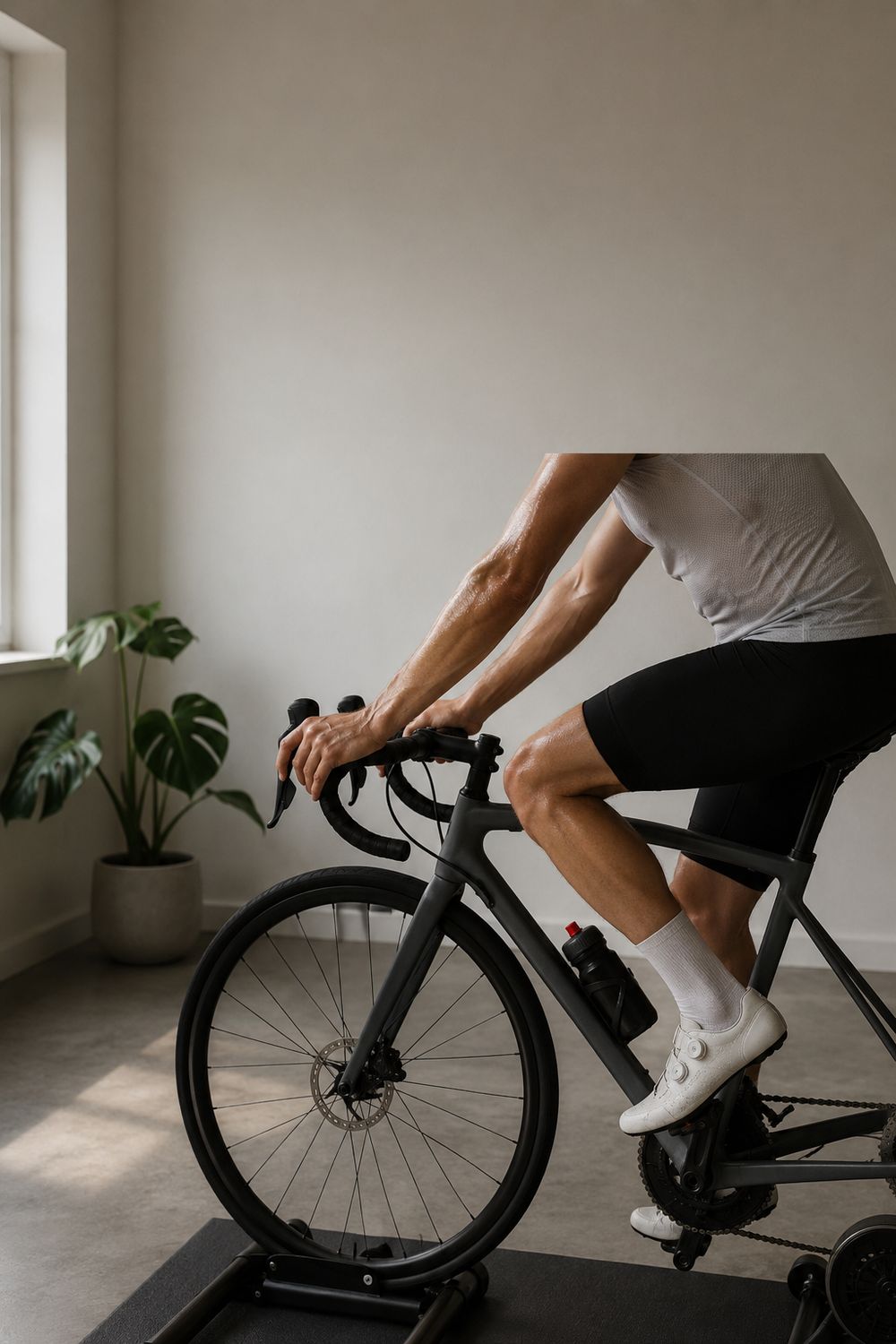
Cycle instead of running, if muscle is the goal
Running interferes with muscle growth more than cycling does, and the explanation is fairly intuitive once you hear it. Every stride is a braking, lengthening contraction.
Your legs take a small amount of damage with each one, and then they’ve got to spend recovery repairing that instead of building.
Cycling doesn’t really do this. It’s almost all pushing, very little braking.
So if you’re leaning towards muscle, put your easy aerobic work on a bike. If you’re training for an actual running race, you obviously have to run, and that’s fine. You’ve just got the second lever instead.
Keep the sessions apart
There’s a good body of research on session sequencing showing that the order you do things in within one session affects how much interference you get. Which is interesting, but there’s a simpler answer: don’t put them in the same session at all.
Different days if you can. At least six hours apart if you can’t. This plan uses different days.
The four-day split
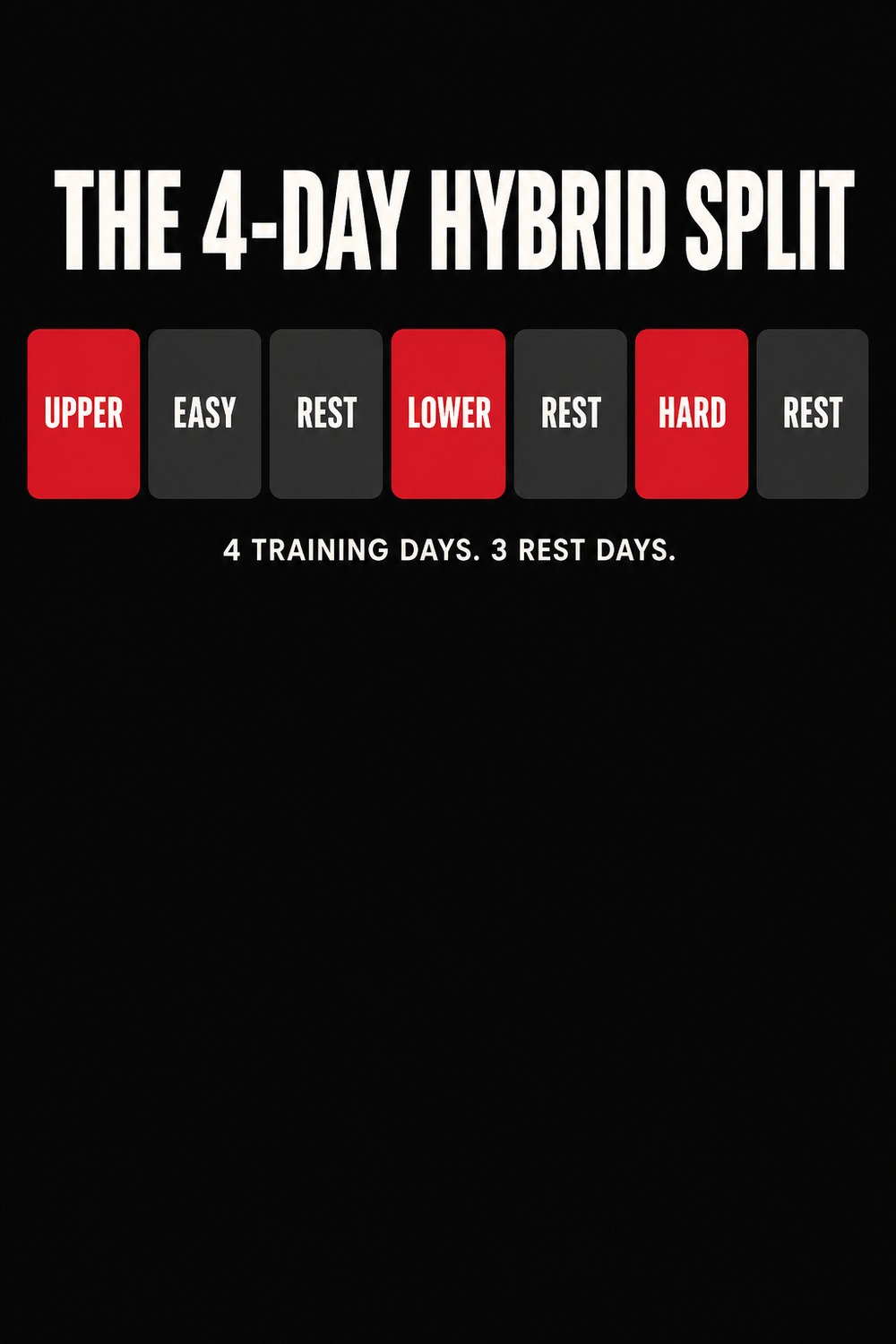
Four training days, three rest days. Leg day and hard running never land on the same day, and never sit next to each other either.
Monday — Upper body
- Bench press or weighted dip — 4 × 5
- Weighted pull-up or lat pulldown — 4 × 6
- Overhead press — 3 × 8
- Barbell row — 3 × 8
- Face pull — 3 × 15
Tuesday — Easy aerobic
35 to 45 minutes at a genuinely conversational pace. If you couldn’t hold a phone call, you’re going too hard. Bike if muscle’s the priority, run if there’s a race in the diary.
Wednesday — Rest
Thursday — Lower body
- Back squat — 4 × 5
- Romanian deadlift — 3 × 6
- Split squat — 3 × 8 each leg
- Calf raise — 3 × 12
- Hanging leg raise — 3 × 10
Friday — Rest
Saturday — Hard aerobic
- Weeks 1–4: 5 × 3 minutes hard, 2 minutes easy in between
- Weeks 5–8: 5 × 4 minutes hard, 2 minutes in between
- Weeks 9–12: 4 × 6 minutes hard, 3 minutes in between
Sunday — Rest, or a walk if you fancy it
How the twelve weeks progress
The split itself doesn’t change. What changes is how much you’re lifting and how long the intervals run. Three blocks of four weeks.
Weeks 1 to 4 — build the base. Start everything at a weight you could genuinely do two more reps with. Yes, it’ll feel too easy. That’s the point. Add 2.5kg to upper body lifts and 5kg to lower body lifts each week.
Weeks 5 to 8 — get heavier. Drop your top sets on squat and bench from 5 reps to 3, and put the weight up to match. Everything else stays as written. Intervals get longer.
Weeks 9 to 12 — push, then back off. Weeks 9 to 11 are your heaviest of the block. Then in week 12, halve your lifting volume but keep the weight where it is.
That last week is usually where everything suddenly feels easier, which is the whole point of it.
After that, take a full week off. Properly off. Then start again from your week 5 numbers.
What twelve weeks will actually get you
If you run this consistently as a beginner, you should see real strength gains across all four main lifts and a noticeable jump in aerobic fitness. Not spectacular on either front. Solid on both.
What you won’t get is what a dedicated strength block would have given you, or what a dedicated running block would have. You’re trading depth for breadth.
For most people who aren’t competing in either sport, that’s a good trade.
And honestly? The thing that derails this usually isn’t injury or overtraining.
It’s that lifting feels more productive, so the aerobic days quietly get skipped, and three months later you’ve got a four-day lifting programme you’re still calling hybrid training.
Four ways people wreck this plan
Running hard on tired legs. Saturday’s intervals sit two days after Thursday’s squats deliberately. Shifting them to Friday because the weekend’s busy is genuinely the most common way this falls apart.
Making the easy day a medium day. Tuesday is supposed to be easy. Most people run their easy days a bit too hard and their hard days a bit too soft, and end up getting the benefit of neither.
Adding a fifth day. If four days is going well and you want more, the answer isn’t another session. It’s more weight on the four you’ve already got.
Not eating enough. Doing both costs more energy than doing either. If you’re also trying to lose weight quickly, the strength side is what’ll stall first.
Where to go from here
If four days is too much to start with, our 7-day beginner gym plan runs three days and builds the base this programme assumes. For the lower-body day, the machines-only leg day is a straight swap.
And if the running side is new to you, what the research says about choosing running shoes will save you money before it saves you injuries.
If you would rather build your own week, the weekly workout plan templates show four ways to lay one out. And for the weeks when motivation dips, what the research says about athlete self-talk is more useful than another quote.
New to lifting? Start with our 3 day workout split for beginners before adding running.
Already training most days? See our 5 day workout split for women for a full weekly structure.
If running is the weaker half of your hybrid training, the couch to 5K schedule is the gentlest way in.
No gym access this week? The 7-day home workout plan keeps you training with nothing but floor space.
Want a race to aim this training at? Our Hyrox training plan for beginners turns hybrid fitness into a 12-week build toward your first event.
Not sure how to split your lifting days? Read our push pull legs vs bro split comparison.
For a lifting-first week with cardio on the off days, see the 4-day workout split.
For lifting-focused weeks, the 6 day workout split shows how to keep sessions short and place easy cardio around push and pull days.
Questions people ask
Is four days really enough?
For a beginner, yes, and it’s far easier to stick to than five or six. Four good sessions where you’ve actually recovered will beat six compromised ones every time, especially when two of them are aerobic.
Can women follow this plan?
Yes, exactly as written. Sets, reps, progression, the interference effect itself — none of it is sex-specific. Where you start with the weights varies far more from person to person than it does between men and women.
What if I mainly want to build muscle?
Run this one, but do the aerobic work on a bike and keep Saturday’s intervals at the shorter end. Muscle growth is where the interference hits hardest, so that’s where you protect.
Do I need a full gym?
You need a barbell and something to pull up on. You can do a dumbbell version with higher reps, but progress on the lower body will be slower.
How long until I notice anything?
Strength usually shows by week four. Aerobic fitness takes longer to feel but tends to show up on the clock around week six. How you look is mostly down to what you eat, not this plan.
Is this really for beginners?
It assumes you can squat, deadlift, bench and pull up with reasonable form, and keep going for 30 minutes on a bike or on your feet. If you’re not there yet, spend six weeks building that first. It’ll be worth it.
One last thing before you start
This plan comes from published training research and fairly standard programme design. It’s a well-researched starting point, not a personalised prescription.
If you’re carrying an injury, managing a health condition, or coming back after a long time off, have a word with a coach or a physio first. They can see things an article can’t.
About the images on this page. The illustrations in this article were generated with AI by the SportsFable team. They are not photographs of real people, real events or real products, and no image here depicts an identifiable individual. We use AI imagery rather than licensed press photography, and we would rather tell you that plainly than let you assume otherwise. Our full approach to sourcing is on our About page.
Related Post