


The confirmation email is still sitting in your inbox: bib pickup details, a course map, and a start date twelve Saturdays away. You paid the entry fee in a burst of courage after a good 5k. Now the number on the screen, 13.1 miles, looks a lot longer than it did when you clicked the button.
Here’s the honest part first. Getting from a 3 mile run to a half marathon costs you about four runs a week, one long morning every weekend, and some tired legs on a few Sundays. What you get back is a finish that feels controlled instead of desperate. This half marathon training plan is written for exactly that gap: you can run about 3 miles, or 30 minutes, without stopping, and you want to cross the line in week 12 still running.
It’s an original 12-week schedule with every run listed in miles, long runs in kilometers too, two cutback weeks, a two-week taper and a free printable grid you can stick on the fridge. No paces to hit, no gadgets required. You run most of it by feel, and that’s the point.

Who this plan is for, and what you need first
This is a beginner plan, but not a from-zero plan. Before week 1 you should be able to:
- Run 30 minutes, or roughly 3 miles, continuously at a relaxed effort.
- Run three times a week for at least the last three to four weeks without lingering pain.
- Find one morning a week for a long run that will grow to about two and a half hours by week 10.
- Own a pair of running shoes you’ve already worn for a few weeks (race day is not the time for new ones).
If 30 minutes still feels out of reach, start with a couch to 5k schedule and come back in two months. And if your shoes are worn flat or giving you blisters, sort that out now with this guide on how to choose running shoes, because you’re about to run roughly 200 miles in them.
How the week works
Every week has the same shape, which makes it easy to plan around work and family:
- Monday: rest.
- Tuesday: easy run.
- Wednesday: optional strength session (about 30 minutes) or rest.
- Thursday: easy run, later with strides or a short steady section.
- Friday: rest.
- Saturday: long run.
- Sunday: short easy run, or rest if Saturday left you wrecked.
Swap days if you need to, with one rule: don’t put the long run and the Thursday steady run back to back.
Easy means easy: use the talk test
Most beginner plans fail because the easy runs aren’t easy. Run at a pace where you can speak in full sentences. The CDC’s talk test for exercise intensity puts it simply: at moderate intensity you can talk but not sing, and at vigorous intensity you can’t say more than a few words without pausing for breath. Nearly all of this plan should feel like the first one. If that means 12 or 13 minute miles, or walking up hills, fine.
Strides and steady running
Strides are 4 relaxed pickups of about 20 seconds at the end of an easy run, walking back to recover between each. They teach your legs to move quicker without adding real fatigue. Steady means comfortably hard: you can say a short phrase, not a paragraph. Warm up with at least 10 minutes easy before it and finish with easy running after.

The 12-week half marathon training plan
All distances are in miles, with long runs also shown in kilometers. The weekly total is the sum of the four runs.
| Week | Phase | Tue | Thu | Sat long run | Sun | Total (mi) |
|---|---|---|---|---|---|---|
| 1 | Base | 3 easy | 3 easy | 4 (6.4 km) | 2 easy | 12 |
| 2 | Base | 3 easy | 3 easy | 5 (8.0 km) | 2 easy | 13 |
| 3 | Base | 3 easy | 4 easy + 4 strides | 6 (9.7 km) | 2 easy | 15 |
| 4 | Base (cutback) | 3 easy | 3 easy | 4 (6.4 km) | 2 easy | 12 |
| 5 | Build | 3 easy | 4 easy + 4 strides | 7 (11.3 km) | 3 easy | 17 |
| 6 | Build | 4 easy | 4 with 10 min steady | 8 (12.9 km) | 3 easy | 19 |
| 7 | Build | 4 easy | 4 with 15 min steady | 9 (14.5 km) | 3 easy | 20 |
| 8 | Build (cutback) | 3 easy | 4 easy + 4 strides | 6 (9.7 km) | 2 easy | 15 |
| 9 | Peak | 4 easy | 5 with 15 min steady | 10 (16.1 km) | 3 easy | 22 |
| 10 | Peak | 4 easy | 5 with 20 min steady | 11 (17.7 km) | 3 easy | 23 |
| 11 | Taper | 4 easy | 4 with 10 min steady | 8 (12.9 km) | 3 easy | 19 |
| 12 | Taper (race) | 3 easy | 2 easy + 4 strides | 13.1 race (21.1 km) | Rest or walk | 18.1 |
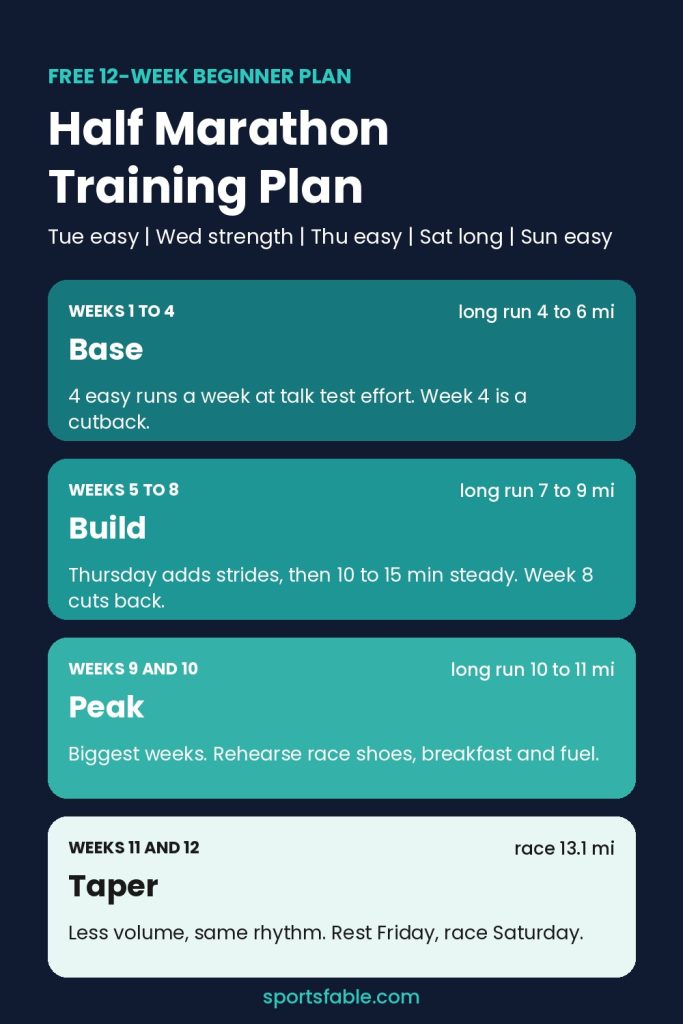
Weeks 1 to 4: base
You’re only adding about a mile a week to the long run. It should feel almost too easy, and that’s on purpose: tendons and bones adapt more slowly than your heart and lungs. Week 4 drops back so your body absorbs the work.
Weeks 5 to 8: build
The long run climbs to 9 miles (14.5 km) and Thursday gets a 10 to 15 minute steady section. Week 8 is your second cutback. Take it seriously, even if you feel great.

Weeks 9 and 10: peak
These are the two biggest weeks: long runs of 10 and 11 miles (16.1 and 17.7 km). At a beginner’s easy pace, 11 miles can take 2 hours 15 minutes or more. Practice what you’ll do on race day: same breakfast, same shoes, and a drink or snack you’ve tested at around 45 to 60 minutes.
Weeks 11 and 12: taper
Volume drops, but you keep running. The steady section stays short so your legs remember a quicker rhythm. In race week, keep Tuesday and Thursday short, rest Friday, and run Saturday’s race at the effort of your easy long runs for the first 3 miles. Pick it up after mile 10 if you feel good.

The optional strength day
One 30 minute session on Wednesday is enough: squats or split squats, step-ups, hip bridges, calf raises and a plank, one or two sets each. Mayo Clinic notes that a single set of 12 to 15 repetitions with the right weight can build muscle efficiently for most people, and the CDC’s adult activity guidelines recommend muscle-strengthening work at least 2 days a week, so this day moves you toward that. Our guide to strength training for runners has a full routine. Keep it moderate during weeks 9 and 10, and drop it in race week.

The free printable has the whole 12-week grid with a checkbox for every run and a notes column for how each long run felt.
Free printable
A one-page 12-week half marathon grid with checkboxes for every run and a notes column.
Download the free 12-week plan (PDF)Want the week at a glance? Save or pin this card with the four phases and the weekly structure, so it’s on your phone when you’re planning Saturday.
How to adjust the plan, and common mistakes
Stretching it to 16 weeks
If you have more time, don’t make the long runs longer. Repeat weeks 1 and 2 before starting, then repeat weeks 5 and 6 once. That adds four gentle weeks and gives you breathing room for a cold, a work trip or a bad week.
Compressing it to 8 weeks
Only do this if you already run about 15 miles a week with a 6 mile long run. Start at week 5 and run the plan to the end. If you’re not there yet, choose a later race. Cramming the mileage is the easiest way to end up on the sidelines.
About the 10 percent rule
You’ll see the advice to never raise weekly mileage more than 10 percent. It’s a reasonable instinct, but it isn’t magic. In a randomized trial of novice runners published in The American Journal of Sports Medicine, a 13-week graded program built on the 10 percent rule had a similar injury rate (20.8 percent) to a standard 8-week program (20.3 percent). This plan rises gradually and uses cutback weeks, but some jumps are a little above 10 percent. What matters more is how you respond: niggles that make you limp, or pain that gets worse as you run, mean you stop and rest.
Mistakes that derail beginners
- Racing the easy runs. If you can’t talk, slow down. Every run doesn’t need to feel like work.
- Making up missed runs. Skip it and move on. Never double the next long run.
- Skipping the cutback weeks. They’re where the fitness actually lands.
- Trying new gear or food on race day. Rehearse everything during weeks 9 and 10.
Your quick checklist
- Can run 30 minutes nonstop before week 1
- Race date counted back exactly 12 weeks
- Long run day blocked out every week
- Shoes with some life left in them
- Printable grid on the fridge, pen nearby
- Race morning breakfast and fuel tested on a 10 mile run
Keep going
If you want to see where running fits alongside lifting and conditioning, start with our hybrid athlete training plan for beginners. Not ready for 13.1 yet? The 10k training plan is a shorter first target. Work out race paces with the running pace chart, log every session in a printable workout tracker, and if winter arrives mid-plan, the treadmill workouts guide keeps your Thursday runs on track.
New training plans: our 18-week marathon training plan, a 6-week 5K training plan and the couch to 10K plan.
Questions people ask
Can I train for a half marathon in 8 weeks, 6 weeks or 4 weeks?
Eight weeks can work if you already run around 15 miles a week with a 6 mile long run: start this plan at week 5. Six weeks or four weeks only makes sense if your long run is already 8 to 10 miles. For a true beginner, those short plans mostly add risk, not speed.
Should I pick a 16, 18 or 20 week plan instead?
A longer runway is a good idea if 3 miles still feels hard or life is unpredictable. For 16 weeks, use the stretch above. For 18 or 20 weeks (roughly 4 to 5 months), spend the extra time building comfortably to 3 or 4 easy runs a week first. A 6 month or 24 week plan suits someone starting from walking, with a 5k block first.
Is a 2 hour half marathon realistic for a beginner?
Running under 2 hours means averaging about 9:09 per mile (5:41 per km) for 13.1 miles. Some first timers manage it, but most beginners on this plan will finish somewhere between 2 hours 15 minutes and 3 hours. Make finishing strong your first goal, then chase a time on your second half.
Can I go from 5k to half marathon, or 10k to half marathon?
Yes. If you’ve just finished a 5k program and can run 30 minutes, start at week 1. If you’ve recently run a 10k and regularly do 6 mile long runs, you can usually start at week 5 and use the extra time as a cushion.
Should I keep lifting weights while training?
Yes, at a lower dose. One or two short sessions a week of squats, lunges, bridges and calf raises is plenty. Keep heavy leg days at least two days away from your long run and drop lifting in race week.
Is there an intermediate or km version?
The long runs in the table are already shown in kilometers, and the printable PDF lists them too. Intermediate runners who already run 20 miles a week can lengthen the Thursday steady section to 25 to 30 minutes and add one more easy run.
If you have a medical condition, are pregnant, or are coming back from injury, check with a doctor before starting a new training plan.
Images in this article are AI-generated illustrations and original graphics created by SportsFable. They show training ideas, not real people or events. The printable is free for personal use.
Related Post