


The first run is usually the worst one. You lace up shoes that have mostly been used for errands, jog to the end of the street, and somewhere around the second lamppost your lungs file a formal complaint. You walk home thinking running just isn’t for you.
It almost never is the running. It’s the plan, or the lack of one. Most beginners go out too fast, try to run the whole way, and quit before their body has had a chance to adapt.
A good couch to 5K plan fixes that by doing something that feels almost too easy at first: mixing short runs with walking breaks, three times a week, and shrinking the walks gradually. Below you’ll find a full nine-week schedule you can follow from day one, a treadmill version, faster and slower options, and the honest answers to the questions most beginners are too embarrassed to ask.

How a couch to 5K plan actually works
The idea is simple. You don’t build running fitness by suffering through long runs. You build it by repeating short, manageable efforts and letting your heart, lungs, tendons and legs catch up between sessions.
The most famous version is the free NHS Couch to 5K programme, which takes beginners from no running to running for 30 minutes without stopping over nine weeks, with three runs a week and rest days in between. The plan below follows the same structure: nine weeks, three sessions, never two hard days in a row.
Every session has the same frame:
- Warm up: 5 minutes of brisk walking.
- Main set: the run and walk intervals for that week.
- Cool down: 5 minutes of easy walking.
Most sessions take 30 to 35 minutes in total. Three of those a week is roughly 90 minutes, which puts you well on the way to the CDC’s recommendation of 150 minutes of moderate activity a week for adults.
The 9-week couch to 5K schedule
Do each week’s session three times, on non-consecutive days (Monday, Wednesday and Saturday works for most people). “Run” means a slow jog. If you can’t talk in short sentences, you’re going too fast.
Weeks 1 and 2: get used to moving
- Week 1: 8 rounds of 1 minute running, 90 seconds walking.
- Week 2: 6 rounds of 90 seconds running, 2 minutes walking.
These weeks are about building a habit. The running should feel easy enough that you finish thinking you could have done more. That’s the point.
Weeks 3 and 4: longer runs, shorter walks
- Week 3: 5 rounds of 2 minutes running, 2 minutes walking.
- Week 4: 4 rounds of 3 minutes running, 90 seconds walking.
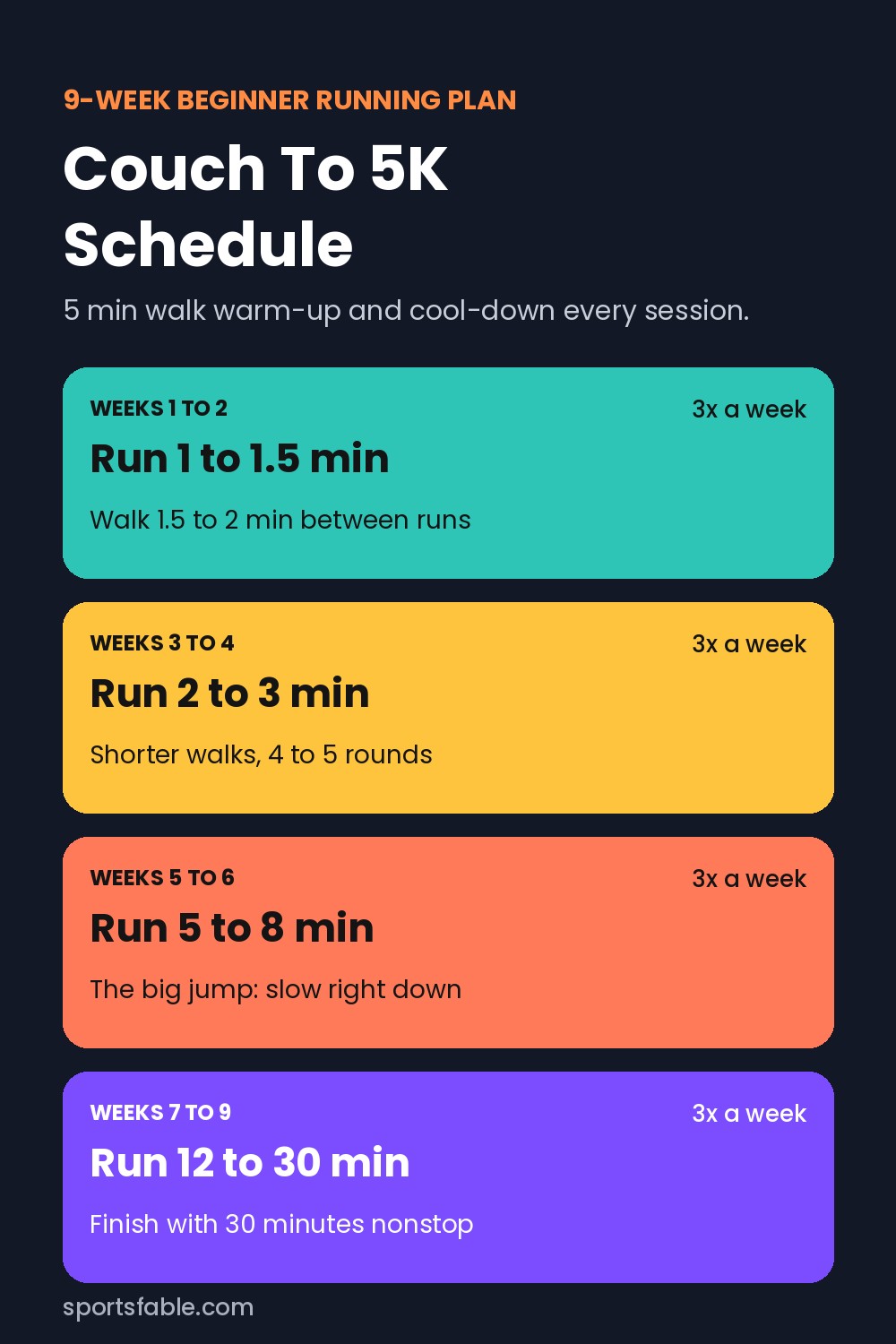
Weeks 5 and 6: the big jump
- Week 5: 3 rounds of 5 minutes running, 2 minutes walking.
- Week 6: 2 rounds of 8 minutes running, 2 minutes walking, then a final 5 minutes running.
Week 5 is where most people stall, and it’s completely normal. Five minutes of running is a different feeling from three. Slow down more than feels necessary. You’re allowed to run so slowly that a brisk walker could pass you.

Weeks 7 to 9: running without stopping
- Week 7: 2 rounds of 12 minutes running, 2 minutes walking.
- Week 8: Session 1 and 2: 20 minutes of continuous running. Session 3: 25 minutes.
- Week 9: 30 minutes of continuous running, three times.
Thirty minutes at a gentle pace covers roughly 5K for many beginners, though not all. If your 30 minutes lands at 4K, that’s still a finished plan. Distance comes with time.
The repeat-a-week rule
If a week feels too hard, repeat it. This is the single most useful rule in any beginner running plan, and the one people skip because it feels like failing. It isn’t. A nine-week plan that takes you eleven weeks is still a plan that worked.
Here’s the part other guides rarely mention. Slowing down your progression won’t automatically protect you from injury. In a randomized trial of novice runners, a 13-week program built on the “10% rule” had the same injury rate as a standard 8-week program: about 20.8% versus 20.3%. So repeat a week when your body is telling you to, not because a rule says you must crawl. Pain that changes how you run is the signal to stop and rest.

How fast should you run?
Slower than you think. The CDC’s talk test is the easiest gauge: at moderate intensity you can talk, but not sing. At vigorous intensity you can’t say more than a few words without pausing for breath. Your run intervals should sit at the edge of moderate. If you can’t get a sentence out, slow down.
Couch to 5K on a treadmill
The same schedule works on a treadmill, and it’s a good option for dark winter evenings or bad weather.
- Set the incline to 1% to make it feel closer to outdoor running.
- Walk intervals at a brisk pace you could hold for an hour.
- Run intervals at a pace that passes the talk test. For many beginners that’s somewhere around 4.5 to 5.5 mph, but your number is your number.
- Use the hand rails only to get on and off, not to hold yourself up.

Shorter and longer versions
Pinterest is full of 4-week, 6-week, 8-week and 12-week couch to 5K plans. Here’s how to choose:
- 4 or 6 weeks: only if you already walk briskly most days or played sport recently. Compress by skipping weeks 2 and 4 (6 weeks) or by running only the odd weeks (roughly 5).
- 8 or 9 weeks: the right default for most beginners.
- 12 weeks: great if you’re coming back from a long break, carrying extra weight or nervous about your knees. Repeat weeks 3, 5 and 7.
- Walking plan first: if a 30-minute brisk walk feels hard, spend two or three weeks walking 30 minutes, three times a week, before week 1.
What you actually need
Less than the adverts suggest. Comfortable running shoes matter most. Our guide to choosing running shoes explains why comfort beats “pronation control” for most beginners. Beyond that: socks that don’t rub, clothes that don’t chafe, and a way to time your intervals (a free app or your phone’s timer).

Your couch to 5K checklist
- Three sessions a week, never two days in a row.
- 5-minute walking warm-up and cool-down every time.
- Run slow enough to talk in short sentences.
- Repeat any week that felt like a struggle.
- Comfortable shoes, no new gear on run days.
- Find a running buddy or a local parkrun for week 9.

Keep building after 5K
Once 30 minutes feels comfortable, add two short strength sessions a week. Our guide to strength training for runners covers the lifts that help most, and the weekly workout plan template makes it easy to fit runs and strength days together. Running through winter? Read our guide to cold weather running outfits before the temperature drops.
Finished the plan and want a new challenge? A Hyrox race is a natural next step, and our Hyrox training plan for beginners assumes you can already run 5K.
Questions people ask
Is couch to 5K good for complete beginners?
Yes, that’s who it’s built for. If you can walk briskly for 30 minutes, you can start week 1. If you can’t yet, walk for two or three weeks first.
Can I do couch to 5K in 4 weeks?
Only if you already have a base of fitness. For true beginners, rushing the plan usually means stalling at the longer runs. Six to nine weeks is more realistic.
Can I do the whole plan on a treadmill?
Yes. Use a 1% incline, keep run intervals at a pace that passes the talk test, and try at least one outdoor run before a race so the change in surface isn’t a surprise.
What if I can’t finish a week?
Repeat it. Many people repeat week 5 or week 7. It doesn’t mean you’re behind, it means you’re adapting.
Is a 12-week couch to 5K better?
It’s better for people returning from injury, older beginners or anyone who wants more time between jumps. Speed of progress is less important than staying consistent.
Should I walk or run on rest days?
Walking, cycling or gentle mobility work is fine. Just avoid hard training, so your legs recover for the next run.
Images in this article are AI-generated illustrations and original graphics created by SportsFable. They show training ideas, not real people or events.
Related Post